


Baremetrics + App Store
Overview
Apple handles your App Store subscriptions. Baremetrics connects to App Store Connect with a Finance API key and brings that revenue together with the other tools you already use, like Google Play, Stripe and QuickBooks. You see app and web revenue in one place, measured the same way, so you can track growth and plan what's next from one set of numbers.
What Baremetrics does with your App Store data
- Puts app and web revenue side by side. Add Google Play, Stripe, Braintree or Recurly from the same Data Connections page, and compare App Store revenue with everything else, calculated the same way.
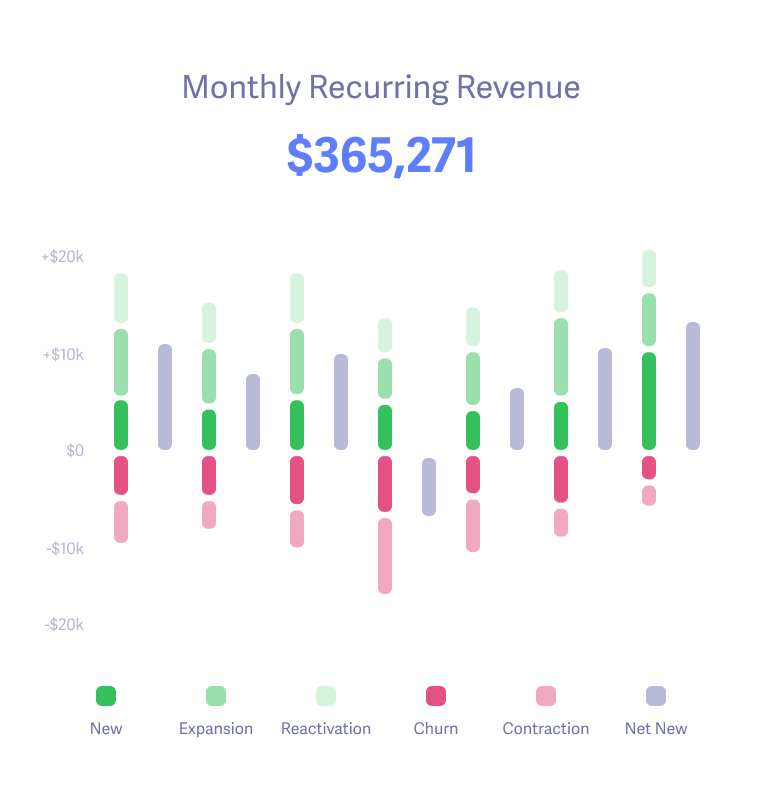
- Tracks growth. MRR, ARR, active customers, churn, LTV and ARPU for your App Store subscribers, built from Apple's subscription reports.
- Plans cash flow. Add QuickBooks Online or Xero, and Forecast+ projects revenue and expenses from the same numbers.
- Keeps your team in the loop. Send alerts to Slack, or ask AI assistants about your metrics through the Baremetrics MCP.
See it with sample data: MRR, active customers and customer churn in the live demo.
Source: Baremetrics Help Center, App Store Connect; Connecting your payment processors and data sources.
How does the App Store Connect connection work?
- Request App Store Connect API access as an account admin, at appstoreconnect.apple.com/access/api, if you haven't already.
- Generate an API key for Baremetrics. Click Generate API Key, name it Baremetrics and give it Finance access.
- Collect four items: the key ID, the API key file (.p8), your issuer ID, and your vendor number from the Payments and Financial Reports page.
- Enter them in Baremetrics when you add App Store Connect as a data connection.
- Expect a 2-day delay. Apple sends its reports with a 2-day delay, so the most recent events appear a little later.
Source: Baremetrics Help Center, App Store Connect.
What are the limits of the App Store Connect integration?
Apple's reports are restrictive, so App Store data in Baremetrics comes with these caveats:
- One year of history. Apple stores subscription history for one year, so customers who subscribed earlier show as starting a year ago.
- Active customers can look higher than in Apple's reports. Apple doesn't tie cancellations to individual customers, so Baremetrics keeps a customer active until 3 days after the subscription expires. Apple removes them from Active Paid Subscriptions right away. The gap is largest with yearly subscriptions.
- No personal data. Apple shares no personal information, so App Store customer profiles show none.
- Recover and Cancellation Insights don't work for App Store subscribers. Both need customer emails, which Apple doesn't share.
- Long gaps count as new customers. A subscriber who comes back after more than 6 months of inactivity is reported as a new customer, not a reactivation.
- Some reports exclude Apple data: Other Revenue, Failed Charges and Coupons.
- Apple's fees aren't removed from MRR or net revenue.
- Data arrives with a 2-day delay.
Source: App Store Connect help article.
For the full walkthrough, see the App Store Connect article in the Help Center.
Questions
How do I track MRR for App Store subscriptions?
Connect App Store Connect to Baremetrics with an API key that has Finance access. Baremetrics reads Apple's subscription reports and calculates MRR, ARR, churn, LTV and active customers, and you can view them next to Google Play and web revenue in one dashboard.
How do I connect App Store Connect to Baremetrics?
As an account admin, request access to the App Store Connect API, then generate an API key named Baremetrics with Finance access. Enter the key ID, the .p8 key file, your issuer ID and your vendor number, found on the Payments and Financial Reports page, in Baremetrics.
Can I see App Store and Google Play revenue together?
Yes. Connect both, and Baremetrics calculates MRR, churn and LTV the same way for each, so you can compare them side by side or see them combined.
Why is my active customer count higher in Baremetrics than in App Store Connect?
Apple's reports don't tie cancellations to individual customers. Baremetrics keeps a customer active until 3 days after their subscription expires, while Apple removes them from Active Paid Subscriptions right away. The difference is biggest if you sell yearly subscriptions.
How much App Store history does Baremetrics import?
One year. Apple stores subscription history for one year, so customers who subscribed earlier than that are shown as starting a year ago.
Why don't App Store subscribers have personal details in Baremetrics?
Apple makes no personal data available in its reports, so Baremetrics can't show personal information on the customer profiles of your App Store subscribers.
How up to date is App Store data in Baremetrics?
Apple sends its reports to Baremetrics with a 2-day delay. If a recent event is missing, wait a couple of days and it will appear.
Connect your first data source for free
Baremetrics is free until you reach $180K ARR. Start with your main billing tool and add the rest whenever you're ready.
