
ARR calculator: annual run rate and annualized run rate
Annual run rate (ARR) is your current monthly recurring revenue projected over 12 months: MRR × 12. Annualized run rate applies the same idea to any period's revenue. Enter your MRR, or one period's revenue, to calculate both.
ARR = MRR × 12
Annualized run rate = Revenue for one period × Number of those periods in a year
A month annualizes × 12, a quarter × 4 and a week × 52. The shorter the period, the more one unusual week or one large deal distorts the result, so monthly or quarterly data is the safer base.
ARR and run-rate calculator
ARR uses recurring revenue only. To annualize total revenue for another period, use the run-rate fields.
ARR = MRR × 12. Annualized run rate = revenue for one period × the number of those periods in a year.
Worked example: ARR and run rate
A company at $40,000 MRR has an ARR of $40,000 × 12 = $480,000. A company that booked $150,000 of revenue last quarter has an annualized run rate of $150,000 × 4 = $600,000. The calculator above is pre-filled with both examples.
What belongs in the ARR base?
- Recurring revenue only. Setup fees, implementation and other one-time charges belong in total revenue run rate, not ARR.
- Monthly value, not cash received. An annual prepayment of $12,000 is $1,000 of MRR.
- What customers actually pay. Use discounted prices, not list prices.
- Paying customers. Trials and free accounts add nothing until they convert, and long-delinquent customers should come out.
For seasonality, one-off spikes and the other ways run rate misleads, read What is annualized run rate?, or the annual run rate guide.
How Baremetrics calculates ARR
In Baremetrics, Annual Run Rate is MRR × 12, your current revenue projected over the next 12 months. Because ARR is built on MRR, the MRR rules apply: non-monthly plans are normalised to monthly (a $120 annual plan adds $10 to MRR), coupons are deducted, customers on 100% off coupons are left out, and customers who are delinquent for more than 30 days are removed. Compare Plans on the ARR chart shows how much each plan contributes.
Source: Baremetrics Help Center (ARR: Annual Run Rate, Monthly Recurring Revenue).
More formulas: SaaS metrics formulas: ARR, NRR, GRR, churn and more.
Track this automatically
See your real ARR — connect Stripe in one click
Skip the spreadsheet. Baremetrics calculates MRR, churn, LTV and dozens of other subscription metrics straight from your billing data, and keeps them up to date.
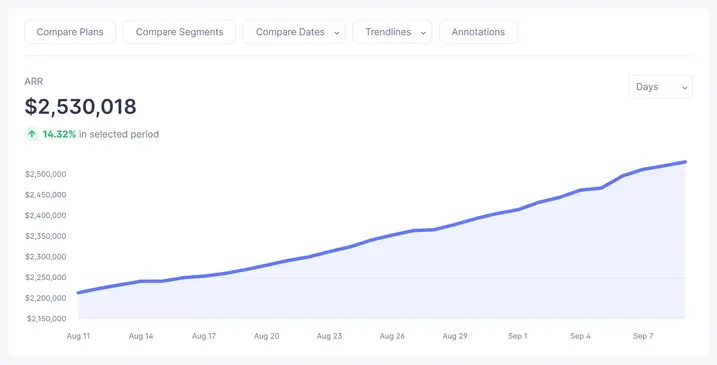
Start your free trial → or explore the live demo
Screenshot shows sample demo data.
Frequently asked questions
How do you calculate ARR from MRR?
Multiply MRR by 12. A company with $40,000 MRR has $480,000 ARR. ARR projects today's recurring revenue across a full year and assumes no new customers, expansion or churn.
What is the difference between ARR and annualized run rate?
ARR is the annualized value of recurring subscription revenue only. Annualized run rate takes any period's revenue, which can include one-time fees, and multiplies it by the number of those periods in a year, for example a quarter × 4.
Should annual prepayments go into the MRR base?
No. A customer who prepays $12,000 for a year contributes $1,000 of MRR, not $12,000. Putting the cash receipt into a monthly base and annualizing it overstates ARR.
How does Baremetrics calculate ARR?
Baremetrics calculates Annual Run Rate as MRR × 12. Non-monthly plans are normalised to monthly, coupons are deducted and customers who are delinquent for more than 30 days drop out of MRR, so any change to MRR changes ARR.
