
Table of Contents

Annualized run rate is your current revenue for a single period, projected forward across a full year. For a subscription business the formula is:
Annualized run rate = current MRR × 12
Or more generally, for any period: current-period revenue × the number of those periods in a year. A quarter × 4. A week × 52.
That is the whole calculation. The interesting part is not the arithmetic — it is what belongs in the base, and what run rate quietly assumes about the future.
💬 CTA: Run rate is only as good as the MRR underneath it. Baremetrics calculates MRR from your billing data and shows the movement behind it, so you can see whether your run rate is stable or coasting. Start a free trial.
How to calculate annualized run rate
From monthly revenue: MRR × 12.
A company at $40,000 MRR has a $480,000 annualized run rate.
From quarterly revenue: quarterly revenue × 4.
A company that booked $150,000 last quarter has a $600,000 run rate.
From any period: period revenue × periods per year.
The shorter the period you annualize from, the more sensitive the result is to noise. Annualizing a single week multiplies whatever happened that week by 52, including a holiday, an outage, or one large deal that closed on a Tuesday. Monthly is the shortest period most SaaS companies should annualize from, and quarterly is more stable.
You will also see the term "ARR run rate", which usually means MRR × 12 specifically. It is a loose hybrid of two terms, which is exactly why the next section exists.
Track this automatically
See your real ARR — connect Stripe in one click
Skip the spreadsheet. Baremetrics calculates MRR, churn, LTV and dozens of other subscription metrics straight from your billing data, and keeps them up to date.
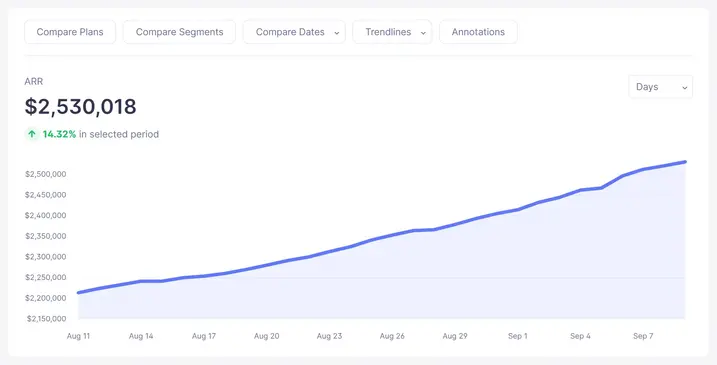
Start your free trial → or explore the live demo
Screenshot shows sample demo data.
Run rate vs. ARR vs. actual annual revenue
These three get used interchangeably and they are not the same thing. This is the single most common source of confusion on this topic.
| What it is | Direction | Includes one-time revenue? | |
| Annualized run rate | Current period's revenue projected across a year | Forward-looking projection | Depends entirely on what you put in the base |
| ARR (annual recurring revenue) | The annualized value of your committed, recurring subscription revenue | Point-in-time measure of contracted recurring revenue | No — recurring only, by definition |
| Actual annual revenue | What you actually earned over a completed 12 months | Backward-looking fact | Yes, everything |
Run rate is a projection. It answers: if nothing changes from today, what does a year look like? Something always changes. That is the whole caveat.
ARR is a measure of a specific thing. It is the annualized value of recurring subscription commitments, and it deliberately excludes one-time revenue — setup fees, professional services, hardware, consulting. A company with $40,000 MRR and $60,000 of annual implementation fees has $480,000 ARR and a higher total revenue run rate. Both numbers are correct; they answer different questions.
Purists distinguish ARR from MRR × 12 as well. If you sell annual contracts, ARR is properly derived from the contracted annual value of live subscriptions, and MRR × 12 is a monthly-normalized approximation of it. In practice they land close enough that most companies use them interchangeably. Where they diverge is mid-term contract changes and non-standard billing cycles.
Actual annual revenue is history. It is what your accountant reports and what shows up in financial statements. It will not match your run rate, and it shouldn't — run rate reflects one moment, actual revenue reflects twelve months of moments.
The practical rule: run rate tells you where you are. Actual revenue tells you where you have been. Neither tells you where you are going, and only one of them is auditable.
What belongs in the base
Because run rate is just a multiplication, all of the judgement sits in the number you multiply. Decide these explicitly:
- One-time charges. Setup fees, implementation, professional services. Include them and you are calculating total revenue run rate, not ARR. Both are legitimate — label which one you mean.
- Annual prepayments. A customer paying $12,000 upfront in January contributes $1,000 of MRR, not $12,000. Putting the cash receipt in a monthly base and annualizing it is the most common and most inflationary error in this whole topic.
- Delinquent revenue. Customers whose payments are failing are still in most raw MRR figures. If they never recover, that revenue is already gone and your run rate is overstating reality.
- Trials and free accounts. Zero revenue until conversion.
- Discounts. Base on what customers actually pay, not list price. A cohort whose annual discount expires next month will change your MRR without any customer doing anything.
- Usage or overage revenue. Genuinely recurring but genuinely variable. Some companies include a trailing average; some exclude it from ARR entirely and report it separately.
Whatever you decide, document it and apply it consistently across periods. Changing the definition mid-year and comparing across the change produces a growth rate that reflects an accounting decision rather than the business. (We go through how Baremetrics resolves each of these in our metrics methodology guide — link once live.)
The four situations where run rate misleads
1. Seasonality. Annualizing a peak or a trough carries that condition across twelve months. A company whose December is its strongest month reports a run rate in January that it will not see again until the following December. The same in reverse for businesses with a summer lull. If your revenue has any seasonal shape, annualize from a trailing average or a full quarter rather than the month you happen to be standing in.
2. One-time revenue in the base. Covered above. It carries the largest magnitude of the four, so it earns the repeat. A single large implementation fee or annual prepayment landing in the month you annualize from can inflate a run rate by a substantial multiple of the underlying recurring business. This is also the error most likely to be caught by a diligence process, which is a bad place to find it.
3. Early-stage volatility. At $8,000 MRR, one $2,000 customer is a quarter of your business. Signing them takes your run rate from $72,000 to $96,000; losing them reverses it. Neither movement says much about the trajectory. Run rate becomes more meaningful as the base grows and no single customer can move it materially.
4. Churn trajectory is invisible in it. This is the subtlest and the most consequential. Run rate is computed from a level, and it says nothing about the flows underneath. Two companies at identical MRR — one growing steadily, one replacing heavy churn with heavy acquisition — produce exactly the same run rate. The second is on a treadmill: the moment acquisition dips, the number falls. Run rate cannot distinguish between them, and that is what the next section demonstrates.
Worked example: two companies, one run rate
Illustrative figures, chosen to make the point.
Both companies finish the month at $100,000 MRR. Both report a $1.2M annualized run rate. Their investor decks show the same number.
Company A
- New MRR: $8,000
- Expansion: $2,000
- Churn: $1,000
- Net movement: +$9,000
Company B
- New MRR: $15,000
- Expansion: $1,000
- Churn: $16,000
- Net movement: $0
Company A is compounding. If it holds this shape, next month's run rate is higher and the month after that higher again, and it is doing it while losing very little of what it already has.
Company B is running to stand still. It is acquiring nearly twice as much new revenue as Company A and has nothing to show for it, because it is losing an equivalent amount out the back. Its $1.2M run rate is entirely dependent on maintaining that acquisition rate forever. One bad month in sales, one channel that stops working, one budget cut, and the number falls.
Company B is also spending far more to hold its position — all that new MRR has an acquisition cost attached, and it is buying replacement rather than growth.
Same run rate. Completely different businesses. This is why run rate is a starting point for a conversation rather than the conclusion of one, and why the MRR movement breakdown — new, expansion, contraction, churn, reactivation, separately — is the number that actually tells you something.
How investors read run rate
Investors and bankers use run rate constantly, and they are not naive about it. Expect to be asked:
"What's in the base?" Recurring only, or does it include services and one-time fees? A run rate that turns out to include implementation revenue gets discounted immediately, and it costs you credibility for the rest of the conversation.
"Is it contracted?" Committed annual contracts and month-to-month subscriptions at the same MRR are not equally valuable. Contracted revenue with a known renewal date is worth more than revenue that can leave next month.
"What's the net and gross retention?" This is the Company A versus Company B question. Net revenue retention tells them whether the base grows on its own; gross retention tells them what you lose before expansion masks it. Both come from cohort analysis, not from a run rate.
"Which month is this?" If your business is seasonal, they will want to know whether you annualized from your best month.
"How does it reconcile to your financials?" Run rate is a management metric, not an audited one. It will differ from your recognized revenue, and you should be able to explain why without sounding surprised by the question.
A note on the milestone conversation: run rate is how companies reach "$1M ARR" before they have earned a million dollars in a year, and that is legitimate as long as you say run rate and mean it. Presenting a run rate as annual revenue is where it stops being a projection and becomes a misrepresentation. That distinction gets checked.
Making run rate useful rather than decorative
Run rate is worth calculating. It is a fast, legible way to size a business, and it is the number everyone reaches for. It is just incomplete on its own.
Three things make it trustworthy:
Compute the base from your billing system rather than a spreadsheet. Manually maintained MRR drifts — definitions change, someone updates one tab and not another, an annual prepayment gets entered as a monthly figure. Baremetrics connects to Stripe, Braintree, Chargebee, Recurly, the app stores, or a custom source via API and calculates MRR from what your billing system actually recorded, with your full history backfilled.
Look at the movement, not just the level. New, expansion, reactivation, contraction, and churn, broken out by day. This is what separates Company A from Company B, and it is not visible in a run rate.
Check the retention underneath it. Cohort retention tables show where in the lifecycle customers leave — month one is an onboarding problem, month nine is a value problem — and revenue-weighted retention shows whether your base holds up without new sales.
If you also need the other side of the picture, Forecast+ connects QuickBooks or Xero and pulls in your actual P&L, so runway and burn rate sit next to the revenue figures. A run rate tells you the size of the business; runway tells you how long you have.
💬 CTA: Want your MRR, run rate, and the movement behind it calculated from your real billing data? Start a free trial — full history backfilled, no spreadsheet required.

