
LTV calculator: customer lifetime value from ARPU and churn
Customer lifetime value (LTV) is a prediction of how much revenue you can expect from a customer before they churn. For a subscription business, divide average revenue per user (ARPU) by your user churn rate. Enter your numbers below to calculate LTV and the average customer lifetime.
LTV = ARPU ÷ User churn rate
ARPU = MRR ÷ Active customers
User churn rate = (Cancelled customers in the last 30 days ÷ Active customers 30 days ago) × 100
- ARPU: average revenue per user, the monthly recurring revenue you make from an average customer.
- User churn rate: the share of customers you had 30 days ago who have cancelled since. Use it as a decimal in the formula, so 5% is 0.05.
- CAC (optional): customer acquisition cost, the total sales and marketing cost of acquiring one new customer.
LTV calculator
Use monthly figures. ARPU is MRR ÷ active customers. User churn rate is the percentage of customers who cancelled in the last 30 days. CAC is optional.
LTV = ARPU ÷ user churn rate (as a decimal). Average customer lifetime = 1 ÷ user churn rate. LTV:CAC = LTV ÷ CAC.
Worked example: how to calculate LTV
Your ARPU is $100 a month and your monthly user churn rate is 5%.
LTV = $100 ÷ 0.05 = $2,000
Average customer lifetime = 1 ÷ 0.05 = 20 months
An average customer stays for 20 months and pays $100 in each of them, which is where the $2,000 comes from. For a more conservative figure, apply a discount rate of around 0.75: $2,000 × 0.75 = $1,500. The calculator above is pre-filled with this example; add your CAC to compare it with LTV.
How do you raise LTV?
LTV has two inputs, so there are two levers. Raise ARPU by raising prices or moving customers onto higher plans, or lower user churn so customers stay longer. Because churn is the denominator, halving your monthly user churn rate doubles LTV, which you can check in the calculator above. Read the full guide to calculating customer lifetime value.
How Baremetrics calculates LTV
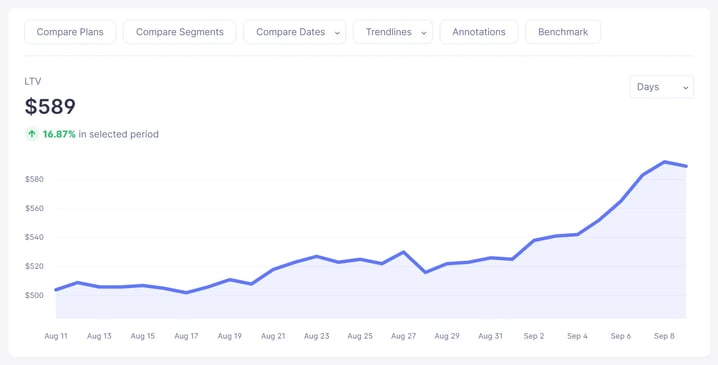
Baremetrics calculates LTV as average monthly recurring revenue per customer divided by the user churn rate, both taken straight from your billing data. ARPU is MRR ÷ active customers. User churn is (cancelled customers in the last 30 days ÷ active customers 30 days ago) × 100, and customers who are delinquent for more than 30 days are treated as cancelled. In the dashboard you can compare LTV across date ranges, smooth it with trend lines, set LTV goals, annotate events such as a price change, and benchmark your LTV against businesses with a similar ARPU.
Source: Baremetrics Help Center (LTV: Lifetime Value, ARPU: Average Revenue Per User, User and Revenue Churn).
More formulas: SaaS metrics formulas: ARR, NRR, GRR, churn and more.
Track this automatically
See your real LTV — connect Stripe in one click
Skip the spreadsheet. Baremetrics calculates MRR, churn, LTV and dozens of other subscription metrics straight from your billing data, and keeps them up to date.
Start your free trial → or explore the live demo
Screenshot shows sample demo data.
Frequently asked questions
What is the formula for LTV?
For a subscription business, LTV = ARPU ÷ user churn rate, with churn written as a decimal. ARPU is MRR divided by active customers, so a $100 ARPU and a 5% monthly user churn rate give an LTV of $100 ÷ 0.05 = $2,000.
Why can't I calculate LTV with 0% churn?
The formula divides by the churn rate, so at 0% it has no finite answer. If none of your customers have cancelled yet, there is not enough churn history for the formula. With a small customer base or limited historical data, treat any LTV figure as a directional estimate rather than a precise one.
How does LTV relate to CAC?
LTV tells you how much you can afford to spend to acquire a customer. If a customer costs $100 to acquire and has an LTV of $500, you keep $400 after acquisition. If an average customer costs $200 to acquire and has an LTV of $100, every new customer loses you money.
How do I make my LTV estimate more conservative?
Multiply the result by a discount rate of around 0.75. It allows for natural variation in when customers churn, so a $2,000 LTV becomes $2,000 × 0.75 = $1,500.
How does Baremetrics calculate LTV?
Baremetrics divides average monthly recurring revenue per customer (ARPU) by the user churn rate, both calculated from your billing data. User churn is cancelled customers in the last 30 days divided by active customers 30 days ago, and customers who are delinquent for more than 30 days count as cancelled.
