
NRR and GRR calculator: net and gross revenue retention
Net revenue retention (NRR) is the percentage of recurring revenue you keep from existing customers after upgrades, downgrades and cancellations. Gross revenue retention (GRR) is the same calculation without upgrades, so it can never go above 100%. Enter four MRR figures below to calculate both.
NRR = (Starting MRR + Expansion MRR − Contraction MRR − Churned MRR) ÷ Starting MRR × 100
GRR = (Starting MRR − Contraction MRR − Churned MRR) ÷ Starting MRR × 100
- Starting MRR: recurring revenue from existing customers at the start of the period.
- Expansion MRR: extra MRR from upgrades and cross-sells to those customers.
- Contraction MRR: MRR lost to downgrades.
- Churned MRR: MRR lost to cancellations.
NRR and GRR calculator
Enter MRR for one period (for example the last 30 days or the last 12 months). Only count customers who were already paying at the start of the period.
NRR = (Starting MRR + Expansion − Contraction − Churned) ÷ Starting MRR × 100. GRR = (Starting MRR − Contraction − Churned) ÷ Starting MRR × 100.
Worked example: how to calculate NRR and GRR
You have 20 customers paying $30 a month, so starting MRR is $600. Over the period, 5 customers cancel and 5 others upgrade to $75 a month.
- Expansion MRR: 5 × ($75 − $30) = $225
- Churned MRR: 5 × $30 = $150
- Contraction MRR: $0
NRR = ($600 + $225 − $0 − $150) ÷ $600 × 100 = 112.5%
GRR = ($600 − $0 − $150) ÷ $600 × 100 = 75%
Ending MRR from these customers is 10 × $30 + 5 × $75 = $675, which is 112.5% of where you started. NRR says the upgrades more than covered the cancellations. GRR says you still lost a quarter of your starting revenue to churn, which the upsells are hiding. The calculator above is pre-filled with this example.
What is the difference between NRR and GRR?
NRR answers "how well do we grow revenue from current customers?", because it adds expansion back in. GRR answers "how well do we keep the revenue we already have?", because it only counts losses. NRR is usually the headline metric for growth from existing customers; GRR is the cleaner signal of retention for products with few upsell opportunities. Read the full guide to net revenue retention or gross churn vs net churn.
How Baremetrics calculates NRR and GRR
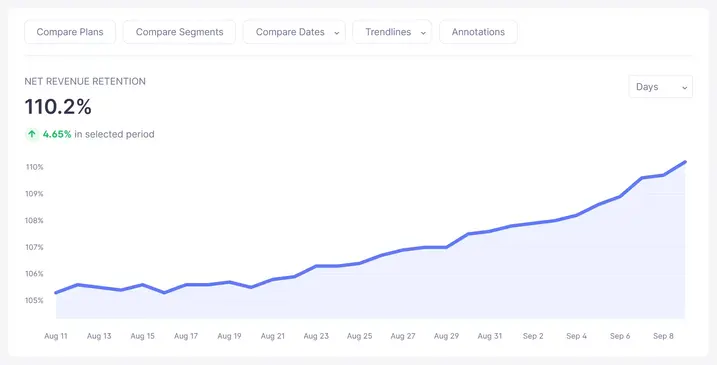
Baremetrics calculates both metrics on a rolling 30-day basis, straight from your billing data: NRR = 100% − ((churned MRR − expansion MRR) ÷ MRR 30 days ago × 100), and GRR = ((MRR 30 days ago − churned MRR) ÷ MRR 30 days ago) × 100. Churned MRR includes downgrades and cancellations, so these match the formulas above. NRR has its own chart in the dashboard, and GRR is the opposite of the Revenue Churn chart (100% − revenue churn).
Source: Baremetrics Help Center (NRR: Net Revenue Retention, NRR vs GRR, User and Revenue Churn).
More formulas: SaaS metrics formulas: ARR, NRR, GRR, churn and more.
Track this automatically
See your real NRR — connect Stripe in one click
Skip the spreadsheet. Baremetrics calculates MRR, churn, LTV and dozens of other subscription metrics straight from your billing data, and keeps them up to date.
Start your free trial → or explore the live demo
Screenshot shows sample demo data.
Frequently asked questions
What is a good NRR?
An NRR above 100% means expansion from existing customers outweighs downgrades and cancellations, so your revenue grows even without new customers. Below 100%, revenue churn is shrinking your existing base. Track GRR alongside it so strong upsells don't hide a churn problem.
Can GRR be higher than 100%?
No. GRR leaves out expansion revenue and only subtracts downgrades and cancellations, so the most it can be is 100%, when you lose nothing. NRR is the metric that can go above 100%.
Should I include new customers in NRR?
No. NRR and GRR only measure customers who were already paying at the start of the period. Revenue from customers who signed up during the period is new MRR, not expansion.
Is net revenue retention the same as net dollar retention?
Yes. Net dollar retention (NDR) is another name for net revenue retention. Both measure recurring revenue kept from existing customers after expansion, contraction and churn.
How does Baremetrics calculate NRR and GRR?
On a rolling 30-day basis. NRR = 100% − ((churned MRR − expansion MRR) ÷ MRR 30 days ago × 100), and GRR = ((MRR 30 days ago − churned MRR) ÷ MRR 30 days ago) × 100, where churned MRR includes downgrades and cancellations.
