
SaaS revenue forecasting software: which type you need and how the tools compare
Updated 3 November 2026. Written by Baremetrics, which makes one of the tools on this page. Competitor details come from each vendor's own website, checked on 3 November 2026 (see Sources at the end).
SaaS revenue forecasting software projects future MRR, ARR, revenue and cash from your real billing and accounting data. Choose by the question you need answered: subscription-metrics tools such as Baremetrics and ChartMogul forecast recurring revenue from billing data, FP&A platforms such as Pigment, Abacum and Aleph model the whole P&L, and sales tools such as Clari Forecast predict pipeline bookings.
What is SaaS revenue forecasting software?
SaaS revenue forecasting software is defined as a tool that projects a subscription company's future revenue from its actual data, rather than from a hand-built spreadsheet. The terms buyers meet most often:
- MRR forecast refers to a projection of monthly recurring revenue built from its parts: new customer MRR, reactivation MRR and expansion MRR, minus churned MRR and contraction MRR.
- Driver-based forecasting is a method that projects each revenue driver (new sign-ups, average revenue per customer, churn) separately and adds them up, instead of extending a single revenue trend line.
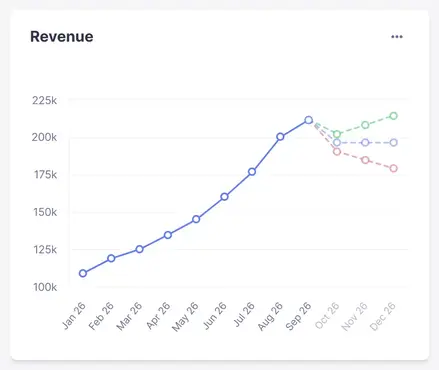
- Scenario planning refers to running the same model under different assumptions, usually a base case, an upside case and a downside case.
- Cash runway measures how long a business can keep running on its current cash balance.
- Customer lifetime value (LTV), also known as CLV, is a prediction of how much revenue a customer will bring in before they churn.
Which type of forecasting tool do you need?
Most "revenue forecasting" tools answer one of three different questions. Decide which one you are asking before you compare products.
| Type | Question it answers | Data it starts from | Examples |
|---|---|---|---|
| Subscription-metrics forecasting | Where will MRR and ARR be in 12 months if current growth and churn continue? | Your billing system (Stripe, Chargebee, Recurly and others) | Baremetrics, ChartMogul |
| FP&A and business planning | What will profit, cash and headcount look like, and when can we afford to hire? | Accounting or ERP data, HR data and spreadsheets | Baremetrics Forecast+, Pigment, Abacum, Aleph |
| Sales pipeline forecasting | How much will the sales team close this quarter? | CRM deals and rep activity | Clari Forecast (Salesloft) |
For a subscription business, recurring revenue is usually the largest line in the plan, and the first type can project it straight from billing data with no manual entry. That makes it a practical starting point; the other two types add profit, cash and sales detail on top.
SaaS revenue forecasting software compared
Each description below uses the vendor's own wording or feature list. Prices are as published on 3 November 2026.
| Tool | Type | What it forecasts | Data it starts from | Published pricing |
|---|---|---|---|---|
| Baremetrics (Revenue Model, Forecast tools, Forecast+) | Subscription metrics + FP&A | MRR by component across base, upside and downside scenarios; customers and cash flow up to 12 months ahead; with Forecast+, P&L, balance sheet, cash flow, runway and hiring | Billing data from Stripe, Braintree, Chargebee, Recurly, Paddle (beta), App Store, Google Play, Shopify and more; Forecast+ adds QuickBooks Online or Xero | Free up to $180K ARR; Launch $49/mo to $360K ARR; Growth from $69/mo; Scale from $409/mo (includes Forecast+); Forecast+ also available as a standalone subscription at a custom price |
| ChartMogul | Subscription metrics | "Revenue forecast modeling": ARR 12 months out under different growth assumptions, on every plan including Free | Billing systems such as Stripe and Chargebee | Free up to $10K MRR; Starter from $69/mo billed monthly ($57/mo annually); Pro from $119/mo ($99/mo annually); Enterprise from $19,900/yr |
| Pigment | Enterprise business planning | Budget planning and forecasting; P&L, cash flow and balance sheet; revenue, headcount and sales planning | NetSuite, Excel, Google Sheets and APIs | Not listed on its website; demo or free trial |
| Abacum | FP&A | Scenario planning, forecasting and reporting, with multi-entity consolidation | Self-service integrations that connect actuals, assumptions and plans | Not listed on its website; demo |
| Aleph | FP&A | Forecasting and reporting that run inside Excel and Google Sheets | ERP, HRIS, CRM and other systems through 150+ no-code connectors, synced into Excel or Google Sheets | Not listed on its website; demo or free trial |
| Clari Forecast (Salesloft) | Sales pipeline | "AI-powered revenue forecasting" with real-time deal tracking | CRM deals and rep activity | Not listed on its website; talk to sales |
| Spreadsheet model | Do it yourself | Whatever you build | Manual exports from billing and accounting | Google Sheets is free; Excel needs a licence; your team's time |
Baremetrics
Baremetrics forecasts at two levels. The Revenue Model (Revenue > Revenue Model) projects MRR from your actual Baremetrics data. Each part of MRR (new customers, reactivations, expansions, churn and contractions) is forecast from a trailing average with a growth rate you set, and you can switch between base, upside and downside scenarios. The Forecast tools project MRR, active customers and cash flow up to 12 months ahead, and the cash flow view is based on the renewal dates of your active subscriptions.
Forecast+ is the financial planning layer. It imports actuals from QuickBooks Online or Xero, then builds an operating model of profit and loss, balance sheet and cash flow statements, with dashboards for revenue, profit, bank balance, runway and expenses, plus hiring plans.
Consider it if you sell subscriptions and want the revenue forecast built from the same billing data as your MRR, churn and LTV. Watch out for: Forecast+ syncs actuals from QuickBooks Online and Xero only; Forecast+ is included in the Scale plan (or available as a standalone subscription at a custom price); and Baremetrics does not forecast CRM sales pipeline.
Source: Baremetrics Help Center (Revenue Model, Forecast, About Forecast+, Operating Model, Dashboards).
ChartMogul
ChartMogul is a subscription analytics platform. Its pricing page lists "Revenue forecast modeling" on all four plans, described as modeling "what ARR looks like in 12 months under different growth assumptions". Consider it if you want subscription metrics plus a built-in CRM. For a feature-by-feature view, see Baremetrics vs ChartMogul.
Source: ChartMogul pricing, checked 3 November 2026.
Pigment, Abacum and Aleph
These are FP&A platforms for finance teams. Pigment describes itself as "agentic AI for enterprise business planning" and lists budget planning and forecasting; P&L, cash flow and balance sheet; revenue planning; and headcount planning. Abacum calls itself an "AI-native FP&A platform" with scenario planning and multi-entity consolidation. Aleph is AI-native FP&A that "connects your data, strategy, and spreadsheets" and works inside Excel and Google Sheets. Consider them if you have a finance team that owns the company plan and you need consolidation across departments or entities. None of the three lists prices on its website.
Sources: pigment.com, abacum.ai, getaleph.com, checked 3 November 2026.
Clari Forecast (Salesloft)
Clari Forecast is sales forecasting software, now sold by Salesloft, which describes "AI-powered revenue forecasting, real-time deal tracking, and integrated execution in one place". It predicts bookings from pipeline rather than recurring revenue from billing data, so it complements a subscription-metrics forecast rather than replacing it.
Source: Salesloft sales forecasting software, checked 3 November 2026.
How do you forecast MRR growth for a subscription business?
Forecast MRR one component at a time, then add the components up. This is the method the Baremetrics Revenue Model automates:
- Start from normalized MRR. Convert every plan to a monthly value: a customer paying $120 on an annual plan adds $10 to MRR.
- Split MRR into its movements. Positive contributors are new customer MRR, reactivation MRR and expansions; negative contributors are churn MRR and contractions.
- Project each movement from a trailing average. Average the last few months to smooth out noise, then apply a growth rate. For example, if your 3-month average for new customers is 100 and you set 5% growth, next month projects 105 new customers.
- Run scenarios. Keep the base case as your most likely outcome, and build upside and downside cases with different growth and churn assumptions.
- Compare the forecast with actuals every month and update the assumptions that drifted.
Next month's MRR = Current MRR + New customer MRR + Reactivation MRR + Expansion MRR − Churn MRR − Contraction MRR
How Baremetrics builds the forecast
The Revenue Model takes trailing averages of your actual Baremetrics data, applies the growth rates you set and lets you override any month where you already know the number. The MRR Forecast tool starts from your current MRR and pre-fills your average MRR growth and revenue churn over the past 3 months. In Forecast+, three scenarios are generated for you: a base case from your last 3 months of actuals, a target case with revenue up 5% month on month and expenses and cost of revenue down 5%, and a worst case with revenue down 5% and expenses and cost of revenue up 5%.
Source: Baremetrics Help Center (Revenue Model, Forecast, Scenarios, Monthly Recurring Revenue).
For cohort-based and driver-based methods in more depth, read Forecasting MRR growth: 3 proven methods.
Where does LTV fit in a revenue forecast?
LTV connects churn to revenue. Baremetrics calculates it as average MRR per customer ÷ user churn rate, so the churn rate you assume in your MRR forecast also changes LTV: lower user churn means a higher lifetime value. Work it out for your own figures with the LTV calculator.
Source: Baremetrics Help Center (LTV: Lifetime Value).
How to choose SaaS revenue forecasting software
- Does it connect to your billing system directly? A forecast built on live subscription data stays current without exports. Check the integrations list for your billing tool.
- Does it forecast MRR by component? New, expansion, reactivation, contraction and churned MRR behave differently and should be projected separately.
- Can you run scenarios and compare them with actuals? A forecast you never check against reality doesn't improve.
- Do you also need profit, cash and hiring plans? If yes, you need FP&A features or a tool that pulls in accounting data.
- How is it priced? Some tools publish prices tied to revenue tracked; enterprise planning platforms usually quote after a demo. See Baremetrics pricing and Baremetrics Forecasting.
Baremetrics Forecasting
Forecast revenue from your real subscription data
Model MRR from your billing data, then plan profit, cash and hiring with Forecast+: modeling, forecasting and scenario planning in one tool.
Start your free trial → See how Forecasting works
Screenshot shows sample demo data.
Frequently asked questions
What is the best software for SaaS revenue forecasting?
It depends on what you need to forecast. To project MRR and ARR from billing data, use a subscription-metrics tool such as Baremetrics or ChartMogul. To plan the whole company (P&L, cash, headcount), use an FP&A platform such as Pigment, Abacum or Aleph. To forecast sales bookings from CRM deals, use a pipeline tool such as Clari Forecast. Baremetrics covers the first two jobs: its Revenue Model forecasts MRR from billing data, and Forecast+ builds the P&L, balance sheet, cash flow and hiring plan from QuickBooks Online or Xero.
Can ChartMogul forecast revenue?
Yes. ChartMogul's pricing page lists revenue forecast modeling on every plan, including Free, and describes it as modeling what ARR looks like in 12 months under different growth assumptions (checked 3 November 2026).
Does Baremetrics do revenue forecasting?
Yes. The Revenue Model projects MRR from your Baremetrics data, broken into new customer, reactivation, expansion, churn and contraction MRR, across base, upside and downside scenarios. The Forecast tools project MRR, customer count and cash flow up to 12 months ahead. Forecast+ adds profit and loss, balance sheet, cash flow, runway and hiring forecasts built from QuickBooks Online or Xero.
What data do I need to forecast SaaS revenue?
For an MRR forecast you need subscription history from your billing system: new, expansion, reactivation, contraction and churned MRR for at least the last few months, because forecasts such as the Baremetrics Revenue Model project from trailing averages. For a profit or cash forecast you also need closed books from your accounting system. For a bookings forecast you need CRM pipeline data.
How much does SaaS revenue forecasting software cost?
Baremetrics is free up to $180K ARR; Launch is $49/month up to $360K ARR, Growth starts at $69/month and Scale at $409/month, and Scale includes Forecast+, which is also available as a standalone subscription at a custom price. ChartMogul is free up to $10K MRR, and its Starter plan starts at $69/month billed monthly. Pigment, Abacum, Aleph and Clari Forecast don't list prices on their websites; you book a demo or talk to sales, and Pigment and Aleph also offer a free trial (checked 3 November 2026).
Sources
All checked 3 November 2026. Baremetrics: Forecasting, Pricing, Integrations, Help Center articles linked above. Competitors: ChartMogul pricing, Pigment, Abacum, Aleph, Salesloft (Clari Forecast). Vendors change features and prices without notice; check their sites before you buy.
