
Table of Contents
What is burn multiple?
Burn multiple measures how much cash a startup burns to add each dollar of annual recurring revenue. Divide net burn by net new ARR for the same period; the lower the result, the more efficient the growth.
Burn multiple = Net burn ÷ Net new ARR
Try your own numbers in the burn multiple calculator.
Last updated: November 2026
Key takeaways
- Burn multiple = net burn ÷ net new ARR, both measured over the same period.
- Net burn = cash spent − cash received. Net new ARR = ARR at the end of the period − ARR at the start.
- David Sacks introduced the metric in The Burn Multiple (2020); his rule-of-thumb scale runs from under 1× (amazing) to over 3× (bad). It is a 2020 investor heuristic for venture-stage startups, not a measured benchmark or a target.
- Burn rate tells you how fast cash leaves; runway tells you how long it lasts; burn multiple tells you what that cash buys in recurring revenue.
- Baremetrics supplies net new ARR from your ARR chart (ARR = MRR × 12); burn comes from your accounting data, for example in Forecast+.
How to calculate burn multiple
Net burn = Cash spent − Cash received
Net new ARR = ARR at end of period − ARR at start of period
Burn multiple = Net burn ÷ Net new ARR
- Pick a period: a month, a quarter or a year. Use the same period for both inputs.
- Work out net burn for the period: the cash you spent minus the cash you received. Use net burn, not gross burn.
- Work out net new ARR: ARR on the last day of the period minus ARR on the first day. If you track MRR, ARR is MRR × 12.
- Divide net burn by net new ARR. A result of 1.5 means you burned $1.50 for every $1 of ARR you added.
Worked example: David Sacks's 2× startup
In The Burn Multiple, Sacks's example is a startup that reports it burned $2M in the quarter while adding $1M to its ARR:
Burn multiple = $2,000,000 ÷ $1,000,000 = 2.0×
Sacks calls 2× reasonable for an early-stage startup. If the same company had burned $5M to add $1M of net new ARR, the burn multiple would be 5×, which he calls terrible.
Worked example: from MRR to burn multiple
A hypothetical SaaS company (illustrative figures, calculated) tracks MRR rather than ARR:
| Input | Value |
|---|---|
| MRR at start of quarter | $100,000 |
| MRR at end of quarter | $125,000 |
| ARR at start (MRR × 12) | $1,200,000 |
| ARR at end (MRR × 12) | $1,500,000 |
| Net new ARR | $300,000 |
| Net burn in the quarter | $450,000 |
| Burn multiple | $450,000 ÷ $300,000 = 1.5× |
On Sacks's scale, exactly 1.5× sits on the line between great and good. The same quarter with only $150,000 of net new ARR would be 3.0×.
What is a good burn multiple?
Lower is better. Sacks gives this scale as a rule of thumb for venture-stage startups:
| Burn multiple | Efficiency (Sacks) |
|---|---|
| Under 1× | Amazing |
| 1–1.5× | Great |
| 1.5–2× | Good |
| 2–3× | Suspect |
| Over 3× | Bad |
Read the scale with care. It is one investor's heuristic, published in 2020, not a benchmark measured across companies and not a target for every business. Exactly 2× sits on the line between good and suspect; in his worked example Sacks calls 2× reasonable for an early-stage startup and 5× terrible, and he expects the multiple to improve as a startup matures. Baremetrics does not publish a burn multiple benchmark.
Why burn multiple matters
Burn multiple puts burn in the context of growth. Sacks flipped Bessemer's Efficiency Score (net new ARR ÷ net burn) so the focus is on burn: the higher the multiple, the more the company is burning to achieve each unit of growth. Two companies with the same burn rate can have very different burn multiples if one adds twice as much ARR with the same cash.
Burn multiple vs burn rate vs runway
| Metric | Formula | Question it answers |
|---|---|---|
| Gross burn | Total cash spent in the period | How much are we spending? |
| Net burn (burn rate) | Cash spent − cash received | How much cash are we actually losing? |
| Runway | Cash on hand ÷ net burn | How long until the cash runs out? |
| Burn multiple | Net burn ÷ net new ARR | How much cash does each $1 of new ARR cost? |
Using the example in our burn rate guide (expenses of $80,000 and revenue of $50,000 in a month, $750,000 in the bank), net burn is $30,000 and runway is 25 months. If MRR grew by $2,000 that month, net new ARR would be $24,000 and the burn multiple $30,000 ÷ $24,000 = 1.25× (calculated, illustrative). Burn rate and runway look the same whether that company grew or not; burn multiple is the one that changes.
Common burn multiple mistakes
- Mixing periods. Quarterly burn divided by monthly net new ARR (or the reverse) is off by a factor of three.
- Using gross burn. The formula uses net burn: cash spent minus cash received.
- Using total ARR instead of net new ARR. The denominator is the change in ARR over the period, not the ARR you ended with.
- Reading a negative result. If net burn or net new ARR is zero or negative, the ratio no longer measures burn efficiency.
- Treating the scale as a target. Sacks's bands are rules of thumb for venture-stage startups and he expects the multiple to improve as a company matures.
How to get net new ARR from Baremetrics
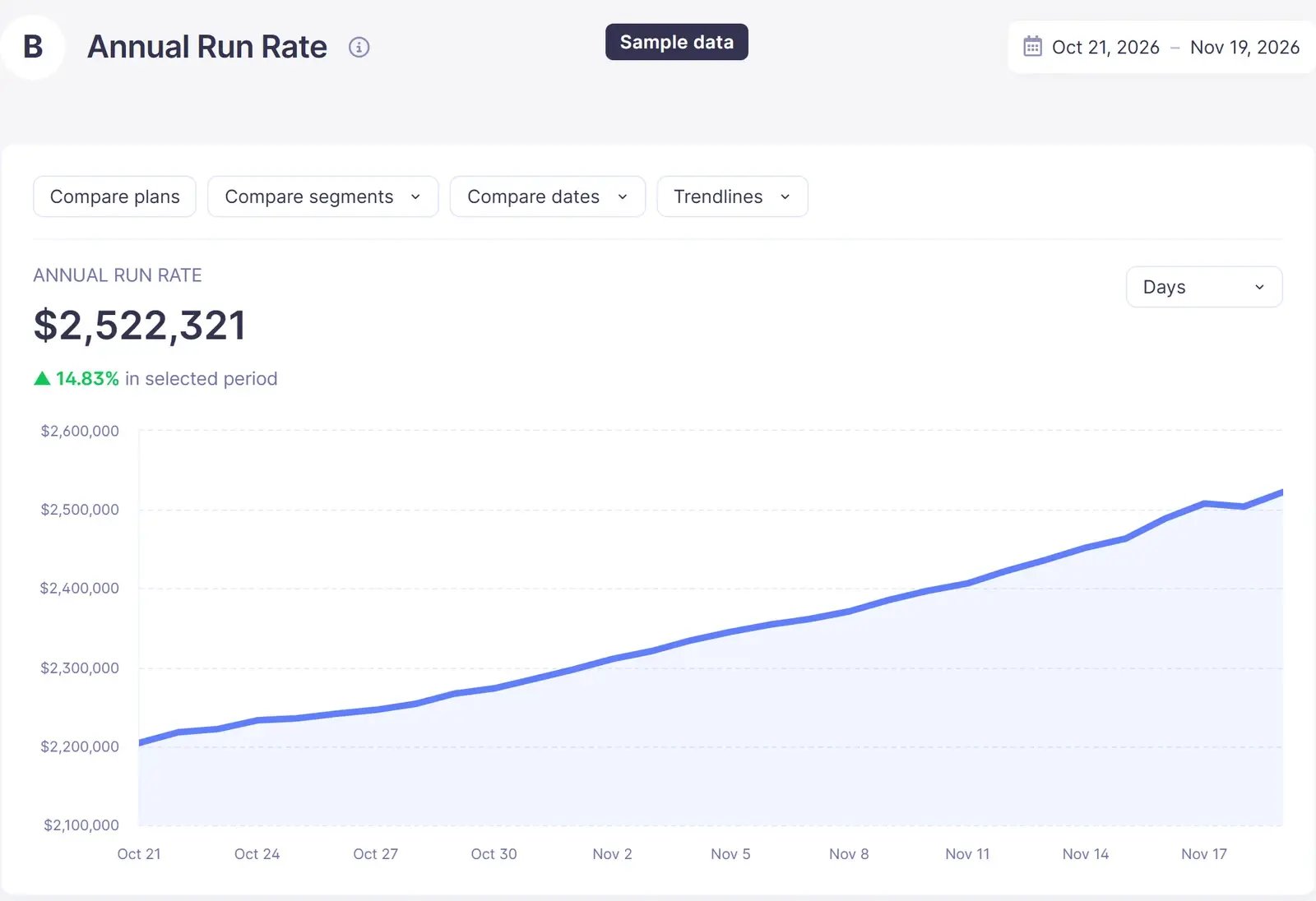
Baremetrics doesn't report burn multiple directly, because burn is a cash figure rather than a billing one. It does give you the denominator. Its Annual Run Rate is MRR × 12, calculated from your billing data, so net new ARR is the change on your ARR chart between the first and last day of the period; Compare Date Ranges shows both dates side by side.
For the burn side, Forecast+ builds profit and loss, balance sheet and cash flow statements from your QuickBooks or Xero books, and its dashboard includes Burn Rate and Runway charts. Forecast+ is included in the Scale plan and is also available as a standalone subscription. For the other core formulas in one place, see SaaS metrics formulas.
Source: Baremetrics Help Center (ARR: Annual Run Rate, Dashboards, Operating Model, About Forecast+).
Related: Burn multiple calculator · Burn rate · Annual run rate · How to forecast MRR growth · SaaS metrics formulas
Get net new ARR automatically
See your real ARR — connect Stripe in one click
Skip the spreadsheet. Baremetrics calculates MRR, ARR and dozens of other subscription metrics straight from your billing data, so the denominator of your burn multiple is always up to date.
Start your free trial →or explore the live demo
Screenshot shows the ARR chart in the Baremetrics demo account (sample data).
Frequently asked questions
What is a burn multiple?
Burn multiple is net burn divided by net new ARR over the same period. It shows how many dollars of cash a startup burns to add one dollar of annual recurring revenue.
How do you calculate burn multiple?
Burn multiple = Net burn ÷ Net new ARR. Net burn is cash spent minus cash received in the period; net new ARR is ARR at the end of the period minus ARR at the start. A startup that burns $2M in a quarter while adding $1M of ARR has a burn multiple of 2.0×.
What is a good burn multiple?
Lower is better. David Sacks's scale for venture-stage startups (The Burn Multiple, 2020) rates under 1× as amazing, 1–1.5× great, 1.5–2× good, 2–3× suspect and over 3× bad. In his worked example he calls 2× (burning $2M in a quarter to add $1M of ARR) reasonable for an early-stage startup and 5× terrible. These are one investor's rules of thumb, not targets or measured benchmarks.
What is the difference between burn multiple and burn rate?
Burn rate is how much cash you spend in a period (gross burn) or lose after revenue (net burn). Burn multiple divides net burn by the net new ARR added in the same period, so it shows what that cash is buying. Runway is cash on hand ÷ net burn.
Can I calculate burn multiple if my company is cash-flow positive?
Not meaningfully. If net burn is zero or negative you aren't burning cash, so the ratio stops measuring burn efficiency. The same applies when net new ARR is zero or negative.
What period should I use for burn multiple?
Any period works, a month, a quarter or a year, as long as net burn and net new ARR cover the same period. Sacks's example uses a quarter.
Does Baremetrics calculate burn multiple?
Not directly, because burn is a cash figure rather than a billing one. Baremetrics gives you net new ARR: its Annual Run Rate is MRR × 12, so net new ARR is the change on your ARR chart between the start and end of the period. Forecast+ covers the burn side with burn rate and runway charts built from your accounting data.
