Table of Contents
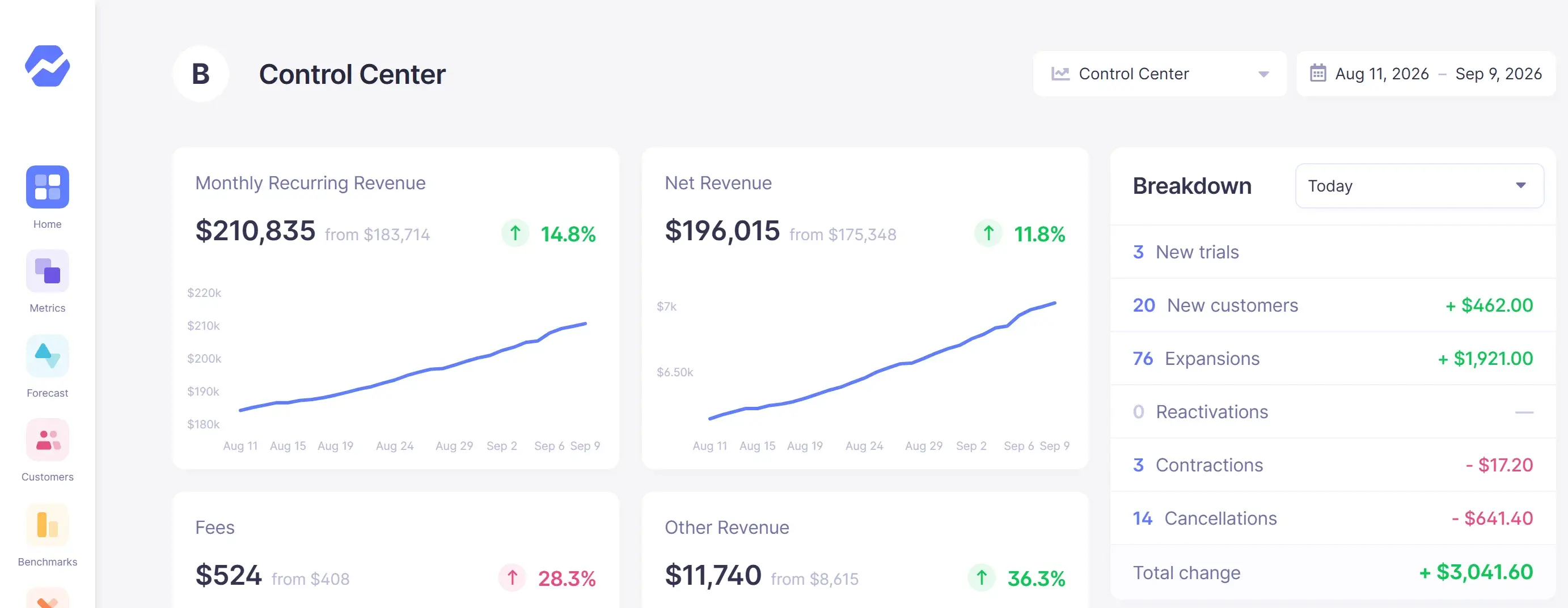
Every subscription metrics platform is doing the same job. It is rebuilding a recurring-revenue number out of billing events it did not create. The best subscription metrics platforms differ from each other in which of those events they can see, and which ones their documentation says they know what to do with.
That is where reporting discrepancies come from. A proration credit, a paused plan, a chargeback landing two months late, a card sitting in its fourth retry: each one is a decision about whether revenue counts this month. Different platforms decide differently, and none of them ask you first.
This comparison covers eight platforms, grouped by where the number is reconstructed rather than by rank. One gateway, several gateways consolidated, a billing suite reporting on data it already owns, a ledger of contracts and invoices, and the app stores. Two suit a business running a single gateway, three suit a mid-market team, two sit at the enterprise end, and one covers revenue billed inside a mobile app.
Before the platform sections there is a rubric of seven recurring-billing events that change an MRR number, with every platform scored against what its own vendor documentation says it does. That rubric is also the shortlisting tool: the events your current number cannot explain are your requirements.
Key Takeaways
- Seven recurring-billing events decide whether an MRR number is defensible: prorated mid-cycle plan changes, annual and multi-year contracts spread across months, pauses, refunds and chargebacks landing after the period closed, failed payments still in dunning retry, mid-lifecycle currency switches, and one customer billed through two gateways.
- No platform assessed here publishes a documented treatment for more than two of those seven events, and the paused subscription is documented by none of the eight. Vendor documentation describes charts far more thoroughly than it describes edge cases.
- Where the number is reconstructed matters more than how many reports ship with it. A billing suite such as Chargebee RevenueStory or Recurly reports only revenue billed through itself, while ProfitWell Metrics, Baremetrics, ChartMogul and RevenueCat each read several billing systems at once.
- Failed payments are the one event with a product response rather than only a report. Baremetrics Recover runs up to seven dunning emails on a day 0 to day 30 schedule with two-way card write-back on Stripe, Braintree and Recurly; Recurly reports recovered revenue from intelligent retries and account updater for revenue it bills itself.
- Invoice-billed B2B revenue does not live in a gateway's subscription objects. Subscript builds ARR, CARR, NRR and GRR from contract and invoice data, with revenue schedules generated in accordance with ASC 606 and IFRS 15.
- Entry pricing (checked September 18, 2026; ProfitWell, Baremetrics, ChartMogul and Chargebee rechecked October 2026): ProfitWell Metrics free, Baremetrics free up to $180K ARR, ChartMogul free under $120K ARR, Chargebee Flow $0 + 0.80% with RevenueStory analytics included, Recurly $249/month + 0.9%, RevenueCat free to $2,500 monthly tracked revenue, Subscript quoted from $15,000/year, Zuora unpublished.
How we evaluated these subscription metrics platforms
Four questions, asked of every platform in the same order. Where does its recurring-revenue number come from? Which recurring-billing events does its own documentation say it handles? Is its price published with a date against it? And does the vendor state its own limits, rather than leaving a buyer to infer them?
Pricing, capabilities and limitations were checked against each vendor's own pricing page or product documentation on September 18, 2026. Where a vendor publishes no figure, this comparison says so instead of estimating one. Data refresh cadence is the most common gap: three platforms here publish none, and that is recorded as unpublished rather than filled in.
Baremetrics publishes this comparison and is assessed on the same four questions, with its add-on costs, its ARR-based plan steps and the gateway limits on Recover stated plainly in its own Cons. It appears second because it belongs beside the single-gateway, fast-setup buyer, not because it is the publisher. The order is by buyer segment throughout and implies no ranking.
Three verified platforms were left out under the same rubric. Maxio is a billing and revenue-recognition platform you adopt by moving invoicing onto it, and its finance-grade case is covered here by Subscript. Adapty reads the same app-store billing surface as RevenueCat. Stripe's billing analytics dashboard is a gateway's built-in view rather than a platform you choose.
The seven billing events that break an MRR number
Recurring billing produces seven events that force a platform to make a judgement about revenue. Each one can move MRR, churn and retention in opposite directions depending on the call. Vendors document their charts exhaustively and these events barely at all, which is why two tools reading the same gateway disagree.
- A mid-cycle upgrade or downgrade with proration. The customer changes plan on day 12 and a prorated credit and a prorated charge land on the same invoice. MRR moves on the change date, at next renewal, or when the invoice settles.
- An annual or multi-year plan spread across months. One invoice for $12,000 is either $1,000 of MRR for twelve months or a $12,000 spike in one, and both answers ship in production somewhere.
- A pause, or a plan on hold. Paused customers are neither churned nor active. Count them as churn and churn is overstated; count them as active and MRR is.
- A refund, partial refund or chargeback after the period was counted. The month closed and then the revenue reversed. The platform either restates a closed month or absorbs the reversal into the current one.
- A failed payment in dunning retry. The card declined on the 3rd and the retry runs on the 7th. Until it resolves, that customer is churned, at risk, or still active, and the three answers produce three churn rates. Our guide to how dunning management works end to end covers the retry mechanics behind this one.
- A customer who switches billing currency mid-lifecycle. The plan price did not change but the reported number did, so FX movement reads as expansion or contraction.
- The same customer billed through two gateways, or migrated between them. One customer becomes a cancellation on one system and a new signup on the other, in the same month.
Each platform below is scored only on what its own documentation says it does with these events. "Not documented" means the vendor publishes no treatment, not that the platform gets it wrong. On that standard no platform here documents more than two of the seven, the paused subscription is documented by none, and the widest coverage belongs to the two-gateway customer.
Subscription metrics platforms at a glance
The table below carries the rubric into the comparison itself. The third column counts how many of the seven billing events each vendor documents a treatment for, with the event numbers in brackets, so a platform shipping more reports does not automatically look stronger than one with fewer and better-defined ones.
| Platform | Where the number comes from | Billing events documented | Starting price (checked September to October 2026) | Main limitation |
|---|---|---|---|---|
| ProfitWell Metrics by Paddle | Several gateways | 2 of 7 (1, 7) | Free | No refresh cadence, export limits or support terms published |
| Baremetrics | Several gateways plus app stores | 2 of 7 (5, 7) | Free up to $180K ARR; Launch $49/month | Recover writes cards back to Stripe, Braintree and Recurly only |
| ChartMogul | Several gateways, including mid-migration | 2 of 7 (6, 7) | Free under $120K ARR | Free and Starter connect one billing system; Pro caps at five |
| Subscript | Contracts and invoices | 1 of 7 (2) | From $15,000/year | No self-serve signup, free tier or trial published |
| Chargebee RevenueStory | Billing suite that owns the data | 1 of 7 (1) | $0 + 0.80% on Flow | Reports only revenue billed through Chargebee |
| Recurly | Billing suite that owns the data | 1 of 7 (5) | $249/month + 0.9% | Analytics sits on All-Access, with a $1M billing volume minimum |
| Zuora Analytics | Billing suite into a data warehouse | 0 of 7 | Not published | The analytics product page names no subscription KPIs |
| RevenueCat | App stores plus Stripe | 2 of 7 (4, 7) | Free to $2,500 MTR | Production data only; cost scales at 1% of tracked revenue |
ProfitWell Metrics by Paddle
ProfitWell Metrics is a free subscription analytics product from Paddle that reads your billing system and returns recurring-revenue KPIs with no bill attached. It suits a business on one or two gateways that needs a defensible MRR number today and has no budget line for analytics at all.
What it does well
It reports MRR, churn, upgrades and downgrades, customer lifetime value, active customers and revenue per customer out of the box, and it connects to Stripe, Chargebee, Braintree, Zuora, Recurly and Paddle plus its own API. Reading more than one billing system makes the two-gateway customer a setup step rather than a reconciliation job, which is unusual at this price.
Pros
- Free, with no paid tier shown on the product page as of September 18, 2026.
- Upgrades and downgrades are reported as named metrics, so mid-cycle plan changes have a documented treatment.
- Six billing systems plus an API, so revenue split across gateways consolidates without a data project.
- Benchmarking and segmentation run against a dataset Paddle describes as 30,000 subscription and SaaS companies.
Cons
- Paddle publishes no data-refresh cadence, no export or API limits and no support commitment for the free product.
- Five of the seven billing events have no documented treatment, including annual spreading, pauses, refunds and dunning retries.
- It is published by Paddle, which also sells the billing it reports on.
Pricing
Free. The product page presents the whole product as free revenue reporting for subscription and SaaS companies and shows no paid tier, as of September 18, 2026.
Best for
A subscription business on one or two gateways that needs a real MRR number immediately and is not ready to pay for one.
Baremetrics
Baremetrics consolidates payment processors, app stores and accounting systems into one view of recurring revenue, then acts on failed payments rather than only reporting them. It suits a business that wants its MRR number and its involuntary-churn recovery to come from one place.
What it does well
Unified Connections brings Stripe, Braintree, Recurly, Chargebee, Google Play Store, Apple App Store Connect, Shopify, Paddle, PayPal, QuickBooks Online, Xero and a Universal Connector API into one view of company health.
Failed payments then get a product response rather than a label: Recover runs the campaign and writes the new card back to the gateway.
Pros
- The only platform here whose published connection list covers app-store billing and accounting ledgers alongside the card gateways.
- Recover runs up to seven customisable emails on a day 0, 3, 7, 13, 15, 20 and 30 schedule, optionally blended with SMS, plus two card-expiration reminders at 30 and 7 days, two annual renewal reminders, in-app reminders escalating to a paywall after a configurable grace period, a branded card-capture widget and two-way card write-back on Stripe, Braintree and Recurly.
- Cancellation Insights collects cancellation feedback, quantifies the revenue lost to each reason and sends personalised win-back emails automatically.
- Segmentation compares profitable customer segments and the attributes that make them an ideal fit, Augmentation merges external data into richer profiles, and a Customers view carries full payment, event and change history.
Cons
- Recover's two-way card write-back covers Stripe, Braintree and Recurly; other connections get email and in-app messaging only, and only where the billing system shares customer email addresses (on Chargebee, only where emails are collected).
- Pricing steps up with tracked ARR: Launch is $49/month to $360K ARR and month-to-month only, then Growth starts from $69/month, and Scale from $409/month above $3.6M ARR, as of October 2026.
- Payment Recovery is an add-on at +$129/month or 10% of recovered revenue, and Cancellation Insights is +$129/month, charged on top of the base plan as of October 2026.
- Five of the seven billing events have no documented treatment, including proration, pauses and mid-lifecycle currency switches.
Pricing
Free up to $180K ARR. Launch is $49/month to $360K ARR (month-to-month only), Growth from $69/month to $3.6M ARR, and Scale from $409/month above that, with Financial Planning included in Scale. Plans are never priced per seat, and annual plans are up to 35% off. Payment Recovery is +$129/month or 10% of recovered revenue, and Cancellation Insights is +$129/month. Per the Baremetrics pricing page, as of October 2026.
Best for
A subscription business billing through more than one system and losing measurable revenue to declined cards. Every plan carries a free trial, so connect your gateways and see whether the recovered-revenue line covers the add-on.
ChartMogul
ChartMogul is a subscription analytics platform built to hold one continuous revenue timeline across several billing systems, including while you are moving between them. It suits a mid-market team whose customers are spread across gateways, or whose MRR history has to survive a billing replatform without a false churn spike.
What it does well
It holds one customer timeline across billing systems and through a migration between them, so a migrated customer is not a cancellation plus a new signup. It also separates FX movement from real expansion when a customer switches billing currency mid-lifecycle, the only documented treatment of that event here.
Pros
- One continuous customer timeline and MRR figure across several billing systems, including during a migration between them.
- FX movement is told apart from real expansion when a customer switches billing currency mid-lifecycle.
- Tiered plans, multi-component subscriptions, add-ons, usage overages and free trials are modelled explicitly rather than flattened into one plan price.
- Two-way CRM sync, Slack and HubSpot, plus Snowflake, Amazon Redshift and Google BigQuery for warehouse export.
Cons
- Starter, the cheapest paid plan, connects one billing system and three team members, as of October 2026.
- Pro caps at five connected billing sources; fifteen requires Enterprise from $19,900 per year.
- The Free plan under $120K ARR connects one billing system, so a second gateway means a paid plan.
- Five of the seven billing events have no documented treatment, including proration, pauses and dunning retries.
Pricing
Free under $120K ARR with one billing system. Starter is $57 per month billed annually or $69 billed monthly at the lowest band, with one billing system and three team members. Pro is $99 per month billed annually or $119 monthly at the lowest band, rising to $1,199 or $1,439 at $7M to $10M ARR, with five billing sources. Enterprise starts at $19,900 per year above $10M ARR with fifteen. Annual billing saves 17%, and a startup discount of $50 per month for twelve months is offered on paid plans, as of October 2026.
Best for
A mid-market subscription business consolidating two or more billing systems, or one mid-migration. There is a closer look at ChartMogul's features and limitations if it is on your shortlist.
Subscript
Subscript builds recurring revenue from contracts and invoices rather than from a payment gateway's subscription objects. It suits invoice-billed B2B companies with ramped deals, multi-year terms and custom payment schedules, where every gateway-reading platform on this page reports a number finance cannot defend in a board meeting.
What it does well
Every other platform here starts from a subscription object a payment processor created. Subscript starts from the contract and the invoice, which is where an enterprise deal lives: a three-year term, a ramp from 200 to 500 seats in year two, and a payment schedule that does not match the service period. It reports ARR, CARR, LTV, CAC, NRR and GRR in real time alongside a stated 54 further SaaS metrics.
Pros
- ARR and CARR are derived from contract and invoice data, so ramped and multi-year deals are represented as signed rather than as billed.
- Revenue schedules generated in accordance with ASC 606 and IFRS 15, so one system answers to the board and to the auditor.
- The only documented treatment here of contract value spread across periods, rather than landing in the month it happened to be invoiced.
- Accounts-receivable workflow sits in the same system, and it connects QuickBooks, NetSuite, Xero, Salesforce and HubSpot through an ingestion engine and API.
Cons
- No self-serve signup, no free tier and no free trial published, as of September 18, 2026.
- Quoted pricing starts well above every self-serve option in this comparison, and the pricing page does not list supported integrations.
- Six of the seven billing events have no documented treatment, including proration, pauses and failed payments in dunning retry.
Pricing
No public tiers; every deal is quoted. The pricing page publishes a ballpark for Analytics plus Billing of $15,000 per year as a minimum, $24,000 per year as the most common figure and $150,000 per year as a maximum, plus an onboarding fee, as of September 18, 2026.
Best for
An invoice-billed B2B company with ramped or multi-year contracts, particularly one whose auditors expect ASC 606 schedules from the same system that reports ARR.
Chargebee RevenueStory
Chargebee RevenueStory is the analytics layer inside Chargebee's billing suite, reporting on subscription data Chargebee already owns with no connector to maintain. It suits a company that bills everything through Chargebee and would rather deepen one system than add a second that has to be kept in sync.
What it does well
It ships 150+ ready-made reports across 12 categories, including Recurring Revenue, Churn, Leakage, Collections and Receivable, with 10 default dashboards, KPI, chart, table and cohort views and a Report Builder. Reading live billing data means no sync to break and no gap between billing and reporting.
Pros
- 150+ ready-made reports across 12 categories, reading live Chargebee billing data with no integration to maintain.
- RevenueStory Integrated Analytics is listed as Included on both the Flow and Enterprise plans, as of September 18, 2026.
- Flow starts at $0 plus 0.80% of monthly invoicing volume and includes 100M usage events per month, so the reporting arrives with no separate licence.
- Downgrade MRR and Cancellation MRR are available as metric alerts, so mid-cycle plan changes have a documented treatment.
Cons
- Reports cover only revenue billed through Chargebee, so a second gateway is out of scope.
- Metric alerts are limited to five metrics: Downgrade MRR, Cancellation MRR, Total Subscription Churn, Paid Subscription Churn and Gross MRR Churn Rate.
- Unlimited dashboard schedules are a Premium feature, capped at three otherwise, and site consolidation is Premium and Live-sites only.
- The documentation does not state a data refresh frequency.
Pricing
Chargebee Billing Flow is listed at $0 + 0.80% for monthly invoicing volume up to $20,000, moving to $99 + 0.65% at what the page gives as a $66K monthly invoicing volume breakeven, and including 100M usage events per month. Enterprise is custom. RevenueStory Integrated Analytics is shown as Included on both, as of September 18, 2026.
Best for
A company already billing everything through Chargebee that wants subscription reporting without buying, connecting or reconciling a second platform.
Recurly
Recurly is a subscription billing platform whose own reporting separates voluntary churn from involuntary churn and reports recovered revenue as a first-class number. It suits a larger subscription business billing through Recurly that treats declined cards as a revenue line rather than as a support queue.
What it does well
Its reporting splits churn by cause and tracks revenue recovered from intelligent retries, account updater, expired card management and backup payment methods, so the dunning event carries an outcome rather than a label. That is a billing suite reporting on a mechanism it also operates.
Pros
- Churn reported by cause, voluntary against involuntary, which a reporting layer can only do if it sees the decline.
- Recovered revenue tracked from intelligent retries, account updater, expired card management and backup payment methods.
- Percentile benchmarking against industry medians and quartiles, plus cohort retention and trial conversion reporting.
- 20+ payment gateways and 10+ payment methods supported, with automated exports and an API into data warehousing tools.
Cons
- Analytics, custom reporting and the intelligent churn-prevention tooling sit on All-Access, an annual plan that requires $1M of billing volume, as of September 18, 2026.
- Starter includes only static churn-prevention tools and one dunning campaign.
- Reporting covers only revenue billed through Recurly, whichever gateway processes it.
- Six of the seven billing events have no documented treatment; the failed payment in retry is the exception.
Pricing
Starter runs at $249 a month, charging 0.9% on billing volume, and the first $40K of monthly billings is included in that fee. All-Access is billed annually, with a rate the pricing page puts as low as below 1% of billing volume, and a $1M billing volume minimum. Engage starts at $1,600 a month and RevRec at $850 a month, both annual, as of September 18, 2026.
Best for
A subscription business already billing through Recurly at a volume where recovered revenue on its own justifies the All-Access step.
Zuora Analytics
Zuora Analytics is native report building over the Zuora platform, with Zuora Warehouse underneath it and output into cloud data warehouses. It suits an enterprise that already runs Zuora billing and has a data team willing to define its subscription metrics rather than accept a vendor's defaults.
What it does well
The product page describes report building native to the platform, customisable refresh rates ranging from once a day to near real time, and high-scale querying into cloud data warehouses. That is a reporting substrate rather than a metrics product, which is the right shape only if your definitions are already settled.
Pros
- Refresh rates are customisable, described as ranging from once a day to near real time.
- High-scale querying with output into Snowflake, Google BigQuery, Amazon Redshift and other cloud data warehouses.
- Report building is native to the Zuora platform, so billing data does not have to leave it to be modelled.
Cons
- The analytics product page names no subscription KPIs at all, so there is no published MRR, ARR, churn or NRR definition to evaluate before buying.
- No pricing is published for any product; the pricing page directs buyers to speak to an expert or talk to sales, checked September 18, 2026.
- None of the seven billing events has a documented treatment on the product page, which makes every one of them an implementation decision.
Pricing
Not published. Zuora shows no numeric pricing for any product and routes buyers to sales, checked September 18, 2026. Budget accordingly: an enterprise platform with unpublished pricing and undefined metrics is a procurement exercise and an implementation project, not a subscription you start on a Tuesday.
Best for
An enterprise on Zuora billing with a data team that wants metric definitions owned in-house and queried at warehouse scale.
RevenueCat
RevenueCat reads a billing system no web gateway can see. It reports subscription revenue from the Apple App Store, Google Play, Amazon Appstore and Stripe in one dashboard, and it suits any business whose customers subscribe inside a mobile app, whether or not it also bills on the web.
What it does well
Its charts cover MRR and ARR, active subscriptions and subscription movement, active trials and the trial conversion funnel, churn, cohort retention, realized and paywall LTV, plus refunds and Play Store cancel reasons. Those refund charts are the only documented treatment here of revenue reversing after a period closed. Charts v3 is described as real-time on most charts.
Pros
- App Store, Google Play, Amazon Appstore and Stripe revenue reported in one dashboard, so in-app and web subscriptions land in one number.
- Refunds and Play Store cancel reasons ship as named charts, the only published treatment here of a post-period reversal.
- Cohort explorer, subscription retention, realized LTV per customer and paywall LTV alongside the trial conversion funnel.
- Free until $2,500 in monthly tracked revenue, so the smallest app pays nothing, as of September 18, 2026.
Cons
- Charts display production transaction data only, so sandbox testing is invisible in reporting.
- The documentation does not state refresh intervals or latency for the charts that are not real-time.
- Pricing is a percentage of tracked revenue, so the cost of measurement scales directly with the revenue being measured.
Pricing
Nothing is charged below $2,500 of monthly tracked revenue. Above that, the rate is 1% of monthly tracked revenue. Enterprise pricing is custom and arranged through sales, as of September 18, 2026.
Best for
Any subscription business with revenue billed inside the app stores. Adapty reads the same billing surface, free below $5,000 in monthly tracked revenue and 1% above it, as of September 18, 2026.
Keeping MRR continuous across two gateways or a migration
The two-gateway customer is the most widely documented of the seven events and still the most frequently broken number. When a customer moves between processors, the old system records a cancellation and the new one records a signup. Both entries are locally correct and the combined report is wrong.
The result is a churn spike and a new-business spike in the same month, against net MRR that never moved. On an annual cohort chart that distortion persists for a year, and it is usually found when someone asks why retention collapsed in a month nobody remembers anything happening.
Four platforms here publish an answer. ChartMogul keeps one customer timeline across billing systems, including during a migration. Baremetrics consolidates twelve connection types through Unified Connections. ProfitWell Metrics reads six billing systems plus an API. RevenueCat unifies three app stores with Stripe.
Three cannot, by design. Chargebee RevenueStory and Recurly report only revenue they bill themselves, and Zuora Analytics publishes no treatment of it. Subscript avoids the question rather than answering it: its ARR comes from the contract and the invoice, and neither of those changes when the processor does.
How to choose a subscription metrics platform
Start with where your revenue is billed, then with the one billing event your current number cannot explain. The first decides which platforms you can use at all, and the second decides which of them you actually need. Feature lists are a poor third, because every platform here reports MRR.
- One gateway, no budget. ProfitWell Metrics, free as of September 18, 2026.
- Two or more gateways, or a migration in progress. ChartMogul if the continuous timeline is the problem; Baremetrics if declined cards are the problem, because Recover works the event instead of reporting it.
- Everything billed through Chargebee or Recurly. Use their own reporting first. RevenueStory is included on Chargebee Flow, and Recurly's churn-cause split is stronger than most add-on tools manage, as of September 18, 2026.
- Invoices against signed contracts, with ramps or multi-year terms. Subscript, because a gateway subscription object does not contain your commercial terms.
- Any revenue billed inside an app. RevenueCat, in addition to whatever reads your web billing.
- Zuora billing with a data team. Zuora Analytics, on the understanding that the metric definitions are yours to write.
Two companion comparisons cover adjacent shortlists: the best SaaS metrics platforms, which adds product-analytics tools such as Mixpanel, PostHog and Amplitude, and the best Stripe analytics platforms, for revenue billed only through Stripe.
If you are willing to move invoicing itself onto the reporting platform, Stripe Billing compared with Maxio covers that adjacent option. And if the event you cannot explain is the failed payment, read why subscription payments fail before you shortlist anything, because the fix is usually a recovery campaign rather than a chart.
Comparing tools?
Try Baremetrics on your own data before you decide
- Subscription metrics from Stripe, Braintree, Chargebee, Recurly, Apple, Google and more, in one dashboard
- Built-in failed-payment recovery and cancellation insights
- Forecasting with Forecast+
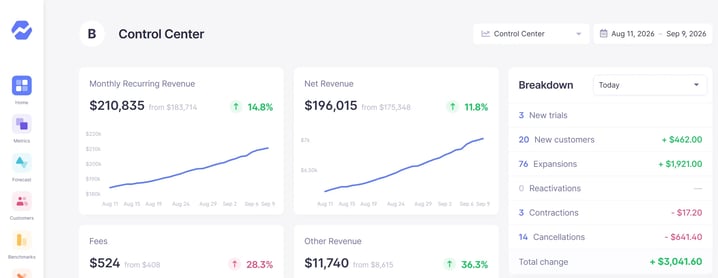
Start your free trial → Explore the live demo
Screenshot shows sample demo data.
Frequently Asked Questions
Which subscription billing management platform is the best for all time?
No platform holds that position, because billing management and subscription metrics are two different jobs and the right answer moves with where your revenue is billed. Chargebee and Recurly are billing platforms with reporting attached. Baremetrics, ChartMogul and ProfitWell Metrics are metrics platforms that read whichever billing systems you already run. Subscript works from contracts and invoices, and RevenueCat covers the app stores. The constraint that matters most is simple: a billing suite reports only the revenue it bills itself, so the moment a second processor appears, the suite stops being a complete answer.
What is the best subscription tracking service?
For a company tracking its own recurring revenue, the shortlist is ProfitWell Metrics when the budget is zero, Baremetrics or ChartMogul when revenue arrives through more than one billing system, and RevenueCat when any of it is billed in an app store. That is free, free up to $180K ARR and then from $49 per month, free under $120K ARR, and free to $2,500 in monthly tracked revenue respectively (RevenueCat as of September 18, 2026; the others as of October 2026). Choose between them on billing events rather than chart counts: whichever platform documents a treatment for the event your current number cannot explain is the one to trial first.
What is the best subscription platform?
Best for whom, and for which job, because the billing platform and the metrics platform are separate purchases. If you need to bill, Chargebee Flow starts at $0 plus 0.80% of monthly invoicing volume and Recurly Starter at $249 per month plus 0.9%, both as of September 18, 2026, and both report on the revenue they bill. If you already bill somewhere and need the number, a metrics platform reading several billing systems is cheaper and faster than replatforming, and it is the only route that survives a second processor.
What is the best app to manage streaming subscriptions?
Consumer subscription trackers, which find and cancel personal streaming and app subscriptions, are a different category from the business platforms in this comparison. The platforms here measure recurring revenue a company collects, not recurring charges an individual pays. If you want the business version, MRR, churn and retention across your own subscribers, every platform on this page does that job.
What should I look for in payment analytics software?
Start with the billing events it documents, not the number of charts it ships. Ask what it does with a prorated mid-cycle upgrade, an annual contract spread across months, a pause, a refund after the month closed, a card in dunning retry, a currency switch mid-lifecycle, and one customer billed through two gateways. Then ask three things the vendor either answers in public or does not: is the price published with a date, is the refresh cadence stated, and are the limits written down. As of September 18, 2026, several platforms here publish no refresh cadence at all.
Which analytics app is best for SaaS companies?
For subscription revenue specifically, the answer is set by where the revenue is billed rather than by a feature list. One gateway and no budget points to ProfitWell Metrics. Several gateways point to Baremetrics, free up to $180K ARR, or ChartMogul, free under $120K ARR. A single billing suite points to its own reporting; contracts and invoices point to Subscript, and in-app revenue points to RevenueCat. Figures checked September 18, 2026; Baremetrics and ChartMogul rechecked October 2026.