
Table of Contents

At $85,600 a month in billing volume, Stripe Billing and Maxio cost within $21 of each other. Below that, Stripe is cheaper by a wide margin. Above $100K, Maxio stops publishing prices. The question underneath the price is whether your billing problem is an engineering problem or an accounting problem.
Stripe Billing is billing infrastructure. You wire it into your product, it handles subscriptions and payments, and it scales without much human involvement. Maxio is a financial operations platform. It runs your billing and your revenue recognition, A/R, and audit reporting, and it assumes a finance team is using it daily.
If you are evaluating these two, you are probably one of the following:
- On Stripe already, and your accountant has started asking for things Stripe cannot produce
- Selling B2B contracts that don't fit self-serve billing — negotiated terms, milestones, custom invoicing
- Preparing for an audit or a raise, and discovering your revenue recognition is a spreadsheet
- Moving to usage-based pricing and finding out your current setup can't meter it
- Watching your Stripe Billing percentage turn into a number that shows up in board decks
We make Baremetrics, an analytics layer that sits on top of billing systems rather than replacing them, so we have a stake in one specific part of this decision. That section is clearly marked and comes after the comparison.
💬 CTA: If you are considering Maxio mainly to get better reporting out of your Stripe data, there is a smaller step first. Baremetrics connects to Stripe in minutes and gives you MRR, churn, cohorts, and forecasting without migrating your billing. Start a free trial or book a walkthrough.
What is the core difference between Stripe Billing and Maxio?
Stripe Billing is a developer-first billing engine bolted to the world's most widely used payment processor. Maxio is a finance-team-first billing and revenue operations platform built for B2B SaaS with contracts, invoices, and GAAP obligations.
That difference shows up everywhere:
- Who implements it. Stripe Billing is an API and a dashboard; your engineers own it. Maxio is an implementation project with sales-led onboarding; your finance team owns it.
- What it's optimized for. Stripe optimizes for conversion and scale on self-serve, high-volume subscriptions. Maxio optimizes for accuracy, auditability, and complex contract structures at lower volumes of higher-value deals.
- How you buy it. Stripe publishes its entire price ladder up to $1M/month in billing volume. Maxio publishes one plan and quotes the rest.
- What you get out the other end. Stripe gives you charges, subscriptions, and a revenue-recognition product sold separately. Maxio gives you audit-ready revenue schedules, deferred revenue roll-forwards, and A/R aging as core functionality.
The mistake to avoid is treating this as a cheap-versus-expensive decision. They are priced completely differently, and as the numbers below show, at the volume where they overlap they cost almost exactly the same.
What does Stripe Billing do?
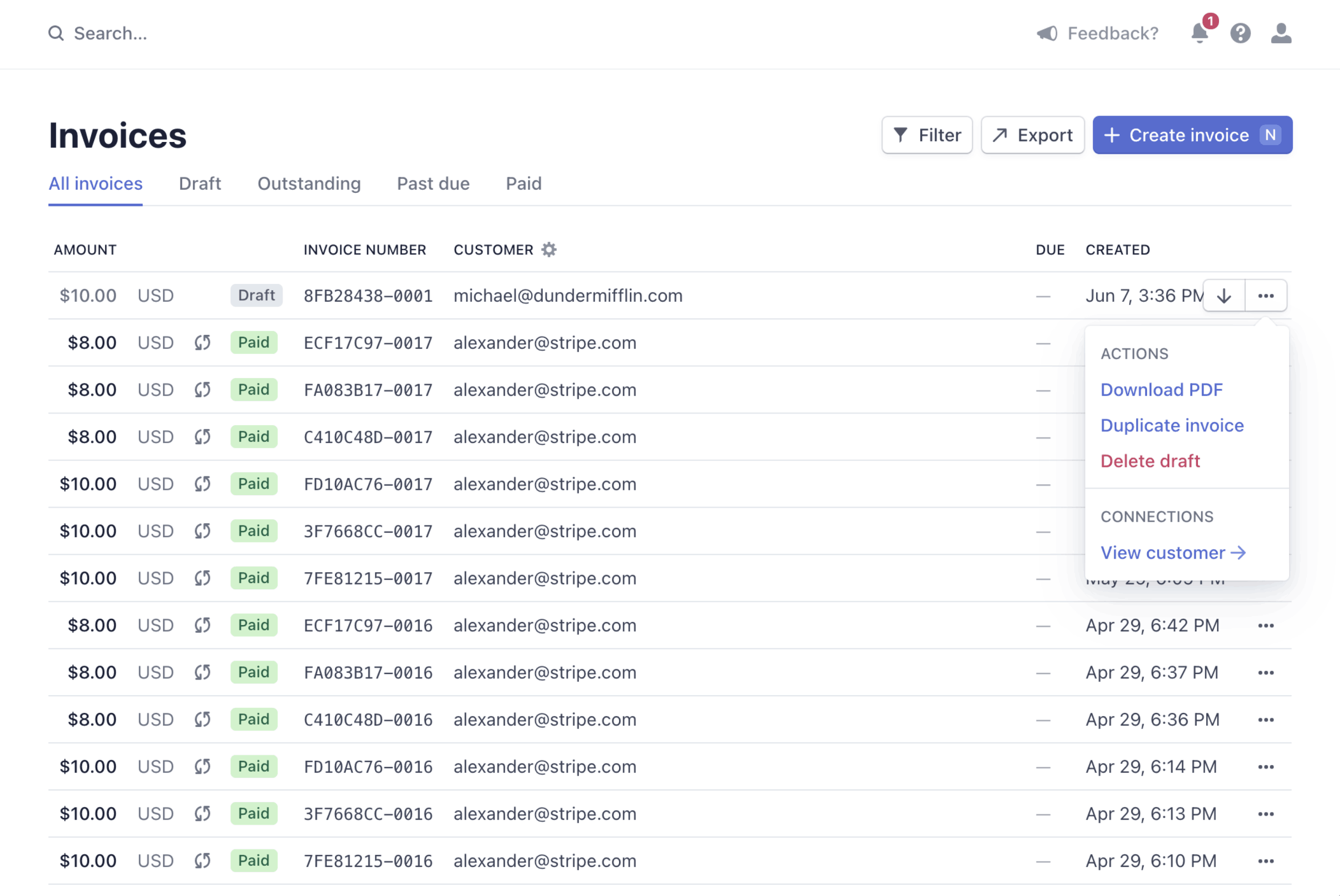
Stripe Billing sits on top of Stripe Payments and handles the recurring side: subscriptions, invoices, retries, and customer self-service.
What's included:
- Recurring billing and subscriptions — flat-rate, per-seat, tiered, and multi-currency pricing models, configurable in the dashboard, via Payment Links with no code, or through the API
- Smart Retries — machine-learning retry timing for failed payments
- Automatic reminders — prebuilt emails for missed and overdue payments
- Recovery and retention automations — up to three automations, including custom retry policies per customer segment
- Customer portal — a Stripe-hosted page where customers manage their own billing ($10/month extra for a custom domain)
- Quotes and multiphase subscription schedules — for scheduled upgrades and staged contract changes
- Invoice auto-reconciliation for recurring invoices paid by ACH or wire
What's not included:
Usage-based billing has moved to Metronome. Stripe acquired Metronome in January 2026, and as of now Stripe's own Billing pricing page routes usage-based billing to Metronome as a separate product with a separate sales conversation. What remains inside Billing is the Meters API for basic usage tracking. If you are pricing on consumption — which describes most AI companies right now — you are buying two products, not one.
One-off invoices are billed separately under Stripe Invoicing, at 0.4% or 0.5% per paid invoice, capped at $2.
Revenue recognition is a separate Stripe product with its own pricing. Stripe does offer ASC 606 revenue recognition — it is simply not part of Billing, so do not assume it is in your 0.7%.
Where Stripe Billing runs out of road
Complex B2B contract structures are the recurring theme: ramped contracts, pooled or rollover credits, parent-child account hierarchies, milestone-based billing, and negotiated terms that don't fit a clean subscription object. Stripe can be made to do some of these with engineering effort. Whether that effort is cheaper than buying a platform designed for them is the actual question.
The other issue is percentage-based cost at scale. 0.7% is invisible at $10K/month and $84,000 a year at $1M/month. It is the same rate; the volume changed. Anyone adopting Stripe Billing should run that arithmetic at their three-year revenue target, not their current one.
What does Maxio do?
![Maxio Dashboard [Product Tour Screenshot]](https://baremetrics.com/hs-fs/hubfs/Maxio%20Dashboard%20%5BProduct%20Tour%20Screenshot%5D.png?width=3418&height=1790&name=Maxio%20Dashboard%20%5BProduct%20Tour%20Screenshot%5D.png)
Maxio is what you get when SaaSOptics and Chargify merged in April 2022 — Chargify's billing engine plus SaaSOptics' revenue recognition and financial reporting, under one brand. If you are searching for either of those products, this is where they went.
What's included on every plan:
- Usage-based billing, subscription management, recurring billing, collections and dunning, and 20+ payment gateway integrations
- Automated invoicing including milestone-based billing, e-invoicing, proforma invoices, and consolidated invoicing
- Subscription management with product catalogs, customer hierarchies (parent-child relationships), contract terms, self-service signup pages, and renewal management
- Revenue recognition — scheduled, recognized, and deferred revenue; performance obligations; SSPs; carveouts; multiple revenue books
- Financial reporting — A/R aging, deferred revenue roll-forwards, contract detail audit reports, DSO, open balance diagnostics
- SaaS metric reporting — including "subscription momentum," their MRR/ARR snowball report covering new, lost, expansion, and contraction, plus churn, retention, CLV and CAC
- Accounting and CRM integrations — QuickBooks, Xero, NetSuite; Salesforce, HubSpot, Pipedrive
- No per-user charges. Maxio's own pricing FAQ confirms unlimited users at no additional cost, which is a real advantage over seat-priced finance tools.
What sits behind a tier or a module:
Financial reports, A/R management, and revenue recognition all step up from "standard" on Grow to "advanced" on Scale. And Maxio's pricing page lists a set of optional modules on top of plan price: advanced revenue management, A/R management, expense amortization, milestone-based projects, multi-entity, event-based billing, and EU hosting.
Check the sequence before you budget: is the capability you are buying Maxio for included in Grow, gated to Scale, or an optional module? For advanced revenue management, expense amortization, metering and rating, and multi-entity, the answer is not Grow.
Where Maxio is harder work
Implementation is a project, not a signup. Maxio's default agreements are paid annually — monthly and quarterly payment are available as premium options, per their own pricing FAQ. And adopting Maxio means migrating your billing, which is the single most consequential difference between these two options and the thing most likely to derail a timeline.
Their dunning, for the record, is capable: subject and body editable, custom HTML and Markdown layouts, a dunning-specific from-address, schedules up to 30 steps across 365 days, and Twilio SMS. Anyone telling you Maxio's recovery emails can't be customized is wrong. The honest caveat is that templating them properly is a developer task — Maxio's docs say layouts are validated against strict XML and their support does not debug HTML in email templates.
Stripe Billing vs. Maxio pricing: what each actually costs
Verified against both Stripe and Maxio's pricing pages on September 1, 2026. Stripe's regional pricing pages differ: the India page, for example, shows pay-as-you-go only.
Stripe Billing
| Plan | Price | Covers |
| Pay as you go | 0.7% of billing volume | Any volume; no commitment. Includes transactions processed on and off Stripe. Excludes one-off invoices. |
| Annual, paid monthly | $620/mo | Up to $100K/mo billing volume, then 0.67% |
| Annual, paid monthly | $1,500/mo | Up to $250K/mo |
| Annual, paid monthly | $2,950/mo | Up to $500K/mo |
| Annual, paid monthly | $5,750/mo | Up to $1M/mo |
| Custom | Quote | Above $1M/mo |
Annual tiers are a 1-year contract, and at the same volume they price below pay-as-you-go.
Maxio
| Plan | Price | Covers |
| Grow | $599/mo | Up to $100K in monthly billings |
| Scale | Get a quote | Over $100K in monthly billings |
Optional modules price on top. Third-party roundups mention a free developer sandbox; it is not a pricing tier on Maxio's plan comparison.
The structural contrast: Stripe publishes every rung up to $1M/month in billing volume before it asks you to call. Maxio publishes the rung below the one many of its buyers need — if advanced revenue management or multi-entity consolidation is your reason for evaluating Maxio, you are in quote-only territory from the start. Neither approach is wrong, but they make budgeting feel very different.
Where the cost crossover sits
Platform fees only, at a range of monthly billing volumes:
| Monthly billing volume | Stripe PAYG (0.7%) | Stripe annual tier | Maxio Grow |
| $10,000 | $70 | $620 | $599 |
| $25,000 | $175 | $620 | $599 |
| $50,000 | $350 | $620 | $599 |
| $85,600 | **$599** | $620 | **$599** |
| $100,000 | $700 | $620 | $599 |
| $250,000 | $1,750 | $1,500 | Quote (Scale) |
| $500,000 | $3,500 | $2,950 | Quote (Scale) |
| $1,000,000 | $7,000 | $5,750 | Quote (Scale) |
Three things fall out of this:
Below roughly $85,000/month in billing volume, Stripe pay-as-you-go is cheaper than either alternative, and it isn't close. At $25K/month you are paying $175 against $599. Nobody at that volume should be choosing Maxio on price — they should be choosing it because they need revenue recognition or contract billing that Stripe can't do.
In the narrow band between about $85,600 and $100,000/month, the three options converge to within a few percent. Stripe's $620 tier and Maxio's $599 plan both cap at $100K/month and cost within $21 of each other. At the volume where they overlap most directly, price is not the deciding factor — capability is.
Above $100,000/month, the comparison stops being like-for-like. Stripe keeps publishing: $1,500, $2,950, $5,750. Maxio moves to a quote. You cannot model Maxio's cost above $100K/month from public information, so build the evaluation around getting that quote early rather than assuming it scales proportionally.
What this table deliberately excludes, because it would mislead otherwise: Stripe's card processing, which you pay regardless; Stripe Invoicing for one-off invoices; Stripe Tax and Revenue Recognition, which are separate products; Metronome for usage-based billing; Maxio's optional modules; and implementation costs on either side. The table also assumes "billing volume" and "monthly billings" mean the same thing. The two vendors define them in their own terms. Confirm with both before signing.
Feature comparison
| Stripe Billing | Maxio | |
| Category | Billing infrastructure | Billing + financial operations platform |
| Built for | Developers, self-serve and PLG | Finance teams, sales-led B2B SaaS |
| Setup | API integration; live in days | Implementation project; sales-led onboarding |
| Recurring subscriptions | ✅ | ✅ |
| **Usage-based billing** | Basic metering via Meters API; **advanced usage billing routed to Metronome as a separate product** | ✅ Included on all plans; metering and rating is a Scale-tier capability |
| Milestone-based billing | Not natively | ✅ (optional module for milestone projects) |
| Customer hierarchies (parent-child) | Not natively | ✅ |
| Quotes / CPQ | ✅ Quotes included | ✅ CPQ is a core product |
| **Revenue recognition (ASC 606)** | Separate Stripe product, priced separately | ✅ Core; standard on Grow, advanced on Scale |
| A/R management, DSO, deferred revenue reporting | ❌ | ✅ Standard on Grow, advanced on Scale |
| Multi-entity consolidation | ❌ | ✅ Scale / optional module |
| Dunning | Smart Retries + prebuilt reminder emails; up to 3 recovery automations | Up to 30 steps over 365 days, editable HTML/Markdown, own from-address, Twilio SMS |
| Payment gateways | Stripe | 20+ gateways |
| Per-user charges | None | None |
| **Pricing transparency** | Full ladder published to $1M/mo | Grow published; Scale quote-only |
| Contract | PAYG has no commitment; annual tiers are 1-year | Annual by default; monthly/quarterly at a premium |
Which should you choose?
Choose Stripe Billing if you are self-serve or PLG, your engineers own billing, your contracts are standard, and you want to be live this week. It is also the cheaper option by a wide margin below roughly $85K/month in billing volume. If you are already on Stripe Payments, the integration cost is close to zero.
Choose Maxio if you sell negotiated B2B contracts, you need ASC 606 revenue recognition and audit-ready reporting as core functionality rather than a separate purchase, you have A/R that needs managing, or you are consolidating multiple entities. If your CFO or auditor is the person driving this decision, Maxio is the right category and Stripe will keep disappointing them.
Look harder at both if you are moving to usage-based pricing. This is where 2026 changed the answer. Stripe's advanced usage billing now lives with Metronome as a separate product and a separate conversation. Maxio includes usage-based billing on every plan but puts metering and rating at the Scale tier. Neither gives you sophisticated consumption billing at the entry price, so get specific about your metering requirements before you compare anything else.
Neither, if your actual problem is reporting. Covered next.
Where Baremetrics fits
Straight up: Baremetrics is not a billing system and is not an alternative to either of these. You cannot invoice a customer with it. If you need billing, you need Stripe Billing or Maxio or something like them.
Here is the case where we are relevant, and it is a common one. A lot of teams start evaluating Maxio not because their billing is broken but because their reporting is. They are on Stripe, they can see charges and payouts, and they cannot see MRR movement, cohort retention, or net revenue retention in a form anyone would put in a board deck. Maxio looks like the answer because it produces excellent finance reporting.
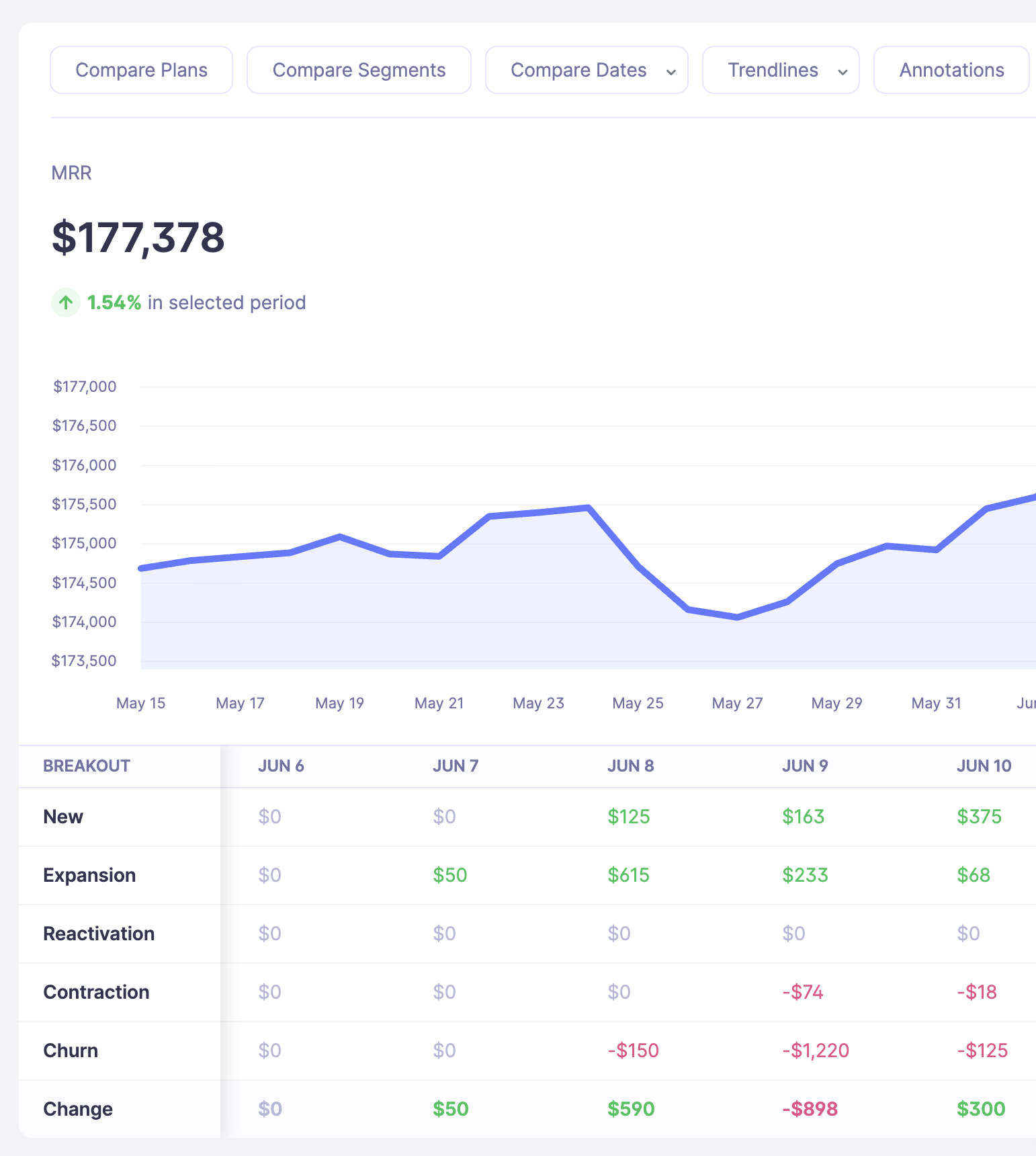
Check whether you are about to migrate your entire billing stack to solve a reporting problem. Baremetrics connects to Stripe with OAuth in minutes, pulls your full history, and gives you MRR with new/expansion/contraction/churn/reactivation breakdown, cohort retention, LTV, segmentation, and revenue forecasting. That is the whole setup.
Forecast+ pulls your actual P&L from QuickBooks or Xero on top of that, so runway, burn rate, CAC, and budget variance sit next to your subscription metrics, and it is included with any paid plan. Recover handles failed payments with up to seven fully customizable emails, a branded card-update page, in-app banners escalating to a paywall, and SMS, with a published guarantee: recover more than your Baremetrics cost or your next month is free.
None of that touches your billing system. Your invoicing stays exactly where it is.
When that isn't enough, and we'll say so: if you need ASC 606 revenue schedules, deferred revenue roll-forwards, A/R aging, multi-entity consolidation, CPQ, or milestone invoicing, we don't do any of it and Maxio does. That is a genuine category difference, not a feature gap we're going to close. If an auditor is driving your timeline, go talk to Maxio.
💬 CTA: Not sure whether your problem is billing or reporting? Book a call — we'll look at your Stripe data with you and tell you honestly which one it is, including when the answer is that you need a billing platform.

