Table of Contents

First, the update most "Recurly vs. Chargify" articles miss: Chargify no longer exists. It merged with SaaSOptics in April 2022 and rebranded as Maxio. If you're comparing these two in 2026, you're really comparing Recurly vs. Maxio — and they've evolved in noticeably different directions.
Subscription businesses weighing these platforms usually have one of these problems:
- Failed payments are quietly draining revenue and nobody owns recovery
- Their pricing model (usage-based, hybrid, negotiated contracts) has outgrown simple plan billing
- Finance is asking for audit-grade revenue recognition they can't produce
- They can't tell which platform fits a consumer subscription vs. a B2B SaaS motion
Whichever billing platform you land on, Baremetrics gives you the metrics layer — natively integrated with Recurly.
Recurly vs. Maxio at a glance
| Dimension | Recurly | Maxio (formerly Chargify + SaaSOptics) |
|---|---|---|
| Sweet spot | Consumer subscriptions, media, DTC + SaaS | Sales-led B2B SaaS with complex contracts |
| Failed-payment recovery | ✅ Hero feature — AI retries, "billions recovered" | ✅ Dunning within billing platform |
| Revenue recognition | RevRec add-on (from $850/mo) | ✅ Core — GAAP/IFRS, ASC 606, audit-ready |
| Usage-based / hybrid billing | ✅ Supported | ✅ Core strength, plus CPQ |
| Gateways | 20+ (Stripe, Braintree, Adyen, PayPal…) | Gateway integrations; platform is the billing system of record |
| Pricing | ✅ Published — Starter $249/mo + 0.9%, no minimum; All-Access quoted | ✅ Published — Grow $599/mo to $100K monthly billings; Scale quote-only |
| Notable customers | Paramount+, Twitch, Cinemark, nuuly, Scentbird | 2,000+ SaaS and subscription businesses, $17B+ in billings under management |
What Recurly does best
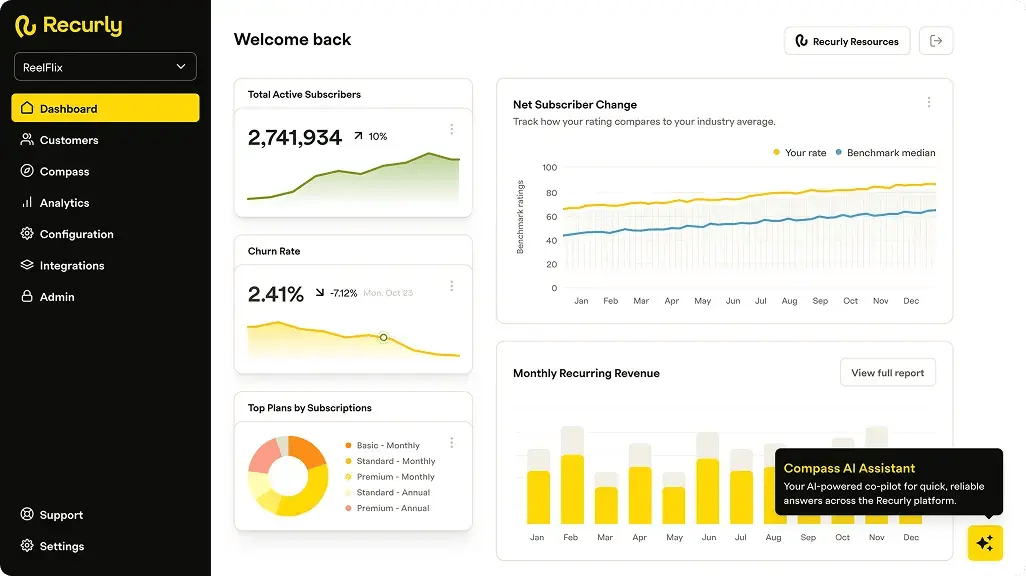
Recurly's Dashboard
Recurly is a gateway-agnostic subscription billing platform. Recovery is its hero pitch. It has the strongest churn-recovery reputation in the category, built on AI-driven retry logic and dunning campaigns. Its customer base skews consumer subscriptions and media (Paramount+, Twitch, Cinemark, nuuly, Scentbird), and its product suite reflects that: Recurly Commerce for Shopify-native subscriptions (sold via the All-Access for Shopify plan), Engage for lifecycle prompts, gift subscriptions, coupons, and trials, plus 140+ currencies and multi-language dunning — though multicurrency itself requires All-Access.
For consumer or DTC subscriptions, Recurly is purpose-built. That's its lane — and since August 2026 it's a lane small companies can actually enter, with a published entry plan and no volume minimum.
What Maxio does best
![Maxio Dashboard [Product Tour Screenshot]](https://baremetrics.com/hs-fs/hubfs/Maxio%20Dashboard%20%5BProduct%20Tour%20Screenshot%5D.png?width=3418&height=1790&name=Maxio%20Dashboard%20%5BProduct%20Tour%20Screenshot%5D.png)
Maxio's Dashboard
Maxio is a billing and financial operations platform for B2B SaaS: recurring and usage-based billing, CPQ, expense recognition, and the decisive feature: GAAP/IFRS-compliant revenue recognition built for ASC 606 audits. Its 2025–2026 partnership with AI-native ERP Rillet underlines the direction. Maxio is building for the CFO stack.
If your company is sales-led, invoices against negotiated contracts, and is prepping for audits or a raise, Maxio is the right category.
If you're torn between these two, check your category
Genuinely struggling to choose between Recurly and Maxio usually means the shortlist is wrong, because they optimize for different businesses. Recurly's roadmap serves consumer mechanics: recovery performance, promo stacking, gift flows, Shopify-native commerce. Maxio's serves the finance office: contract terms, rev-rec schedules, CPQ approval chains. A B2B SaaS choosing Recurly buys a world-class recovery engine and thinner finance tooling. A consumer brand choosing Maxio buys audit-grade rev-rec it may never use. Match the platform to who owns billing in your org. Growth owns it: Recurly. Finance owns it: Maxio. Nobody owns it yet: stay lighter.
Pricing compared
Both platforms publish an entry price now. That's new — Recurly restructured in August 2026, and most comparisons still describe it as quote-only.
Recurly (verified August 2026):
- Starter — $249/month plus 0.9% of billing volume, with the first $40,000 of billings included free every month. 90-day trial. No volume minimum. Includes one dunning campaign.
- All-Access — quoted at "as low as under 1%" of billing volume, billed annually, $1M billing-volume minimum. This is where multiple dunning campaigns, AI retry timing, churn prevention, and multicurrency live.
- Engage from $1,600/month; RevRec from $850/month. Enterprise onboarding fees of $1–10K are reported by third parties.
Maxio (verified August 2026):
- Grow — $599/month, up to $100K in monthly billings.
- Scale — quote-only above that. Advanced revenue management, expense amortization, metering and rating, and multi-entity support are all Scale-only. Annual payment is standard on Grow; monthly or quarterly billing is a paid add-on, which matters if you're comparing monthly platform fees.
The crossover is worth knowing. Below roughly $79,000/month in billings, Recurly Starter is the cheaper platform fee — at $40K it's $249 against Maxio's $599. Above that, up to Grow's $100K ceiling, Maxio wins: $599 against Recurly's $789 at $100K. Gateway processing is separate on both.
But price isn't really the fork here, and the tier structure tells you why. Recurly's entry plan withholds the recovery tooling it's famous for; Maxio's entry plan withholds the rev-rec it's famous for. Each one publishes the rung below the one most of its buyers actually need.
Where each is heading
The 2025–26 investments confirm the split. Recurly keeps shipping into recovery and consumer surface area (Engage lifecycle prompts, Recurly Commerce for Shopify), and in August 2026 opened up a published entry tier with no minimum — a move down-market it hadn't made before. Maxio keeps building toward the CFO stack, with the Rillet partnership pointing at AI-native ERP integration. Neither is drifting toward the other's lane. Buy the trajectory, not just the feature list.
Which should you choose?
Choose Recurly if: you're a consumer subscription, media, or DTC brand; recovery is a top priority; you want gift subs, promos, and Shopify-native subscription commerce. There's no volume floor on the entry plan any more — but if recovery is the reason you're buying, budget for All-Access, because Starter includes only one dunning campaign.
Choose Maxio if: you're B2B SaaS with complex contracts and your finance team needs audit-grade revenue recognition and CPQ inside the billing system of record — noting that advanced rev rec and multi-entity sit on the quote-only Scale tier, not the published $599 one.
Choose neither (yet) if: you're an early-stage, self-serve company on Stripe with straightforward plans. Neither has a hard minimum now, but both entry tiers are deliberately limited on the capability you'd be switching for — Stripe Billing plus an analytics layer covers you for a fraction of the cost and effort.
Getting real analytics on either platform
Here's the gap both share. Their analytics see only their own data. Recurly's dashboards are decent but Recurly-only; Maxio's metrics are audit-grade but live inside the billing system. Neither answers cross-source questions, and neither is built for the operator who wants to slice churn by plan, country, and cohort in two clicks.
Baremetrics integrates natively with Recurly (alongside Stripe, Braintree, Chargebee, Apple, Google, and Shopify). Everything normalizes into one MRR view. You get the full MRR waterfall, cohort retention, LTV, unlimited saved segments, plus Forecast Plus for runway, burn rate, and CAC from your actual QuickBooks/Xero P&L. If you're mid-migration between billing systems (a common reality), a normalization layer is the only way to see the whole business in one place.