Table of Contents

Chargebee is a subscription billing and revenue management platform for SaaS and recurring-revenue businesses. The key thing to understand: Chargebee is not a payment processor. It's a billing orchestration layer that sits on top of payment gateways (40+ of them, including Stripe, Braintree, PayPal, and Adyen) and handles the subscription logic: plan catalogs, recurring invoicing, proration, trials, dunning, tax, and self-serve customer portals. You pay your gateway's processing fees plus Chargebee's platform fee.
That architecture is Chargebee's whole pitch. Because it isn't tied to one processor, you can route European transactions through one gateway and US transactions through another, or switch processors entirely without rebuilding your billing system.
Chargebee at a glance
| Dimension | Detail |
|---|---|
| Category | Subscription billing and revenue management (billing orchestration) |
| Founded | 2011; led by co-founder and CEO Krish Subramanian |
| Funding | $470M+ raised; $3.5B valuation ($250M round, February 2022, led by Tiger Global and Sequoia) |
| Payment gateways | 40+, including Stripe, Braintree, PayPal, and Adyen |
| Free tier | No self-serve free tier; qualifying startups can apply to bill \$1M free |
| Paid pricing | Flow — 0.80% of billing, or 0.65% + \$99/month on the commit variant |
| Security | PCI DSS Level 1 certified |
| Best for | SaaS with complex catalogs, global billing, and finance-owned pricing |
About the company
Chargebee was founded in 2011 and is led by co-founder and CEO Krish Subramanian. The company has raised more than $470 million, reaching a $3.5 billion valuation in a $250 million round led by Tiger Global and Sequoia (February 2022). The platform is PCI DSS Level 1 certified. That's the highest level of payment-data security compliance. Customers named in Chargebee's own case studies and announcements include Zapier, Condé Nast, Pret A Manger, and AI cloud company Lambda.
What Chargebee actually does
Chargebee automates the operational side of recurring revenue:
- Subscription lifecycle management — sign-ups, upgrades, downgrades, pauses (a smart alternative to outright cancellation), and renewals, with proration handled automatically.
- Flexible plan catalogs — flat plans, tiered pricing, usage-based and hybrid models, add-ons, coupons, and ramp deals, all configurable from the UI without engineering tickets.
- Invoicing and quote-to-cash — automated invoice generation, consolidated and advance invoicing, and quote-based workflows for negotiated B2B deals.
- Dunning and recovery — Both basic and smart dunning are included in Chargebee Billing. Cancellation and retention flows live in Chargebee Growth, a separate product whose entry tier is free to Billing customers.
- Global tax and currency — built-in multi-jurisdiction tax handling, 100+ currencies, and localized checkout.
- Self-serve portals — customers manage their own plan changes, payment methods, and invoices.
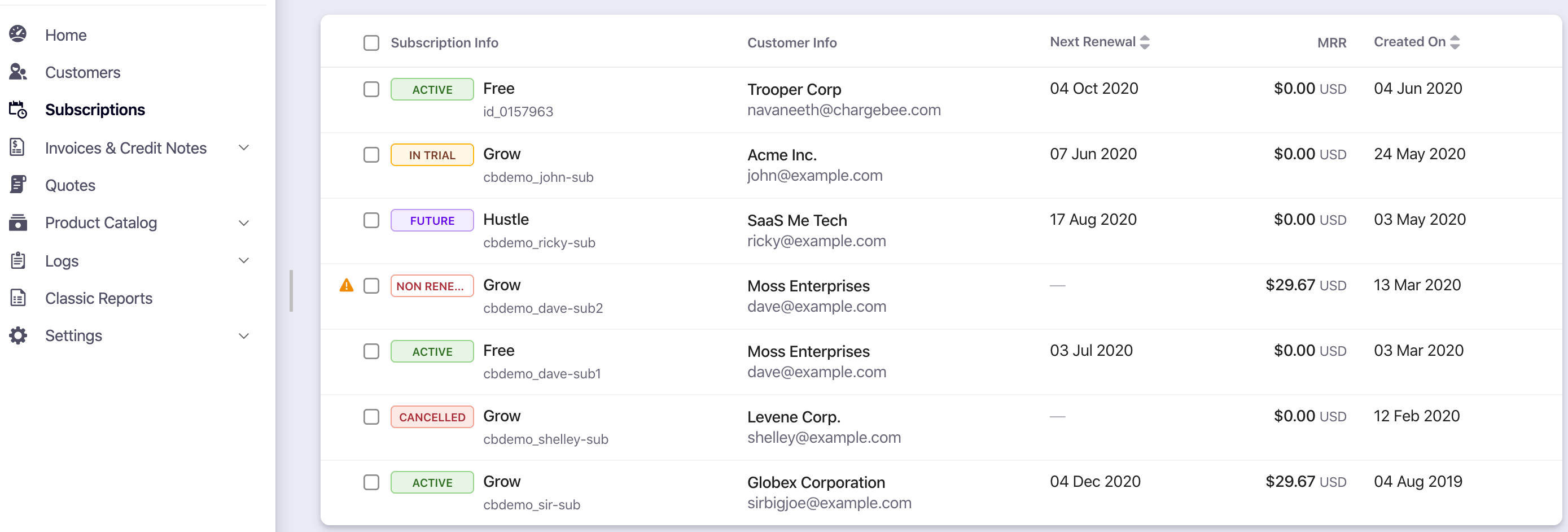
Chargebee's subscription dashboard
Product and finance teams can change pricing, run coupon campaigns, and experiment with packaging directly from the dashboard. No developer required. That's a genuine organizational advantage if RevOps or finance owns billing at your company.
What's new at Chargebee in 2026
Two developments stand out this year. In May 2026, Chargebee named Avalara its preferred partner for global e-invoicing and live tax reporting, embedding country-specific compliance directly into the billing lifecycle. And Chargebee is pushing hard into AI monetization: usage billing on tokens, API calls, and agent workflows, aimed at AI-native pricing models. Both moves deepen the same thing — billing operations. Neither adds subscription analytics, which remains the layer you bring separately.
Chargebee pricing in 2026
Chargebee retired the Starter / Performance / Enterprise tiers. Billing now has two plans.
-
Flow: the only self-serve plan, in two variants. Pay-as-you-go is 0.80% of monthly billing value with no platform fee. Commit-monthly is 0.65% plus a $99/month platform fee. Both include 100M usage events per month, 40+ gateway integrations, and both basic and smart dunning. The commit variant overtakes pay-as-you-go at about $66,000/month in billing value.
-
Enterprise Plus: quote-only. Adds multi-entity management, account hierarchies, contract terms, SAML, and native data export to GCS, Amazon S3, Snowflake, and BI tools.
-
Startup program: qualifying startups bill free until their first $1 million in cumulative billing, then move to pay-as-you-go with no annual commitment. It's an application, screened on funding raised and current billing volume, not a self-serve tier.
-
Separate products: CPQ (Lite free for the first 50 quotes), RevRec, and Growth are priced separately, and all of them require Chargebee Billing underneath.
Who Chargebee is for
Chargebee earns its platform fee when your billing is genuinely complex: plan families, hybrid usage models, frequent pricing experiments, sales-led deals with custom terms, or multi-gateway strategies. If your catalog is two or three flat plans on Stripe, Stripe Billing gets you there faster and cheaper. Chargebee is an implementation project. That's fine if you're buying it for the long haul.
Where Chargebee falls short: analytics
Chargebee's reporting is better than it usually gets credit for. RevenueStory ships with Billing and covers MRR movement, revenue and subscription churn as separate metrics, net dollar expansion, churn and MRR growth cohorts, and 150+ prebuilt reports.
The limits are structural rather than feature-based. It reports on Chargebee data only, so revenue running through Stripe, the app stores, or any other rail sits outside it entirely. Dashboards are role-gated to Admins, Owners, and Finance Executives. And there's no financial layer (no P&L, runway, or burn, and no QuickBooks or Xero connection) so forecasting that blends billing data with actual company financials has no equivalent at any tier.
Pairing Chargebee with Baremetrics
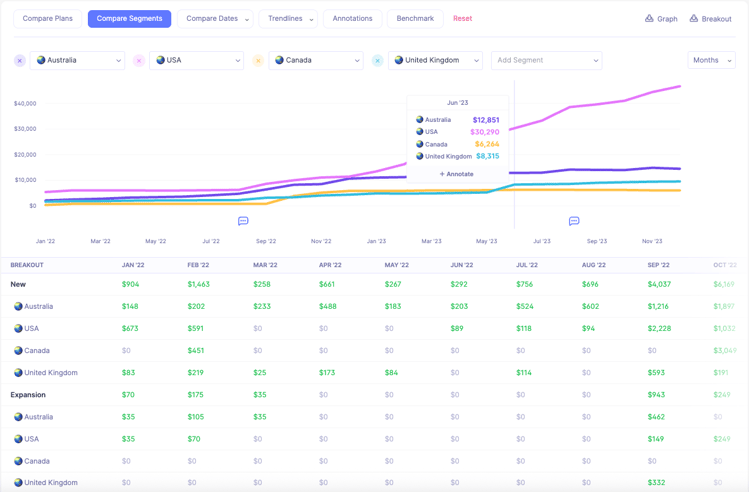
Comparing segments in Baremetrics
Baremetrics connects natively to Chargebee and turns your billing data into 26 subscription metrics (MRR, churn, LTV, ARPU, expansion revenue, cohorts) in one live dashboard. No exports or BI tooling required.
If you run the common Stripe-plus-Chargebee architecture, Baremetrics normalizes both sources into a single MRR view. And where Stripe, Braintree, or Recurly is the gateway underneath, Recover chases failed payments at a flat, published $129/month — the median customer earns back roughly 8× its cost in a month, per our May 2026 recovery benchmark.