
Table of Contents

Chargebee and Zuora are not really competing for the same buyer. Chargebee is billing orchestration for mid-market subscription companies. Zuora is an enterprise quote-to-cash monetization suite built for organizations like GM, The New York Times, and Caterpillar. If both are genuinely on your shortlist, one of them is probably wrong for you, and this post is meant to help you work out which.
What you're actually weighing is how much platform, at what implementation cost, and whether the heavier option solves problems you have today.
At Baremetrics, we integrate natively with Chargebee and we're not in the running against either of these for billing. That's roughly why we can compare these two solutions to help you make the best decision for your business.
Teams evaluating these two are usually trying to solve for:
- Pricing that their current billing setup can't express — usage, tiers, ramps, bundles, conditional logic
- Revenue recognition that will survive an audit
- Multi-entity, multi-currency, or multi-gateway operations across regions
- Getting off a system where finance rebuilds the same reports by hand every month
Before you migrate billing: if what you actually need is clean MRR, churn, and cohort retention, that's an analytics layer on the billing you already run — not a replacement for it. See how Baremetrics works with Chargebee.
The core difference
Chargebee is a billing orchestration solution that sits on top of payment gateways. It doesn't process payments. Stripe, PayPal, or whichever gateway you use still moves the money, and you still pay them processing fees. Chargebee runs the subscription layer above: catalogs, proration, invoicing, tax, dunning, renewals — across more than 40 gateways with per-region routing.
Zuora is an enterprise monetization suite covering the full quote-to-cash cycle. CPQ, billing, collections, and revenue recognition, with 50+ charge models and 180 currencies. Zuora's founder coined the phrase "Subscription Economy," and the company serves 1,000+ enterprise customers including GM, The New York Times, Caterpillar, Zoom, and Box.
The practical translation: Chargebee is something a mid-market team configures over weeks. Zuora is something an enterprise implements over months, usually with a systems integrator.
Chargebee
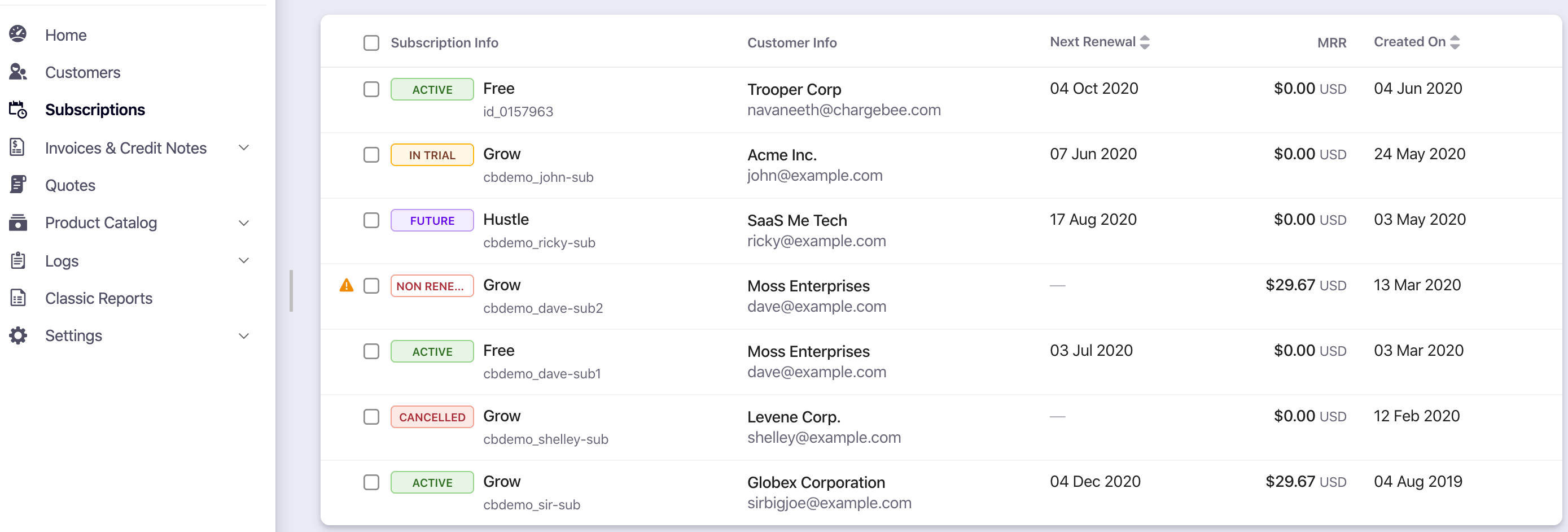
Chargebee's subscription tab
Where it's strong
Catalog flexibility. Chargebee handles tiered, usage-based, hybrid, ramp deals, and plan families all natively without custom engineering. This is the most consistent reason teams cite for adopting it.
Gateway independence. More than 40 gateways with per-region routing lets you optimize authorization rates by market and avoid processor lock-in. There is no processor-native billing product that can match this structurally.
Bundled tax and global handling. Multi-jurisdiction tax built in, 100+ currencies, localized checkout.
Time to value. Faster than Zuora by a wide margin. Still a project, but a mid-market-sized one.
Where it's limited
The analytics ceiling is scope, not capability. RevenueStory ships with Billing and reports MRR movement, revenue and subscription churn separately, churn cohorts, net dollar expansion, and saved segments. The limits are narrower than most comparisons claim: Chargebee data only, dashboards restricted to Admins, Owners, and Finance Executives, and no P&L layer, which means no runway, burn, or accounting connection. Warehouse export is Enterprise Plus only.
Recovery is split across two products. Cancellation and retention tooling isn't part of Chargebee Billing. It sits in Chargebee Growth, which is free at Starter for existing Billing customers. However, Enterprise custom-priced on active subscriber count does not have a published figure.
Revenue recognition is less mature than Zuora's. Available and custom-priced, but not built for the same complexity ceiling.
Pricing
Chargebee repriced billing in 2026. The Starter / Performance / Enterprise model is retired, along with the $250,000 cumulative lifetime threshold it used to carry. Billing now has two plans. Flow is the published one, in two variants:
- Pay as you go — 0.80% of monthly billing value, no platform fee.
- Commit monthly — 0.65% of monthly billing value plus a $99 platform fee.
- Both include 100M usage events per month and connect to 40+ gateways. Basic and smart dunning are both included. The two variants cross over at $66,000 in monthly billing value; below that pay-as-you-go is cheaper, and Chargebee's own calculator says so.
- Enterprise Plus — the second Billing plan, quote-only. Adds native data export to Google Cloud Storage, Amazon S3, Snowflake, and BI stacks, plus SAML. Flow has neither.
- Everything else prices separately. CPQ Lite is free for 50 quotes and the full tier is quote-only. Revenue recognition is quote-only at both its tiers. Chargebee Growth handles cancellation and retention — free at Starter, Enterprise quote-only. All three entry tiers require you to be a Chargebee Billing customer.
All of this sits on top of gateway processing fees.
Zuora
![Zuora Customer Insights Tab [2026]](https://baremetrics.com/hs-fs/hubfs/Zuora%20Customer%20Insights%20Tab%20%5B2026%5D.jpeg?width=1200&height=675&name=Zuora%20Customer%20Insights%20Tab%20%5B2026%5D.jpeg)
Zuora's overview dashboard
The 2026 context first: Zuora was taken private on February 14, 2025, acquired by Silver Lake and GIC at $10.00 per share in a deal valuing it around $1.7B, and delisted from the NYSE. Tien Tzuo remained CEO. If you're evaluating Zuora now, you're evaluating a private-equity-owned company rather than a public one. Most comparison articles still describe it as publicly traded.
Where it's strong
Complex monetization. This is Zuora's genuine advantage and it isn't close. Intricate multi-tier pricing, bundles, conditional logic, 50+ charge models. If your pricing has grown organically over fifteen years and nobody can fully describe it, Zuora can probably model it.
Enterprise revenue recognition. Built for the scale and scrutiny that comes with audits at large organizations.
Quote-to-cash coverage. CPQ through collections in one system, which matters when sales, finance, and billing are separate departments with separate systems today.
Multi-entity and global scale. 180 currencies, multi-entity structures, the operational complexity of a large enterprise.
Automation depth. Reviewers consistently credit it here.
Where it's limited
Steep learning curve. The same reviewers describe it as overwhelming for smaller teams. Zuora optimizes for mature, defined processes rather than iteration speed.
Implementation runs months. Typically with a systems integrator or consultants.
Cost opacity. Covered below — it's the sharpest contrast between these two.
Pricing
Zuora publishes no pricing. What's known from press materials is a dynamic model combining a flat monthly platform fee, per-unit or usage-based components, and an upfront activation fee. Reviewers consistently flag both the opacity and the total cost, including expenses that surfaced after signing.
We're not going to print a number, because there isn't a public one. Treat any article that quotes a specific Zuora price as unsourced.
Pricing transparency
This is the cleanest practical difference between the two, and it deserves its own section.
| Chargebee | Zuora | |
| Published pricing | Flow, both variants — yes. Enterprise Plus — no | No |
| Entry point | 0.80% of monthly billing value, no platform fee | Sales conversation |
| Committed rate | 0.65% plus $99/month | Not disclosed |
| Activation fee | None published | Yes — upfront, amount not disclosed |
| Can you model cost before talking to sales? | On Flow, yes. On Enterprise Plus, no | No |
If you need to put a number in a budget before you start a procurement process, that asymmetry matters more than most feature comparisons.
Implementation reality
Chargebee: a mid-market implementation project. Catalog migration, gateway configuration, and invoice testing all take real engineering time. Weeks, not days, and not an afternoon of configuration.
Zuora: months, typically with a systems integrator or external consultants. The platform is built for organizations with defined, stable processes — which is a strength at enterprise scale and a liability if you're still changing your pricing every two quarters.
One thing worth factoring into a multi-year decision: Stripe acquired Metronome in January 2026, specifically to close its usage-based and complex-billing gap. Stripe didn't disclose the price, which was reported at roughly $1B. That doesn't change what's true today. But if the reason you're considering either platform is usage-based pricing, that gap is closing.
Comparison table
| Chargebee | Zuora | |
| Category | Billing orchestration | Enterprise quote-to-cash suite |
| Typical buyer | Mid-market subscription business | Large enterprise |
| Processes payments | No — orchestrates 40+ gateways | No — integrates with gateways |
| Complex catalogs | Strong | Strongest — 50+ charge models |
| CPQ | No | Yes |
| Revenue recognition | Separate product, quote-only | Core strength, enterprise-grade |
| Currencies | 100+ | 180 |
| Dunning / recovery | Basic and smart dunning both included in Billing; Growth product for cancellation and retention, price unpublished | Collections included in suite |
| Published pricing | Flow yes; Enterprise Plus no | No |
| Implementation | Weeks — mid-market project | Months, typically with an SI |
| Ownership | Independent | Private — Silver Lake and GIC since Feb 2025 |
| Cohort retention reporting | Churn cohorts in RevenueStory, Chargebee data only | Requires BI layer |
| Native Baremetrics integration | Yes | No — open API only |
Neither one is a full analytics layer
This is the part most comparisons skip, and it's the most common source of buyer's remorse on both sides.
Chargebee's RevenueStory is included with Billing and it does report subscription metrics properly: for example, MRR movement, churn by revenue and by subscription, churn cohorts, and net dollar expansion. Zuora is the opposite case; deployments generally sit under a BI layer someone has to build and maintain.
What neither gives you is revenue that lives outside the billing system. Chargebee's analytics see Chargebee, and consolidating even multiple Chargebee sites is a premium feature requiring a support ticket. Neither has a financial layer either, which means no P&L ingestion, runway, or burn rate. And Chargebee's dashboards are visible only to Admins, Owners, and Finance Executives.
If part of your reason for migrating billing was "and then we'll finally understand our retention," that's worth examining before you sign. A billing migration is an expensive way to solve a reporting-scope problem.
If you're under ~$10M ARR, read this before migrating
A lot of people comparing Chargebee and Zuora are earlier than either platform's real buyer. If you're on Stripe under roughly $10M ARR and wondering whether you need Zuora, you almost certainly don't yet. What you usually need is visibility (like metrics, forecasting, and churn recovery) and that's a layer on your existing stack rather than a billing migration.
On the billing you already run, that means:
- MRR movement by day — new, expansion, reactivation, contraction, churn, each clickable to the customer and event behind it
- Cohort retention tables, live — across every source, not just the billing system
- Unlimited stacked segmentation and saved dashboards — by plan, price point, cadence, country, custom attributes, or synced HubSpot properties
- Forecast+, included with any paid plan — QuickBooks or Xero P&L ingestion producing runway, burn rate, CAC, and budget variance alongside subscription metrics
- Recover — $129/month flat and published, up to seven fully customizable emails, branded billing widget, in-app banner into paywall, and SMS. Per our May 2026 recovery benchmark, the median customer earns back roughly 8× its cost within a month. Recover works with Stripe, Braintree, and Recurly — so it applies if one of those is the gateway under your Chargebee layer, and not if Chargebee is routing you elsewhere or you're on Zuora.
Setup is minutes on Stripe, and there's no implementation project.
How to choose
Chargebee if you're mid-market, you need gateway flexibility or multi-region routing, your pricing involves usage or tiers or ramps that your processor can't express, and you want published pricing you can model before entering a sales cycle.
Zuora if you're a large enterprise with genuinely complex monetization, you need CPQ and enterprise-grade revenue recognition in one system, you operate multi-entity across many currencies, and you have the internal resources plus an implementation budget to do it properly.
Neither, yet, if you're under $10M ARR on Stripe with reasonably straightforward plans. Stripe Billing likely covers what you do, and the gap you're feeling is probably analytics rather than billing.

