Table of Contents

Chargebee is a strong subscription billing platform. But it isn't right for everyone. The most common reasons teams look elsewhere in 2026: Chargebee's 2026 repricing, which charges a percentage of billing from the first dollar on the self-serve path; fees that are additive to whatever your gateway already takes; implementation lift; and reporting that only ever sees Chargebee data.
Here's the honest map. One clarification saves a lot of confused evaluations: analytics platforms like Baremetrics aren't Chargebee alternatives. They're the layer that sits on top of whichever billing system you choose.
Quick answer: the top Chargebee alternatives
- Stripe Billing: best if you're already on Stripe and your catalog is simple. Billing built directly into the processor: 0.7% of Billing volume pay-as-you-go, or four annual tiers — $620 up to $100K/month, $1,500 up to $250K, $2,950 up to $500K, $5,750 up to $1M — each with 0.67% on volume above the cap. Its ~$1B Metronome acquisition (January 2026) signals serious investment in usage-based pricing, historically its weak spot. The trade-off: Stripe only, with no multi-gateway flexibility.
- Recurly: the closest like-for-like alternative: gateway-agnostic subscription management with a strong reputation for dunning and involuntary-churn recovery. A natural shortlist companion if recovery performance is your top criterion.
- Maxio (formerly Chargify + SaaSOptics): built for B2B SaaS with complex, sales-led billing: usage-based models, quote-to-cash, and finance-grade revenue recognition in one platform. Published from $599/month up to $100K in monthly billings, with advanced rev rec and multi-entity on a quote-only tier above that; aimed at companies with real RevOps needs.
- Zuora: the enterprise heavyweight. Deep revenue recognition, multi-entity support, and CPQ for large, complex organizations. Expect enterprise sales cycles and implementation timelines to match.
- Paddle: a different architecture entirely: a merchant of record that handles payments, global sales tax, and compliance for you. Attractive for lean teams selling globally; the trade-off is less control and an all-in fee structure.
How they compare
| Platform | Model | Best for | Key trade-off |
|---|---|---|---|
| Chargebee | Billing orchestration on 40+ gateways | Flexible catalogs, self-serve + sales-led mix | Fees additive to processing; reporting sees Chargebee data only |
| Stripe Billing | Billing inside the processor | Stripe-native teams, simple plans | Stripe-only lock-in |
| Recurly | Gateway-agnostic subscription management | Dunning and recovery focus | Narrower finance tooling than Maxio/Zuora |
| Maxio | Billing + revenue recognition suite | B2B SaaS with quote-to-cash needs | Heavier implementation and cost |
| Zuora | Enterprise revenue platform | Large multi-entity organizations | Enterprise price and complexity |
| Paddle | Merchant of record | Lean teams selling globally | Less control; all-in fees |
The alternatives in depth
Stripe Billing
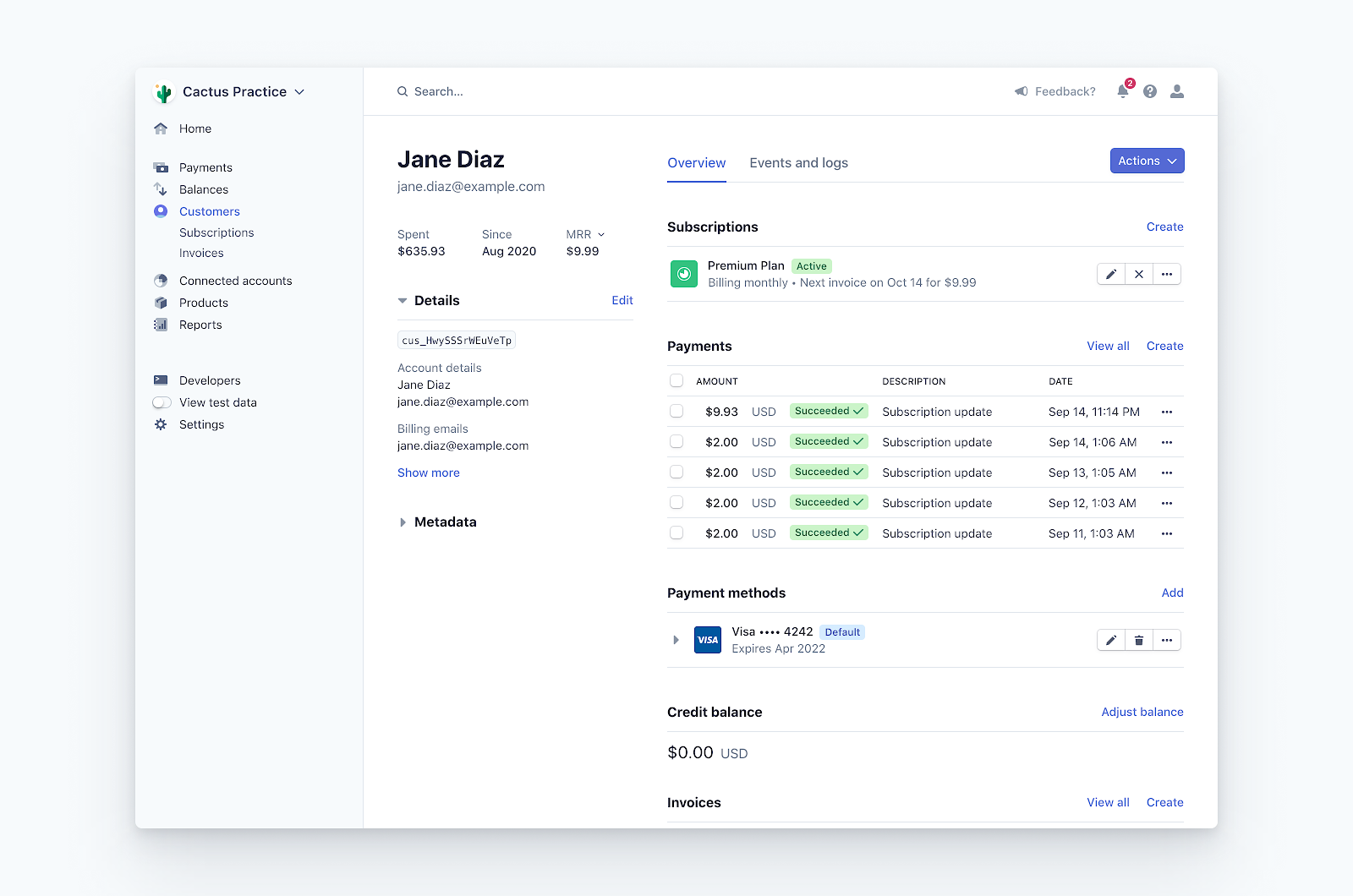
Customer view within Stripe Billing
Stripe Billing is billing built into the processor: plans, proration, invoicing, a hosted customer portal, Smart Retries, and 135+ currencies. Already on Stripe? It's an activation, not a migration.
Pricing: 0.7% of Billing volume pay-as-you-go, or four annual tiers paid monthly on a 1-year contract ($620 up to $100K/month, $1,500 up to $250K, $2,950 up to $500K, $5,750 up to $1M) each with 0.67% on additional volume. Stripe states savings of 11% to 18% against pay-as-you-go. The reported ~$1B Metronome acquisition (January 2026) is aimed at its historic weak spot, usage-based pricing.
Caveats: Stripe only. No multi-gateway routing, no processor leverage in negotiations. And complex catalogs (ramps, hybrid usage, plan families) take more custom code than Chargebee.
Best for: Stripe-native teams with simple catalogs, especially under ~$50K MRR.
Recurly
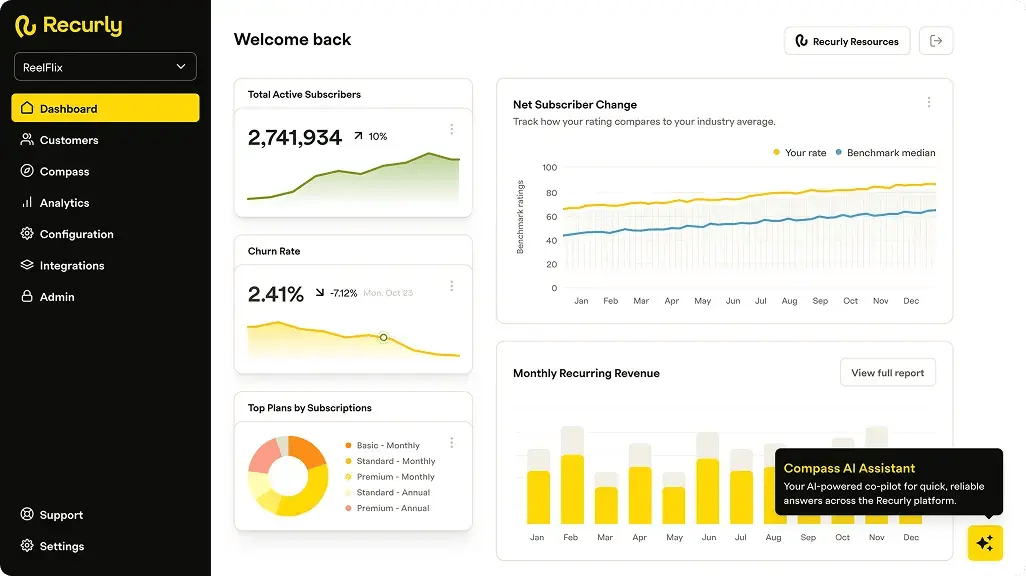
Recurly's Dashboard
Recurly is the closest like-for-like swap: gateway-agnostic billing orchestration with a platform fee additive to your gateway's fees. Recovery is its hero pitch. AI retry timing and dunning campaigns lead the marketing ("billions recovered"), and the customer roster (Sling, Twitch, BarkBox, FabFitFun, Paramount) skews consumer subscriptions and media.
Pricing: Starter is $249/month plus 0.9% of billing volume, with the first $40,000 of billings included free every month and a 90-day free trial. There's no volume minimum. Above that, All-Access is quoted "as low as under 1% of billing volume," billed annually, and carries a $1M billing-volume minimum. Add-ons are published too: Engage from $1,600/month, RevRec from $850/month.
Caveats: The platform fee is additive to your gateway's processing fees, and the entry tier is deliberately limited on Recurly's own headline strength — Starter includes just one dunning campaign, with multiple campaigns and AI-driven churn prevention reserved for All-Access. Multicurrency is All-Access too. And its analytics see only Recurly data.
Best for: Consumer or DTC subscription businesses where recovery performance is the deciding factor — now viable at small scale too, though the strongest recovery tooling sits on All-Access.
Maxio
![Maxio Dashboard [Product Tour Screenshot]](https://baremetrics.com/hs-fs/hubfs/Maxio%20Dashboard%20%5BProduct%20Tour%20Screenshot%5D.png?width=3418&height=1790&name=Maxio%20Dashboard%20%5BProduct%20Tour%20Screenshot%5D.png)
Maxio's Dashboard
Maxio is Chargify plus SaaSOptics, merged in April 2022. It's the CFO-stack option: recurring and usage-based billing, CPQ, expense recognition, and audit-ready ASC 606 / IFRS 15 revenue recognition. At merger, the combined company reported $10B+ in ARR under management across 2,300+ customers.
Maxio publishes an entry price: Grow at $599/month, covering up to $100K in monthly billings. Above that, Scale is quote-only. The tier split matters more than the price: advanced revenue management, expense amortization, metering and rating, and multi-entity support are all Scale-only, so if rev rec or multi-entity consolidation is the reason you're looking at Maxio, you're in quote-only territory. Expect an annual contract and a real implementation either way.
Best for: Sales-led B2B SaaS invoicing against negotiated contracts, where revenue recognition drives the decision.
Zuora
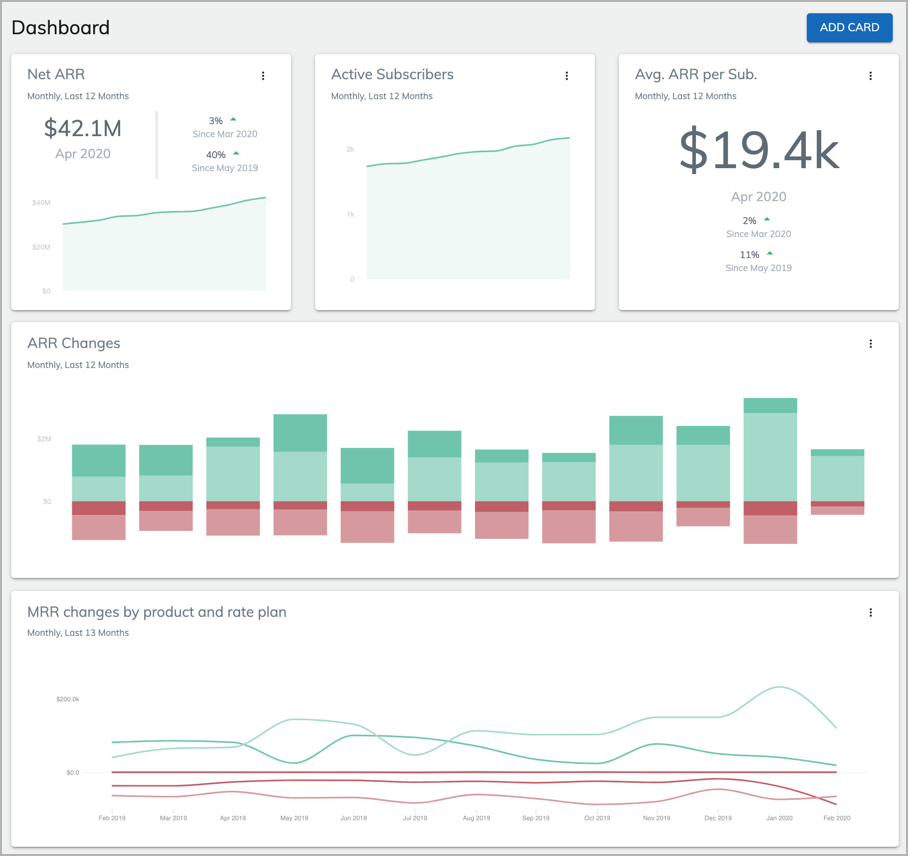
Zuora's Dashboard
Zuora is the enterprise heavyweight: subscription billing, revenue recognition, and CPQ for large, multi-entity organizations with complex product lines. It handles scale most platforms can't. The trade is everything that comes with enterprise software: quote-based pricing, long sales cycles, and implementation timelines measured in quarters, not weeks.
Best for: large organizations with multi-entity billing and dedicated RevOps teams. If Chargebee's entry tiers fit your budget, Zuora is almost certainly too much platform.
Paddle
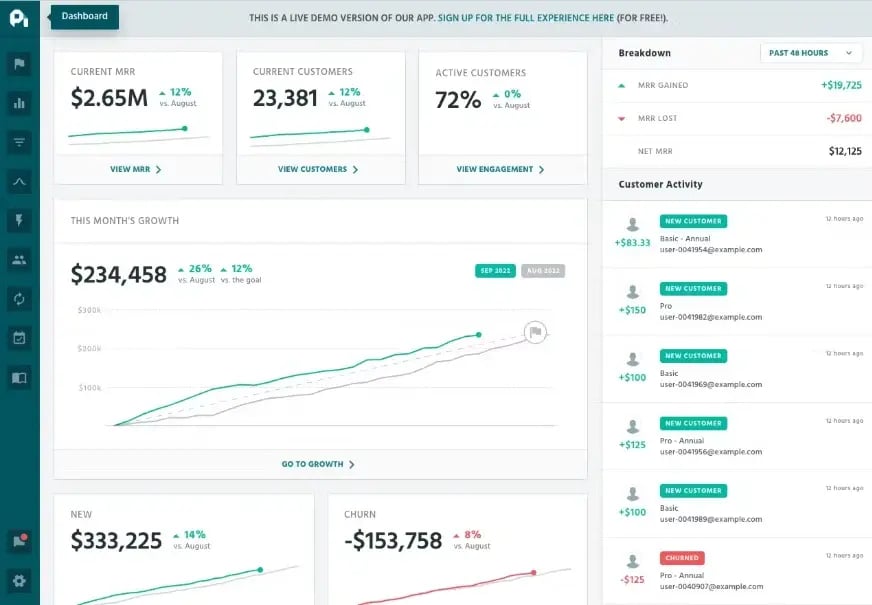
Paddle's Dashboard
Paddle isn't a billing layer at all; it's a merchant of record. Paddle is legally the seller: it processes the payment, calculates and remits global sales tax, and absorbs compliance liability. You get one all-in fee per transaction instead of a stack of gateway, billing, and tax vendors.
The trade-offs are real. Less checkout control, payouts on Paddle's schedule, and customer payment relationships that live with Paddle, which makes a later migration harder.
Best for: lean global software teams that would rather delete the tax-and-compliance problem than manage it.
How to choose
Stay on Chargebee if you're using its flexibility (plan families, hybrid pricing, multi-gateway routing) and finance or RevOps owns billing. That's what the platform fee buys.
Choose Stripe Billing if you're already on Stripe with a simple catalog. It now wins on cost at almost every volume — Chargebee's 2026 repricing put both platforms on a percentage model, and Stripe's is the lower one, so the gap widens rather than closes as you scale. Chargebee only edges ahead in a narrow band near $200K/month in billing. Choose on architecture, because price has stopped being the tiebreaker.
Choose Recurly if failed-payment recovery is the deciding factor and you want gateway independence.
Choose Maxio or Zuora if quote-to-cash and revenue recognition drive the decision — Maxio for growth-stage B2B SaaS, Zuora at enterprise scale.
Choose Paddle if you'd rather outsource tax and compliance entirely and can accept the merchant-of-record trade-offs.
Whatever you pick, the analytics gap follows you
Reporting varies more than you'd expect across these five, but the same gap runs through all of them: each one only sees its own data. Chargebee's RevenueStory and Recurly's built-in dashboards both cover MRR, churn, and cohorts perfectly well — for the revenue flowing through that platform. The moment you run a second rail, keep a legacy Stripe account through a migration, or want billing numbers sitting next to your P&L, none of them can show you the whole business.
Baremetrics solves that layer regardless of your billing choice, with native integrations for Chargebee, Stripe, Recurly, and more — 26 subscription metrics calculated automatically in one live dashboard. Where Stripe, Braintree, or Recurly is the gateway underneath, Recover automates failed-payment recovery at a flat, published $129/month; the median customer earns back roughly 8× its cost in a month, per our May 2026 recovery benchmark.