Table of Contents

Both Chargebee and Recurly do the same fundamental job: billing orchestration on top of payment gateways. Neither processes payments. Both sit above Stripe, Braintree, Adyen, PayPal, and others. Both charge a platform fee on top of your gateway's processing fees.
Teams comparing them are usually wrestling with:
- Pricing catalogs (usage, tiers, hybrids, ramps) that have outgrown simple plan billing
- Failed payments eating a meaningful share of churn with no owned recovery process
- Global expansion — multi-currency, multi-gateway routing, localized tax
- Pricing that both platforms restructured in 2026, leaving most published comparisons describing plans that no longer exist
The decision comes down to fit: business model, pricing model economics, and where each platform is strongest.
Already on Chargebee or Recurly? Baremetrics connects natively to both — one MRR view, no exports.
Chargebee vs. Recurly at a glance
| Dimension | Chargebee | Recurly |
|---|---|---|
| Sweet spot | B2B SaaS, complex catalogs, global tax | Consumer subscriptions, media, DTC |
| Gateways | 40+, per-region routing | 20+ |
| Catalog flexibility | ✅ Mature — usage, hybrid, ramps, plan families without custom code | ✅ Strong, especially consumer promo mechanics |
| Failed-payment recovery | Basic and smart dunning included; retention flows in Chargebee Growth | ✅ Hero feature — but Starter includes just 1 dunning campaign; AI retries need All-Access |
| Tax / global | ✅ Built-in multi-jurisdiction tax, 100+ currencies, localized checkout | 140+ currencies, multi-language dunning |
| Entry pricing | ✅ Published: 0.80% of billing, no platform fee, no contract | ✅ Published: Starter \$249/mo + 0.9%, first \$40K of billings free monthly, no minimum |
| Notable customers | Broad SaaS mid-market | Sling, Twitch, BarkBox, Paramount, Sprout Social |
Where Chargebee is strongest
Chargebee's core advantages: catalog flexibility and global operations. Complex pricing (tiered, usage-based, hybrid, ramp deals, plan families) works without custom code. Multi-gateway routing lets you send transactions through different gateways per region to optimize authorization rates. Tax handling is bundled: multi-jurisdiction logic, 100+ currencies, localized checkout.
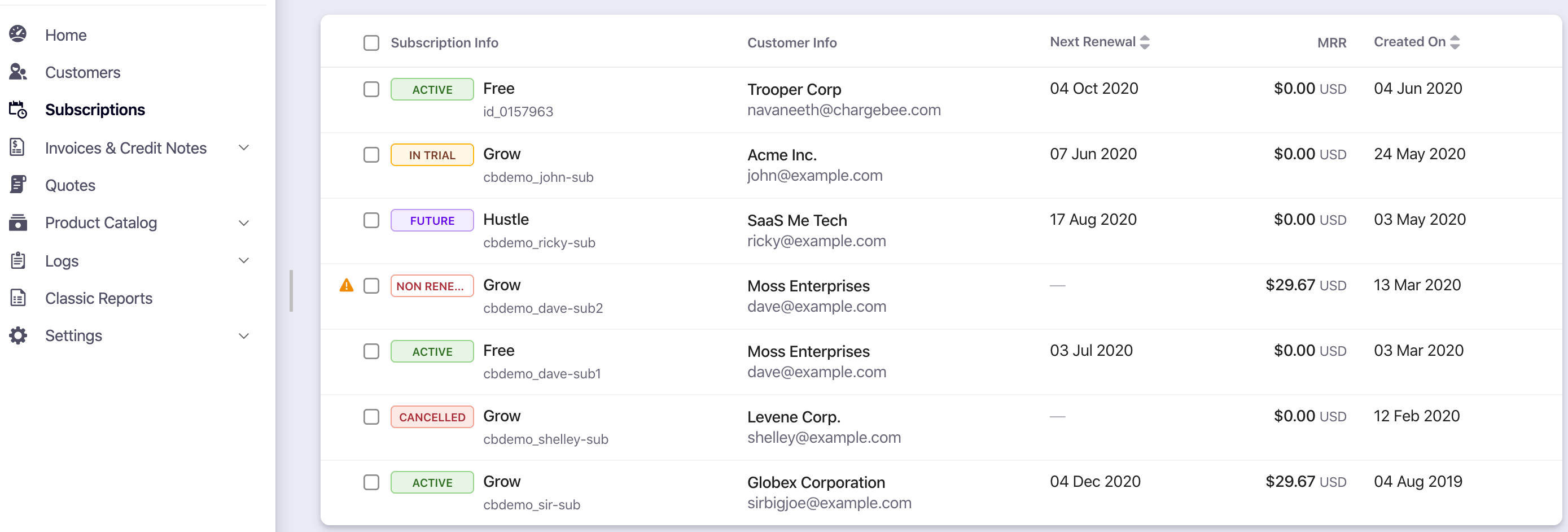
Chargebee's Subscription Dashboard
Two realistic caveats. Implementation is a project, not an afternoon. And while RevenueStory ships with Billing and handles MRR movement, churn, and cohorts, it only ever sees Chargebee data — with no P&L or runway layer at any tier.
Where Recurly is strongest
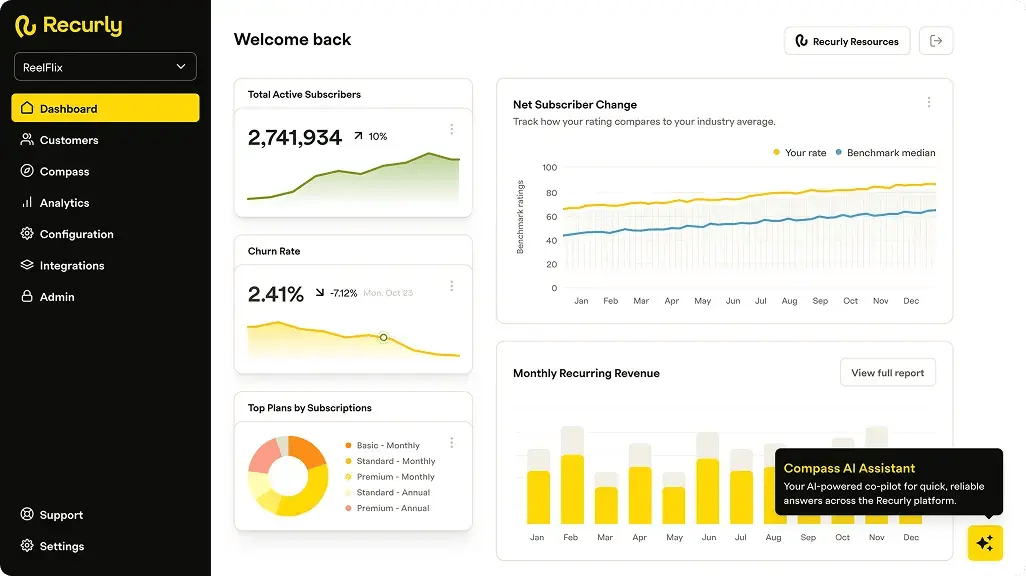
Recurly's Dashboard
Recurly's flagship strength is churn recovery. AI-driven retry logic and dunning campaigns are its lead claim ("billions recovered"). Its customer roster (Sling, Twitch, BarkBox, FabFitFun, Paramount) tells you its center of gravity: consumer subscriptions and media. Purpose-built consumer features follow: gift subscriptions, box-model mechanics, a Shopify-native product now called All-Access for Shopify, priced on billing volume, Engage for lifecycle prompts from $1,600/month, and 140+ currencies with multi-language dunning.
The caveats: the strongest recovery tooling (with AI retry logic, multiple dunning campaigns, intelligent churn prevention) sits on All-Access, not the Starter tier, so the feature you'd buy Recurly for is partly gated behind its \$1M billing-volume minimum. Multicurrency is All-Access too. And its analytics see only Recurly data.
Same architecture, different bets
Both are billing layers, so watch where each invests. Chargebee's 2026 moves point at global operations and new pricing models: a May 2026 Avalara partnership embeds e-invoicing and live tax reporting into the billing lifecycle, and its releases push usage billing for AI products (tokens, API calls, agent workflows). Recurly keeps doubling down on its recovery engine and consumer surface: Engage lifecycle prompts and the Shopify-native Commerce product. Neither is wrong. But if your roadmap is global B2B expansion, Chargebee's bets track yours. If it's consumer retention at scale, Recurly's do.
Pricing compared (the part everyone gets wrong)
Chargebee:
- Flow — The only self-serve plan, in two variants: pay-as-you-go at 0.80% of monthly billing value with no platform fee, or commit-monthly at 0.65% plus $99/month. Both include 40+ gateways and both basic and smart dunning. The variants cross over around $66K/month.
- Enterprise Plus — Quote-only, adding multi-entity, contract terms, SAML, and warehouse export.
- Startups — Qualifying companies can apply to bill their first $1M free.
Recurly: Starter at $249/month plus 0.9% of billing volume, with the first $40,000 of billings included free every month and a 90-day trial. There is no volume minimum. Above that, All-Access is quoted "as low as under 1%" of billing volume, billed annually, with a $1M billing-volume minimum. Add-ons publish too: Engage from $1,600/month, RevRec from $850/month.
The honest read: Both publish entry pricing now, and which one is cheaper depends entirely on where you sit.
Because Chargebee charges a pure percentage with no platform fee while Recurly charges $249 plus a percentage on billings above a free $40K, the answer flips twice as you grow. Below roughly $31,000/month in billing, Chargebee is cheaper — you're not paying a platform fee at all. Between roughly $31,000 and $84,000, Recurly's free $40K allowance makes it the cheaper option. Above $84,000, Chargebee's commit variant pulls back ahead. At $100K/month the three options land within about $50 of each other: $749 on Chargebee commit, $789 on Recurly Starter, $800 on Chargebee pay-as-you-go.
Gateway processing is separate and identical either way, so it cancels out. Model your own numbers before signing anything annual — and note there's a real gap in Recurly's ladder between Starter and All-Access's $1M floor, which is where its "we'll build the right structure for you" language comes in.
How to model the real cost
Quote-shaped pricing rewards a five-line model.
-
Line one: gateway processing fees at your volume, identical either way.
-
Line two: the platform fee — Chargebee's 0.80% (or 0.65% plus $99) against Recurly's $249 plus 0.9% above the free $40K.
-
Line three: implementation, in engineering weeks.
-
Line four: the add-ons you'll actually buy (Chargebee Growth, RevRec, or on the Recurly side Engage from $1,600/month and RevRec from $850/month).
-
Line five: expected recovery lift, in dollars, from whichever dunning setup you'd run.
Total both columns over 24 months. The winner is rarely obvious from the pricing pages, which is the point.
Which should you choose?
Choose Chargebee if: you're B2B SaaS with a complex or evolving pricing catalog, you're expanding globally and want bundled tax, or you're early enough that published $0-entry pricing matters.
Choose Recurly if: you're a consumer subscription or media business at scale, involuntary churn is a top-three problem, and you want the category's most battle-tested recovery engine plus DTC-native features.
The analytics gap both share
Both platforms report on their own data. Only their own data. Chargebee's RevenueStory and Recurly's built-in dashboards both handle MRR, churn, and cohorts competently — each for its own platform's data only.
Neither does financial forecasting, and neither normalizes across sources if you're running (or migrating between) multiple billing systems.
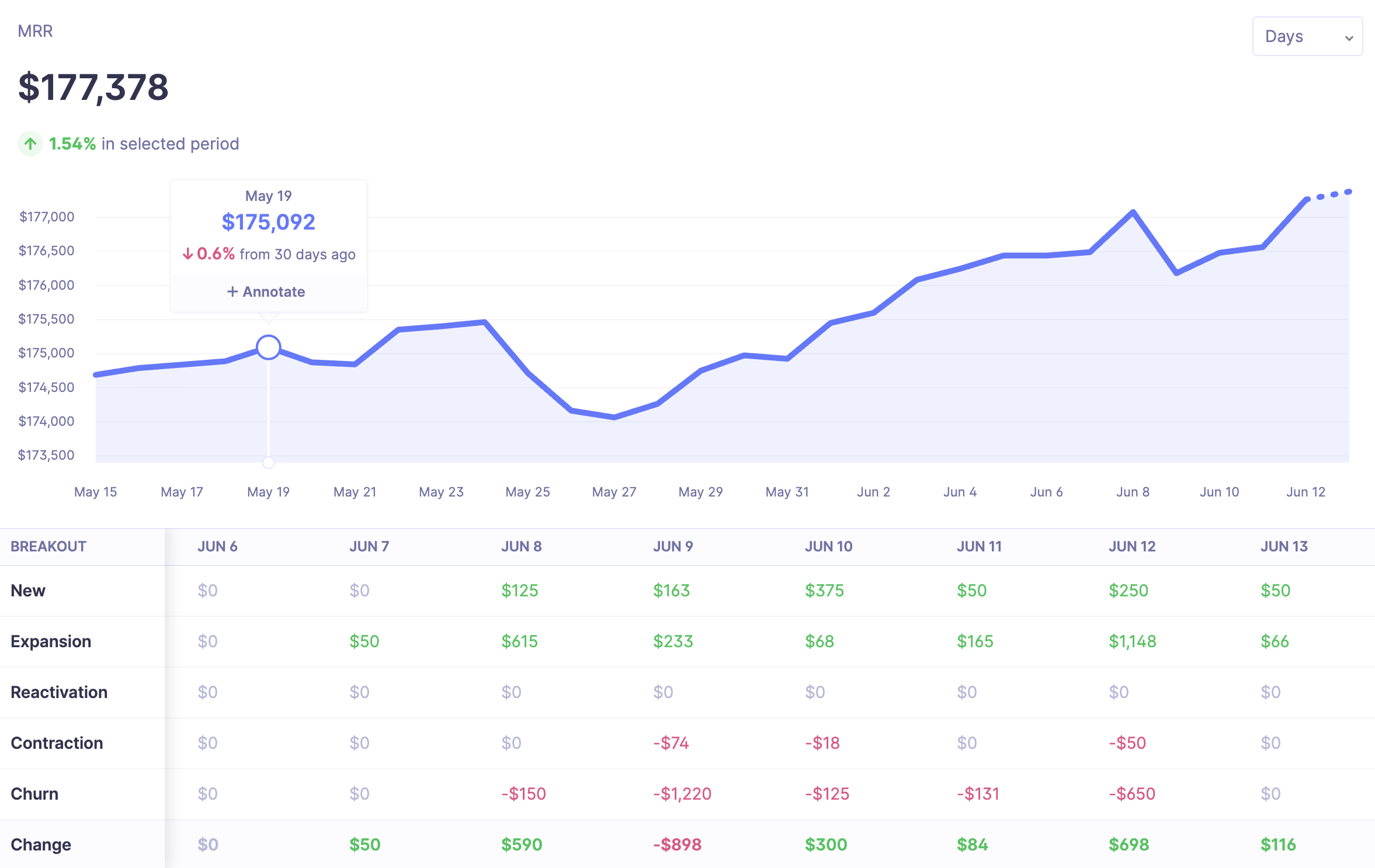
Baremetrics integrates natively with both Chargebee and Recurly (plus Stripe, Braintree, Apple, Google, and Shopify) and normalizes everything into one MRR. You get the full waterfall (new, expansion, contraction, churn, reactivation), cohort retention, LTV, unlimited saved segments, and Forecast Plus (QuickBooks/Xero → runway, burn, CAC, scenario planning). Whichever billing layer wins, the metrics layer is solved. Setup takes about 30 minutes.