
Table of Contents

Stripe and Recurly don't sit at the same layer of the stack.
Stripe is a payment processor with billing built into it. Recurly is a billing platform that sits on top of payment processors — including Stripe. More than 20 gateways are supported: Stripe, Braintree, Adyen, GoCardless, PayPal, Amazon Pay. Recurly doesn't move money. Whichever processor you use still does, and you still pay them.
Which means Recurly's platform fee is additive to your processing fees, not instead of them. That distinction gets lost constantly. Any comparison that puts Recurly's percentage next to Stripe's 2.9% + 30¢ as if they're alternatives is comparing the wrong things.
It also means the honest version of this decision isn't always either/or. Running Stripe as the processor with Recurly as the subscription layer above it is a normal architecture, not a compromise.
We're Baremetrics, a subscription analytics platform that integrates natively with both Stripe and Recurly. We don't have a billing horse in this race.
Most people arrive at this comparison because they're tired of:
- Failed payments quietly draining revenue with no recovery process running
- Pricing or packaging that Stripe Billing can't express without engineering work
- Running consumer subscriptions on tooling that was clearly shaped around SaaS
- Being locked to one processor when authorization rates vary by region
- Reporting that finance rebuilds by hand every month
Whichever way you go: Baremetrics is native to both Stripe and Recurly, and normalizes multiple sources into one MRR. Start a free trial or book a call.
The architectural difference
| Stripe Billing | Recurly | |
| What it is | Billing inside the payment processor | Gateway-agnostic billing layer |
| Processes payments | Yes — it is the processor | No — 20+ gateways, fees separate |
| Processor lock-in | Stripe only | None — switch or route by region |
| Cost structure | One vendor, one bill | Platform fee on top of gateway fees |
Everything else follows from this. Stripe is simpler when you're a Stripe-native company with reasonably standard subscriptions. Recurly earns its additive cost when you need capabilities Stripe doesn't have, or independence Stripe can't offer.
Stripe Billing: pros and cons
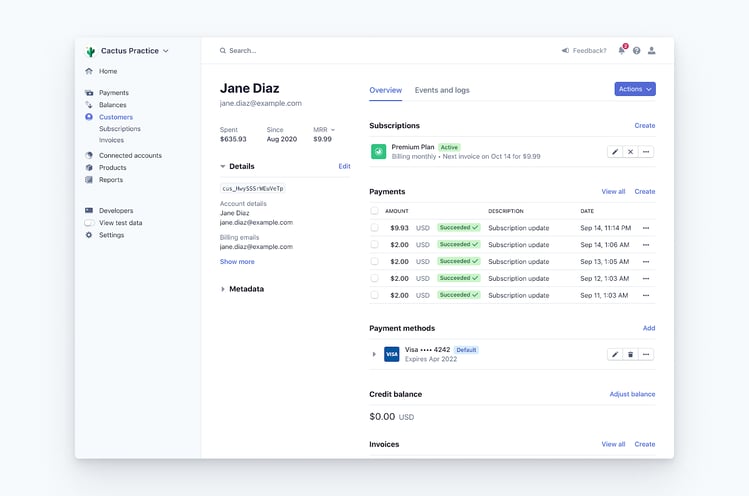
Customer subscription view in Stripe
Pros
It's already there. If you're on Stripe, turning on Billing is days-to-weeks of work, self-serve, no implementation project and no sales cycle.
Published pricing, top to bottom. Stripe publishes every tier and every volume cap, so you can model your cost at any scale before speaking to anyone.
One vendor, one bill. No platform fee stacked on processing fees, no reconciling two invoices.
Global payment coverage. 135+ currencies and 100+ payment methods.
Recovery is included, not upsold. Smart Retries ships on every Stripe Billing plan, and the ML retry logic is genuinely good.
Heavy ongoing investment. Stripe acquired Metronome in January 2026, specifically to close its usage-based and complex-billing gap. Stripe didn't disclose the price; it was reported at roughly $1B. Worth weighing in a multi-year decision: Stripe's weakest area is the one it just bought its way into.
Cons
Complex catalogs need work. Fine for straightforward plans. Intricate usage-based models, ramp deals, and conditional pricing have historically meant custom engineering. Narrowing, per the above, but true today.
Dunning communication is Stripe-branded. Smart Retries optimizes when the card gets charged again. What you don't get is a sequenced recovery campaign you write yourself.
Processor lock-in. No multi-gateway routing, no authorization-rate optimization by market.
Consumer-subscription features are thin. It works, but the product is SaaS-shaped. Gift subscriptions and box models aren't what it's built around.
Dashboards are basic. Transactions and revenue, not revenue movement. More on this below.
Recurly: pros and cons
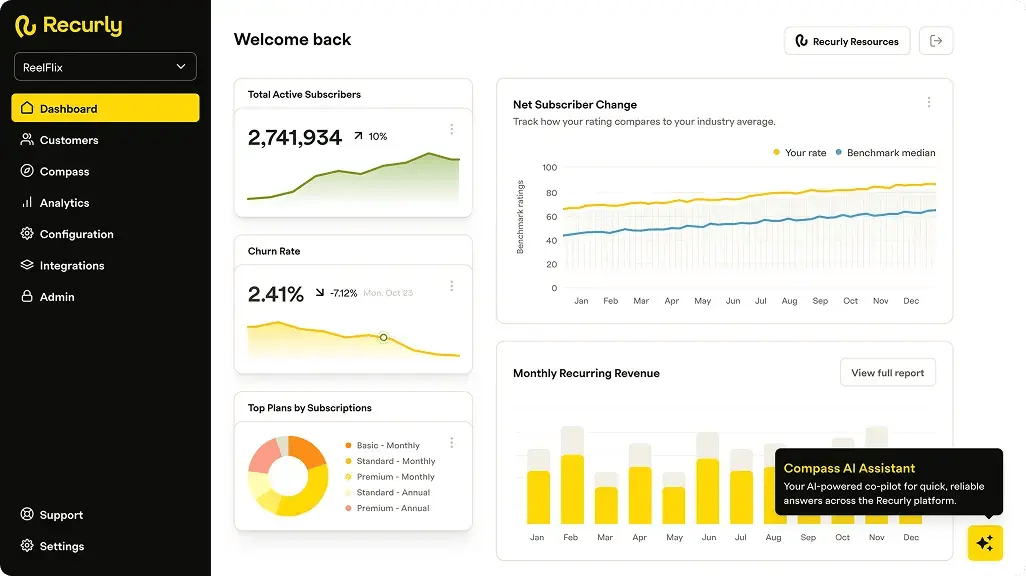
Recurly's dashboard
Pros
Failed-payment recovery. Recurly's strongest genuine advantage, and worth stating without hedging. AI-driven retry logic and dunning campaigns are what their marketing leads with, and the reputation is earned. For a high-churn consumer subscription business, recovery performance can move revenue more than anything else on this page.
Purpose-built for consumer and eCommerce subscriptions. Gift subscriptions, box-model features, trials, coupons, and promotional tooling built in rather than bolted on, plus a Shopify-native product. Their customer base leans heavily that way — Paramount+, Twitch, Cinemark, nuuly, Scentbird — though they also feature B2B SaaS names like PandaDoc and Lucid, so the product isn't only shaped around consumer any more.
Gateway independence. 20+ gateways, so you can switch processors or route by region without rebuilding billing.
Global reach. 140+ currencies and multi-language dunning emails, though multicurrency support sits on the higher tier.
Revenue recognition. RevRec handles ASC 606 and IFRS, published from $850/month.
Built-in metrics. MRR, churn, and LTV dashboards — genuinely more than a bare processor gives you.
It publishes pricing now. As of August 2026 Recurly lists its entry plan, Engage, and RevRec openly. That's new, and most comparisons haven't caught up.
Cons
The headline feature is tier-gated. This is the important one. Recurly's entry plan includes a single dunning campaign. Multiple campaigns, AI-driven retry timing, and intelligent churn prevention are all on All-Access — which carries a $1M billing-volume minimum. The thing you'd buy Recurly for is partly behind the tier most small companies can't reach.
Additive cost. Platform fee on top of whatever your processor charges.
A gap in the ladder. Between the entry plan and All-Access's $1M floor, there's no published middle. Recurly's answer is that they'll build a structure for you, which means a sales conversation.
Implementation and onboarding fees. Enterprise onboarding has been reported in the $1–10K range — third-party, not published by Recurly.
Analytics only see Recurly. Real dashboards, limited scope. If you also run a legacy Stripe account, an app store, or a second product on different rails, Recurly won't unify them.
What each one costs
Stripe Billing:
- Pay-as-you-go — 0.7% of Billing volume, on top of standard processing at 2.9% + 30¢
- Annual tiers, paid monthly on a one-year contract, each with a published volume cap and 0.67% above it: $620 to $100K/month · $1,500 to $250K · $2,950 to $500K · $5,750 to $1M. Stated savings run 11% to 18%.
- Above $1M/month, custom pricing
- Tax, Revenue Recognition, and Sigma are priced separately
(Stripe's regional pages differ — the India page shows pay-as-you-go only. Figures above are US.)
Recurly:
- Starter — $249/month plus 0.9% of billing volume, with the first $40,000 of billings included free every month. 90-day free trial. No volume minimum.
- All-Access — quoted at "as low as under 1%" of billing volume, billed annually, $1M billing-volume minimum. Adds multiple dunning campaigns, AI retry timing, churn prevention, and multicurrency.
- All-Access for Shopify — Shopify-native subscriptions, priced on billing volume
- Engage — from $1,600/month
- RevRec — from $850/month
- Plus gateway processing fees, separately
The honest cost verdict
Because Stripe charges a flat percentage and Recurly charges a fee plus a percentage above a free allowance, neither is simply cheaper. Comparing platform fees at the same billing volume — processing is identical if Stripe is the gateway underneath either way, so it cancels out:
| Monthly billing volume | Stripe Billing | Recurly Starter | Cheaper |
| $25K | $175 | $249 | Stripe by $74 |
| $40K | $280 | $249 | Recurly by $31 |
| $50K | $350 | $339 | Recurly by $11 |
| $100K | $620 (annual tier) | $789 | Stripe by $169 |
| $250K | $1,500 (annual tier) | $2,139 | Stripe by $639 |
Recurly's free $40K allowance makes it the cheaper platform fee in a band roughly between $35,000 and $55,000 a month in billing. Below that, Stripe's percentage is smaller than Recurly's base fee. Above it, Stripe pulls ahead and the gap widens with scale — and past $1M you're comparing against a quoted All-Access rate rather than a published one.
But that comparison only matters if the two products do the same job for you. If you're a high-churn consumer subscription business, Recurly's recovery tooling can plausibly recover more than the price difference. That's the real fork, and it's a question about your churn profile rather than your budget.
Comparison table
| Stripe Billing | Recurly | |
| Layer | Processor + billing | Billing on top of gateways |
| Best-fit business | SaaS, self-serve to mid-market | Consumer / media / DTC subscriptions |
| Published pricing | Yes, every tier and cap | Entry plan, Engage, and RevRec published; All-Access quoted |
| Entry cost | 0.7% of Billing volume | $249/mo + 0.9% above a free $40K/mo |
| Minimum volume | None | None on Starter; $1M on All-Access |
| Failed-payment recovery | Smart Retries — included on all plans | Core strength — but 1 campaign on Starter, AI retries on All-Access |
| Complex catalogs | Adequate; Metronome closing the gap | Good |
| Consumer subscription features | Limited | Purpose-built — gifts, boxes, promos |
| Shopify subscriptions | Via third parties | Native — All-Access for Shopify |
| Revenue recognition | Separate Stripe product | RevRec, from $850/mo |
| Currencies | 135+ | 140+, multicurrency on All-Access |
| Processor flexibility | Stripe only | 20+ gateways |
| Time to launch | Days to weeks, self-serve | Weeks to months; $1–10K onboarding reported |
| Built-in analytics | Basic dashboards | MRR / churn / LTV, Recurly data only |
| Native Baremetrics integration | Yes | Yes |
| Baremetrics Recover coverage | Yes | Yes — works on either side of this choice |
If dunning is your only reason to switch
This is the most common version of this evaluation, so it's worth its own section.
A lot of people reach this comparison already on Stripe, watching failed payments pile up, having read that Recurly is the best in the business at recovering them. That's a fair read — it largely is. The question is whether recovery alone justifies migrating your billing system.
Usually it doesn't, for two reasons. The first is that recovery is available as a layer, and one that works on either side of this decision. The second is more specific: Recurly's best recovery tooling isn't on its entry plan. Multiple dunning campaigns, AI retry timing, and churn prevention are All-Access features, behind a $1M billing-volume minimum. If you're switching to Recurly primarily for recovery and you'd land on Starter, you're getting one dunning campaign for your trouble.
Baremetrics Recover runs on top of your existing billing at $129/month flat, with no commission on recovered revenue:
- A default seven-email sequence, fully customizable — running from day 0 (within 24 hours of the failure) through day 13 delinquent; you write the copy, subject, sender, sequence, and timing
- Card expiration warnings at 30 and 7 days before expiry, catching failures before they happen
- Annual renewal reminders
- A branded billing widget carrying your logo and colors; customers update their card straight into your billing system and we never store card data
- In-app banner into paywall after a grace period you configure
- SMS recovery with custom templates, priced on credits
- A recovery dashboard showing failed charge volume, recovery rate, and per-email open, click, and recovery performance
Per our May 2026 recovery benchmark (a sample of 119 typical US B2B SaaS companies using Recover), the median attempted recovery rate was 12.7%, the median month-over-month ROI on a Baremetrics subscription was 808%, and 95% of the sample saw the tool pay for itself within that month. There's also a guarantee: if it doesn't recover its own fee in failed charges, the next month is credited free.
What we won't claim: that Recover matches Recurly's recovery performance at consumer-subscription scale. Recurly's retry logic is trained on vastly more transaction volume and is genuinely sophisticated, and if you're processing millions of small recurring charges with high involuntary churn, they will likely outperform us. That's fine. Recover offers most of the outcome for a fraction of the cost and effort, on billing you already run, live in minutes rather than months.
Recover works with Stripe, Braintree, and Recurly — which means it applies on both sides of this comparison. Stay on Stripe and add it; move to Recurly and it still works, alongside Recurly's own retry logic rather than instead of it.
Neither one is an analytics platform
Stripe's dashboards show you that money arrived. They don't explain that $4,000 of new MRR was offset by $3,600 of contraction, or that your growth last month was mostly reactivations. Stripe Sigma goes further if someone writes SQL.
Recurly's dashboards are better — real MRR, churn, and LTV reporting. The limitation is scope: they see Recurly. That's fine until you're running Recurly alongside a legacy Stripe instance mid-migration, or an app store, or a second product, at which point no unified number exists anywhere.
Baremetrics connects natively to both, plus Braintree, Chargebee, Shopify, Apple App Store, and Google Play, normalizing everything into one MRR you can still segment by source.
- MRR movement by day — new, expansion, reactivation, contraction, churn, each clickable to the customer and event behind it
- Live cohort retention tables — see whether you lose people in month one or month six
- Unlimited stacked segmentation and saved dashboards — plan, price point, cadence, country, custom attributes via API, synced HubSpot properties
- Forecast+, included with any paid plan — QuickBooks or Xero P&L ingestion producing runway, burn rate, CAC, expense breakdown, and budget variance alongside subscription metrics
How to choose
Stripe Billing if you're already on Stripe, your subscriptions are reasonably standard, you want published pricing you can budget against at any scale, or you want to launch in weeks without an implementation project.
Recurly if you run consumer, media, or DTC subscriptions; failed payments are a material revenue problem at scale; you need Shopify-native subscriptions, gift subs, or box-model features; or you want processor independence and multi-region routing. Note that its strongest recovery features live on All-Access, so weigh whether you'd actually reach that tier.
Both, layered, if you want Stripe processing with Recurly's subscription and recovery tooling on top. That's a legitimate architecture and it's what a fair number of Recurly customers actually run.
Neither changed, if the real gap is visibility. Better metrics and payment recovery are both available as a layer on the billing you have.

