
Table of Contents

Most comparisons between Recurly and Zuora treat them as interchangeable enterprise billing platforms. They aren't, and the gap between them just got wider in a way most articles haven't caught up with.
As of 2026, one of these two companies publishes its pricing and the other doesn't. Recurly lists a real entry price ($249 a month plus a percentage) on its website. Zuora publishes nothing at all and quotes every deal individually. If you need to put a number in a budget before you enter a sales cycle, that difference is more practical than any feature table.
The products are aimed at different businesses, too. Recurly grew up around consumer and media subscriptions, with customers like Sling, Twitch, BarkBox, FabFitFun, and Paramount, and its product is shaped by that: aggressive failed-payment recovery, gift subscriptions, box-model features, Shopify-native commerce. Zuora grew up around enterprise B2B quote-to-cash, serving organizations like GM, The New York Times, and Caterpillar, with CPQ, 50+ charge models, and audit-grade revenue recognition.
Teams comparing these two are usually solving for:
- Failed payments and involuntary churn eating a meaningful share of revenue
- Pricing or packaging their current system can't express
- Revenue recognition that needs to survive an audit
- Multi-currency, multi-region, or multi-entity operations
- Reporting that finance currently rebuilds by hand every month
Already on Recurly? Baremetrics connects natively — MRR movement, cohort retention, churn, and runway, unified with any other revenue source you run. Start a free trial or book a call.
The core difference
Both Recurly and Zuora are billing layers that sit on top of payment gateways. Neither processes payments. Recurly supports 20+ gateways including Stripe, Braintree, Adyen, GoCardless, PayPal, and Amazon Pay; Zuora integrates with gateways similarly. In both cases the platform fee is additive to what you pay your processor.
Where they diverge is the business they're built around:
Recurly optimizes for subscription volume and retention. Consumer subscriptions, media, DTC boxes, high transaction counts, and churn as the central operational problem.
Zuora optimizes for monetization complexity. Enterprise contracts, quote-to-cash across departments, pricing structures that took a decade to accumulate, and revenue recognition at audit scale.
Recurly
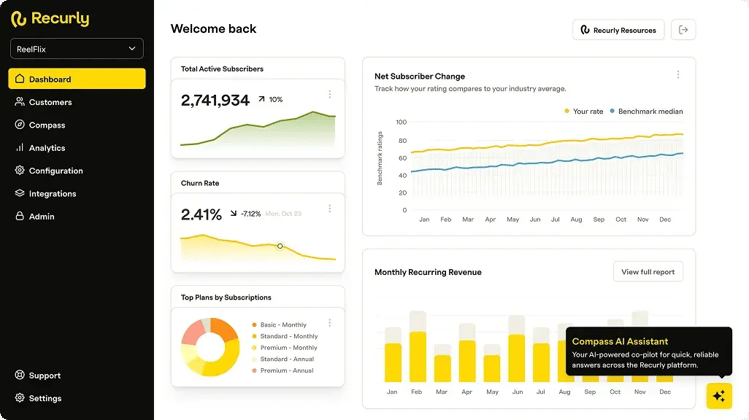
Recurly's dashboard
Where it's strong
Failed-payment recovery. This is Recurly's genuine and best-documented edge. AI-driven retry logic and dunning campaigns are what their marketing leads with, and the reputation is earned. For a high-churn consumer subscription business, recovery performance can move revenue more than any other line item on this page. One caveat worth knowing before you buy on this basis: the entry Starter tier includes one dunning campaign. Multiple campaigns and the AI-powered churn-prevention tooling sit on All-Access.
Consumer and eCommerce subscriptions. Purpose-built rather than adapted. Gift subscriptions, box-model features, trials, coupons, and promotional tooling built in. All-Access for Shopify is a Shopify-native subscriptions product with subscribe-and-save, prepaid and gift subscriptions, hybrid subscription support, and a hosted subscriber portal with passwordless login. Zuora has no equivalent.
Published pricing with a real entry point. Covered below, and it's the biggest change in this comparison since last year.
Global reach. 140+ currencies, multi-language dunning emails. Note that multicurrency is an All-Access feature and isn't included in Starter.
Revenue recognition. RevRec handles ASC 606 and IFRS as a bundle add-on, with automated contract modifications, rules-driven allocations, multi-GAAP compliance, and an immutable audit trail.
Lifecycle messaging. Engage drives personalized offers, cancel-save and upsell flows, A/B testing, and an AI propensity-to-churn model.
Where it's limited
The All-Access rate is still vague. "As low as <1% of billing volume" isn't a number you can budget against, and it carries a $1M billing volume minimum. For the tier most growing companies would actually land on, you're still in a sales conversation.
Analytics only see Recurly. Recurly's built-in MRR, churn, and LTV dashboards are decent — genuinely more than a bare processor gives you. The limitation is scope: they report on Recurly data. If you also run a legacy Stripe instance, an app store, or a second product on different rails, Recurly won't unify them.
Implementation is a project. Enterprise onboarding fees have been reported in the $1–10K range on top of platform costs, though that figure comes from third-party sources rather than Recurly.
Zuora
![Zuora Customer Insights Tab [2026]](https://baremetrics.com/hs-fs/hubfs/Zuora%20Customer%20Insights%20Tab%20%5B2026%5D.jpeg?width=1200&height=675&name=Zuora%20Customer%20Insights%20Tab%20%5B2026%5D.jpeg)
Zuora's dashboard
The 2026 context first: Zuora was taken private on February 14, 2025, acquired by Silver Lake and GIC at $10.00 per share, valuing the company at roughly $1.7 billion, and delisted from the NYSE. Co-founder Tien Tzuo remained CEO. Most comparison articles still describe Zuora as publicly traded, which is a reliable signal the page hasn't been updated since 2024.
Where it's strong
Monetization complexity. Zuora's real advantage, and it isn't close. 50+ charge models, intricate multi-tier pricing, bundles, conditional logic. If your pricing grew organically over fifteen years and nobody can fully describe it, Zuora can probably model it.
Quote-to-cash in one system. CPQ through collections, which matters when sales, finance, and billing operate as separate departments on separate tools today.
Enterprise revenue recognition. Built for the scrutiny that comes with audits at large organizations.
Global and multi-entity scale. 180 currencies and multi-entity structures.
Automation depth. Consistently credited by reviewers.
Where it's limited
Steep learning curve. The same reviewers describe it as overwhelming for smaller teams. Zuora optimizes for mature, defined processes rather than iteration speed — a strength at enterprise scale, a liability if your pricing still changes every couple of quarters.
Implementation runs months, typically with a systems integrator.
Cost opacity. Reviewers consistently flag both the lack of transparency and expenses that surfaced after signing. This is now the sharpest contrast between the two.
What each one actually costs
This is where the comparison has changed most, and where most articles are still describing outdated pricing that no longer exists.
Recurly
Subscription products:
- Starter — $249/month + 0.9% of billing volume, with the first $40,000 of billings included at no charge each month. That allowance recurs monthly; it isn't a trial cap. There's a 90-day free trial and no volume minimum. Includes automated global subscription billing, flexible plans and pricing, static churn-prevention tools, one dunning campaign, 10+ payment methods, and 20+ payment gateways.
- All-Access — "as low as <1% of billing volume," billed annually, with a $1M billing volume minimum. Better rates at higher volume. Adds AI-powered agents and analytics, intelligent churn-prevention, multiple dunning campaigns, advanced plans and promotions, payments orchestration across multiple gateways, custom reporting and automated exports, ACH and additional payment methods, multicurrency, and SSO.
- All-Access for Shopify — "as low as <1% of billing volume," billed annually.
Engagement and compliance add-ons:
- Engage — from $1,600/month, billed annually, based on prompt volume and capability needs.
- RevRec — from $850/month, billed annually, based on billing volume.
What that means in practice. Below $40,000 a month in billings, Recurly Starter is a flat $249 with no percentage at all. At $100,000 a month, you'd pay $249 plus 0.9% on the $60,000 above the allowance — about $789 a month. That's a number you can put in a budget today without talking to anyone, which was not true of Recurly a year ago.
Zuora
Zuora does not list any public pricing on their website. Press materials describe a dynamic model combining a flat monthly platform fee, per-unit or usage-based components, and an upfront activation fee, quoted per deal. We're not printing a number because there isn't a public one, and any article that quotes a specific Zuora price is giving you something unsourced.
| Recurly | Zuora | |
| Entry price published | Yes — $249/mo + 0.9% | No |
| Free monthly allowance | First $40K of billings, every month | None |
| Free trial | 90 days | No |
| Minimum volume | None on Starter; $1M billing volume on All-Access | Not disclosed; enterprise-oriented |
| Mid/upper tier rate | "As low as <1%" — still a sales conversation | Not disclosed |
| Add-on pricing published | Yes — Engage from $1,600/mo, RevRec from $850/mo | No |
| Activation / onboarding fee | $1–10K reported for enterprise tiers (third-party) | Yes — upfront, amount undisclosed |
| Can you budget before contacting sales? | Yes, at the entry tier | No |
| Gateway fees | Separate, on top | Separate, on top |
Comparison table
| Recurly | Zuora | |
| Category | Subscription billing + recovery | Enterprise quote-to-cash suite |
| Best-fit business | Consumer, media, DTC subscriptions; SMB through mid-market | Large enterprise B2B |
| Processes payments | No — 20+ gateways | No — gateway integrations |
| Entry price | $249/mo + 0.9%, no minimum | Not published |
| Failed-payment recovery | Core strength — AI retries, dunning campaigns (1 campaign on Starter, multiple on All-Access) | Collections within the suite |
| Complex catalogs | Good | Strongest — 50+ charge models |
| CPQ | No | Yes |
| Revenue recognition | RevRec add-on, from $850/mo | Core strength, enterprise-grade |
| Shopify subscriptions | Yes — All-Access for Shopify | No |
| Gift subs, boxes, promo tooling | Built in | Not a focus |
| Currencies | 140+ (multicurrency requires All-Access) | 180 |
| Implementation | Weeks to months | Months, typically with an SI |
| Ownership | Independent | Private — Silver Lake and GIC since Feb 2025 |
| Built-in analytics | MRR / churn / LTV, Recurly data only | Requires BI layer |
| Native Baremetrics integration | Yes | No — open API only |
| Baremetrics Recover coverage | Yes — Recurly is a supported source | No |
Neither one is an analytics platform
Recurly's dashboards are better than most billing platforms', and Zuora deployments generally sit under a BI layer someone has to build. Both are billing systems, and analytics is a different job.
The specific limitation with Recurly is scope rather than quality. Its analytics see Recurly. That's fine until you're running Recurly alongside a legacy Stripe account mid-migration, or an app store, or a second product on different rails — at which point no single number exists anywhere.
Where we fit
Baremetrics integrates natively with Recurly, along with Stripe, Braintree, Chargebee, Shopify, Apple App Store, and Google Play, and normalizes all of it into one MRR figure you can still segment by source.
We do not have a native Zuora integration. Zuora data would come through our open API, roughly a day of engineering work. ChartMogul and ProfitWell both support Zuora natively; we don't. If you're going Zuora and want a metrics layer without engineering involvement, they're the better option and we'd rather say so than pretend otherwise.
On either platform, what you'd get from us:
- MRR movement by day — new, expansion, reactivation, contraction, churn, each clickable through to the customer and event
- Live cohort retention tables — no export, no BI project
- Unlimited stacked segmentation and saved dashboards — plan, price point, cadence, country, custom attributes, synced HubSpot properties
- Forecast+, included with any paid plan — QuickBooks or Xero P&L ingestion producing runway, burn rate, CAC, and budget variance alongside subscription metrics
If recovery is the reason you're evaluating
Worth pausing on, because it's the most common version of this evaluation.
If failed payments are the main thing pushing you toward Recurly, note that Baremetrics Recover works with Recurly, Stripe, and Braintree. So it applies whether you adopt Recurly or stay where you are — and if you land on Recurly Starter, which includes only one dunning campaign, Recover adds a fully customizable sequence on top without moving to All-Access.
Recover runs at $129/month flat with no session caps — up to seven fully customizable emails, card-expiration warnings at 30 and 7 days, a branded billing widget, in-app banner into paywall, and SMS. Per our May 2026 recovery benchmark, the median customer earns back roughly 8× its cost within a month.
That won't match Recurly's own recovery performance at consumer-subscription scale. Their retry logic is sophisticated and trained on enormous volume, and the two are complementary rather than interchangeable.
Recover does not cover Zuora, so on that side of this comparison it isn't an option.
How to choose
Recurly if you run consumer, media, or DTC subscriptions; failed payments are a material revenue problem; you need Shopify-native subscriptions, gift subs, or box-model features; or you want a billing platform whose entry price you can look up rather than negotiate. The $249 Starter tier with no minimum means Recurly is now a realistic option for small and early-stage businesses, which was not true a year ago.
Zuora if you're a large enterprise with genuinely complex monetization; you need CPQ and enterprise revenue recognition in one system; you operate multi-entity across many currencies; and you have the internal resources and implementation budget to do it properly.
Neither, if you're a Stripe-native SaaS company with straightforward plans. Stripe Billing likely covers what you do at lower cost, and if the pain is retention visibility or failed payments, both are solvable as a layer rather than a migration.

