
Table of Contents

Stripe vs. Braintree is the closest matchup in online payments — two full-stack, API-first processors that have both powered household names (Stripe: Amazon, Shopify; Braintree: Uber, Airbnb, GitHub). It's also a comparison where the basic facts have shifted: Braintree (founded in Chicago in 2007, acquired by PayPal in 2013 for around $800 million) is now being folded into the "PayPal Enterprise Payments" brand. The product isn't going away. The name on the door is changing, and it tells you where PayPal is pointing it: enterprise.
The short version:
- Choose Braintree if native PayPal and Venmo acceptance matters to your checkout — it's the only processor where those wallets are first-party, in a single integration.
- Choose Stripe for SaaS and subscriptions — Stripe Billing, the broader product suite, and the industry-benchmark developer experience are a clear tier ahead.
- Fees are close enough that they shouldn't decide it — this one comes down to wallet strategy and product needs, not rates.
What each platform is in 2026
Stripe is the modular payments platform. Payments sits at the core, with Billing (subscriptions), Connect (marketplaces), Radar (fraud), Terminal (in-person), Tax, and Sigma (analytics) as products on top, plus ~300+ third-party integrations. Its 2026 moves (the ~$1B Metronome acquisition for usage-based billing, stablecoin settlement) show where the R&D budget lives.
Braintree is PayPal's developer-focused processing platform. It offers full-stack card processing with the signature advantage of native PayPal and Venmo acceptance, the well-regarded Vault tokenization system, and marketplace/sub-merchant capabilities. Its integration ecosystem is smaller (~50+ apps), and enterprise-grade PayPal dev work increasingly routes through it under the new Enterprise Payments banner.
How Baremetrics combines Stripe and Braintree data
Baremetrics treats Stripe and Braintree as two data sources on one account. Connect the first, let the import and calculations finish, then use Add Connection on the Data Connections page to add the second. Stripe connects through Stripe's API as long as you're a Stripe admin; Braintree needs a dedicated Baremetrics API user (public key, private key and merchant ID) plus a webhook. The sources are combined in one dashboard, and you can segment revenue by source in Customer Insights, though not every graph breaks metrics out by individual source. One difference: the Fees metric covers Stripe fees but not Braintree's, and fees are never removed from MRR or Net Revenue. Setup steps are on the Braintree integration page.
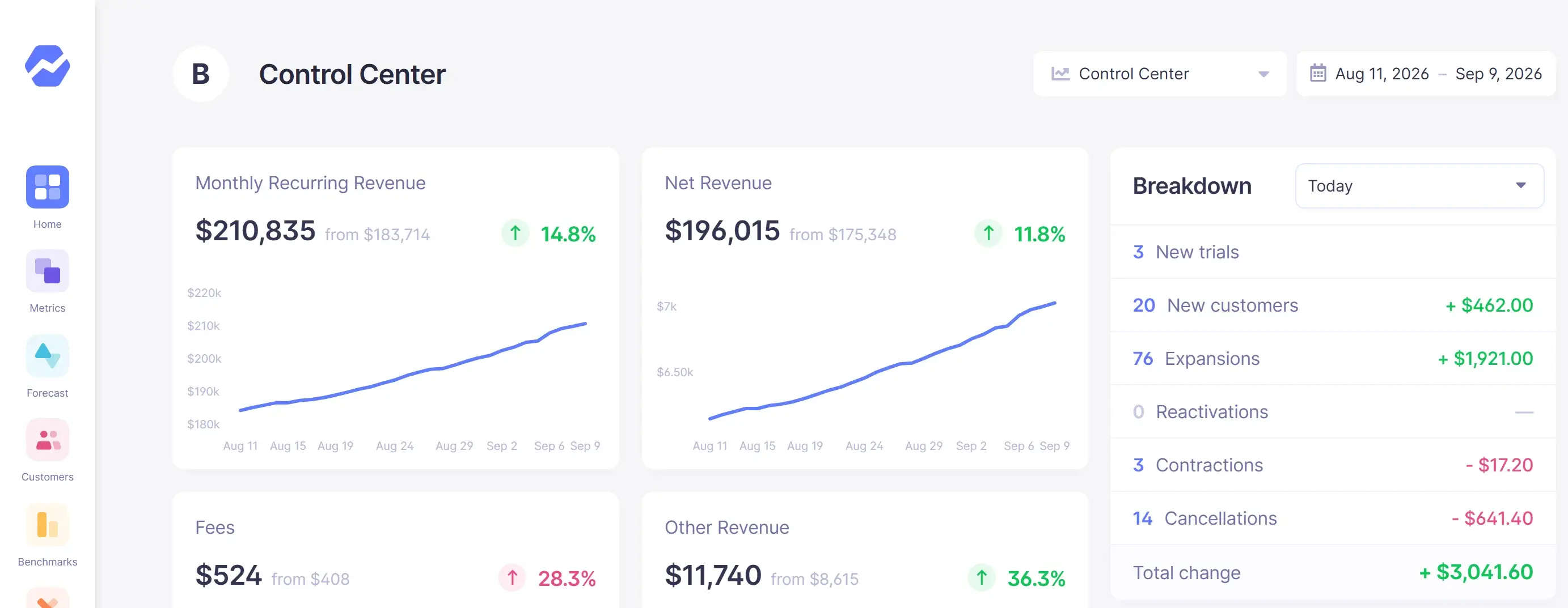
Screenshot shows sample demo data. Source: Baremetrics Help Center (Connecting Your Payment Processors and Data Sources, Braintree, Stripe Integration Guide, Fees Metric).
Fees: closer than you think
| Scenario | Stripe | Braintree |
| Standard US online card | 2.9% + 30¢ | **2.89% + 29¢** (cards & third-party digital wallets, standard merchants — confirmed from the official fee schedule Jul 8, 2026) |
| PayPal via platform | Not supported | 3.49% + 49¢ |
| Venmo | Not supported | 3.5% + 49¢ |
| ACH bank debit (US) | 0.8%, capped at $5 | 0.75%, capped at $5 |
| International cards / currency conversion | +1% / +1% | +2% / +1% |
| Chargebacks | $15 | $15 |
Both offer custom interchange-plus pricing at volume — ask, don't assume the rack rate is final. Braintree's standard rate (2.89% + 29¢) actually sits a hair below Stripe's 2.9% + 30¢ (about 2¢ on a $100 sale) and clearly below PayPal's own Advanced Checkout (2.99% + 49¢). The differences that add up are elsewhere: wallet pricing on PayPal/Venmo volume, and Stripe's lower international surcharge (+1% vs. +2%). For most businesses these roughly wash. Fees shouldn't decide it.
Braintree's real advantage: the wallets
If your customers skew consumer and mobile, PayPal and Venmo in a single native integration is a genuine conversion asset — no redirect bolted onto your stack, one settlement flow, one reporting surface. That's the honest reason to pick Braintree. No amount of Stripe tooling replicates it (Stripe does not process PayPal or Venmo).
A second, quieter advantage: the Vault. Braintree's stored-card tokenization is known for being portable — if you ever leave, your customer payment data migrates out with less friction than most processors allow. Anti-lock-in is worth something.
Stripe's real advantage: everything around payments
For subscription businesses the gap is wide. Stripe Billing (0.7% of billing volume pay-as-you-go, or annual tiers from $620/month) handles trials, proration, smart retries, and usage-based pricing natively; Braintree's recurring billing covers the basics. Add the documentation and API design that remain the industry's reference point, the larger integration ecosystem, and a product suite that keeps expanding, and Stripe is the default for SaaS — that's not controversial in 2026, and Braintree's own enterprise repositioning tacitly agrees.
Running both? That's normal — and it creates a metrics problem
Plenty of scaled companies run Stripe and Braintree simultaneously: a legacy stack on one, new markets on the other, or Braintree specifically for PayPal/Venmo volume. It works fine for payments. Reporting is another story — two dashboards that define MRR differently, and no single answer to "what's our revenue?"
Baremetrics integrates natively with both Stripe and Braintree — connect either (or both) in a few clicks and get 26 subscription metrics in one dashboard, with revenue segmentable by source so you can see which processor drives higher-LTV customers. No spreadsheet reconciliation, no definitional drift. See how it works in our guide to unifying Stripe and Braintree reporting, or start a free trial.

