
Table of Contents

Searching "Chargebee vs. Chargify" in 2026 needs one correction up front: Chargify no longer exists. It merged with SaaSOptics in April 2022 and rebranded as Maxio — a combined billing and financial-operations platform. So the real comparison is Chargebee vs. Maxio, and it's a closer, more interesting matchup than the old one: two billing platforms that grew in different directions.
Teams comparing them are usually dealing with:
- A pricing catalog (usage, tiers, hybrids, ramp deals) that simple billing can't model
- Finance demanding GAAP-compliant revenue recognition (ASC 606) instead of spreadsheet rev-rec
- Global expansion and the tax/currency mess that comes with it
- Quote fatigue — trying to figure out what either platform will actually cost

Need SaaS metrics without waiting on a billing decision? Baremetrics connects natively to Chargebee today.
Chargebee vs. Maxio at a glance
| Dimension | Chargebee | Maxio (formerly Chargify + SaaSOptics) |
|---|---|---|
| Category | Billing orchestration on gateways | Billing + financial operations platform |
| Sweet spot | PLG-to-mid-market SaaS, global | Sales-led, mid-market B2B SaaS |
| Revenue recognition | RevRec add-on (custom pricing) | ✅ Core — GAAP/IFRS, ASC 606, audit-ready |
| Catalog flexibility | ✅ Usage/hybrid/ramps without custom code | ✅ Strong, plus CPQ |
| Gateways | 40+, per-region routing | Gateway integrations; Maxio is the system of record |
| Entry pricing | ✅ Published — 0.80% of billing, no platform fee, no contract | ✅ Published — $599/mo up to $100K monthly billings; quote-only above |
| Recovery/dunning | Basic and smart dunning included; retention flows in Chargebee Growth | Dunning up to 30 steps over 365 days, editable templates, Twilio SMS |
Where Chargebee is strongest
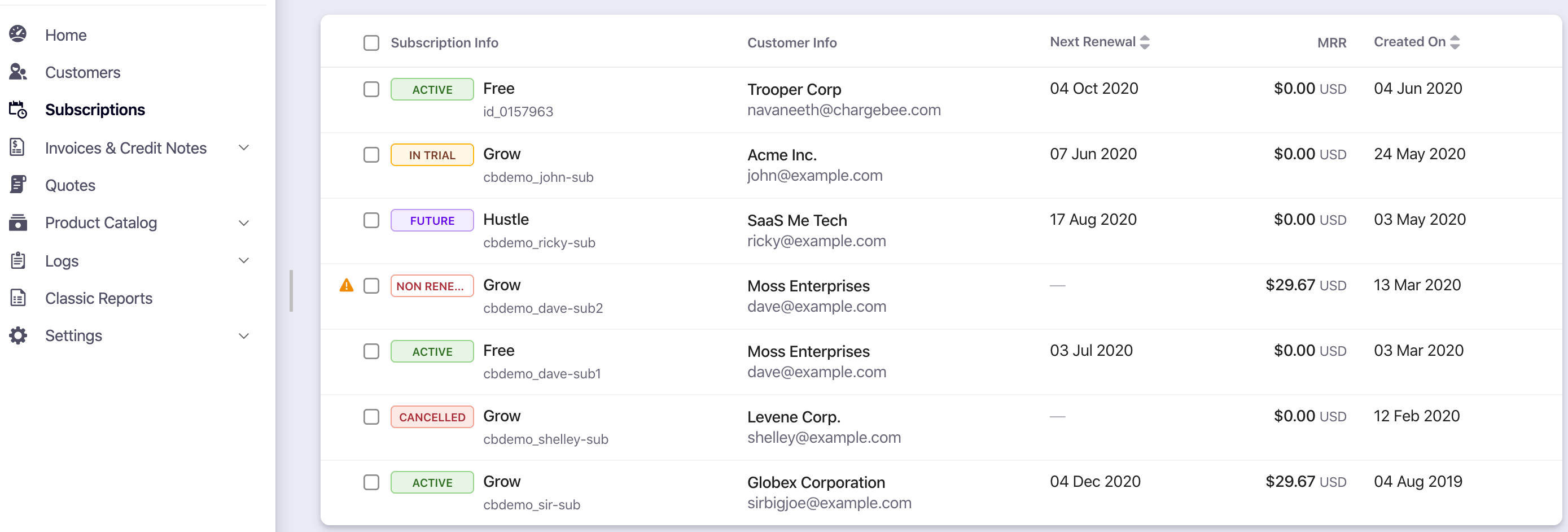
Chargebee's Subscription Dashboard
Chargebee's advantages are accessibility and global catalog flexibility. Both platforms publish an entry price now, but Chargebee's has no platform fee and no annual contract — you pay 0.80% of what you bill, starting from the first dollar. Complex pricing models work without custom code. It routes across 40+ gateways per region to optimize authorization rates.Tax handling is bundled (multi-jurisdiction, 100+ currencies, localized checkout).
Two honest caveats. Implementation is a real project, not an afternoon's work. And while RevenueStory ships with Billing and handles MRR movement, churn, and cohorts perfectly well, it only ever sees Chargebee data — and there's no P&L or runway layer at any tier.
Where Maxio is strongest
![Maxio Dashboard [Product Tour Screenshot]](https://baremetrics.com/hs-fs/hubfs/Maxio%20Dashboard%20%5BProduct%20Tour%20Screenshot%5D.png?width=3418&height=1790&name=Maxio%20Dashboard%20%5BProduct%20Tour%20Screenshot%5D.png)
Maxio's Dashboard View
Maxio inherited Chargify's billing engine and fused it with SaaSOptics' financial operations. The result is a CFO-stack platform. It combines recurring and usage-based billing with CPQ, expense recognition, and its decisive advantage: audit-ready ASC 606 / IFRS 15 revenue recognition. At merger (April 2022) the combined company reported $10B+ in ARR under management across 2,300+ customers, and its recent partnership with AI-native ERP Rillet confirms the finance-stack direction.
If your buyer is a controller or CFO at a sales-led B2B SaaS with negotiated contracts, Maxio is playing your sport.
The growth-path question
Most teams aren't choosing in a vacuum. They're choosing for a trajectory. Chargebee assumes you start self-serve and layer in sales-led deals: no platform fee, no contract, catalog experiments from the dashboard. Maxio assumes sales-led from day one: CPQ, negotiated contracts, rev-rec schedules an auditor signs off on. The common switching trigger is a finance event. An audit, a raise, or a board that wants GAAP numbers pushes companies from operator-shaped billing toward Maxio's category. If that event is more than two years out, Chargebee's lighter start usually wins. If it's next year, buy for the audit.
Pricing compared
Chargebee:
- Flow — the only self-serve plan. Pay-as-you-go at 0.80% of monthly billing value with no platform fee, or commit-monthly at 0.65% plus $99/month. Both include 40+ gateways and both basic and smart dunning.
- Enterprise Plus — quote-only, adding multi-entity and warehouse export.
- Startups — qualifying companies can apply to bill their first $1M free.
Maxio:
- Grow — $599/month, up to $100K in monthly billings.
- Scale — quote-only above $100K. Advanced revenue management, expense amortization, metering and rating, and multi-entity support are all Scale-only.
Run the numbers and the usual story inverts at the top of the range. Below roughly $75,000/month in billing, Chargebee's percentage costs less than Maxio's flat $599. Above that, up to Grow's $100K ceiling, Maxio's platform fee is actually the lower one — $599 against Chargebee's $800 at $100K. Gateway processing is separate on both.
The catch is what Grow leaves out. If the reason you're looking at Maxio is audit-grade rev rec or multi-entity consolidation, that's Scale, and Scale is a procurement process. So the honest framing isn't "cheap versus expensive" — it's that Chargebee prices the whole ladder publicly while Maxio publishes only the rung below the one most of its buyers need.
Where each is heading in 2026
The platforms are diverging, which helps the choice. Chargebee's 2026 moves: a May 2026 Avalara partnership embedding global e-invoicing and live tax reporting, plus usage billing built for AI products (tokens, API calls, agent workflows). Maxio's move is deeper into the finance stack, with its Rillet partnership pointing at AI-native ERP integration. Pick the roadmap that tracks yours. Global self-serve expansion favors Chargebee. CFO-stack consolidation favors Maxio.
Which should you choose?
Choose Chargebee if: you're a self-serve or hybrid SaaS scaling globally, your pricing catalog changes often, and you want to start on published pricing without a sales cycle.
Choose Maxio if: you're sales-led B2B SaaS with negotiated contracts and your finance team needs audit-grade rev-rec, CPQ, and invoicing in one system of record — especially heading into an audit or raise.
The metrics layer both leave open
Neither platform is an analytics product, though both report competently on their own data. Chargebee's RevenueStory covers MRR movement, churn, and cohorts; Maxio's metrics are finance-grade but shaped for auditors more than operators. Neither gives you cross-source normalization, saved operator segments, or P&L-driven forecasting alongside your subscription data.
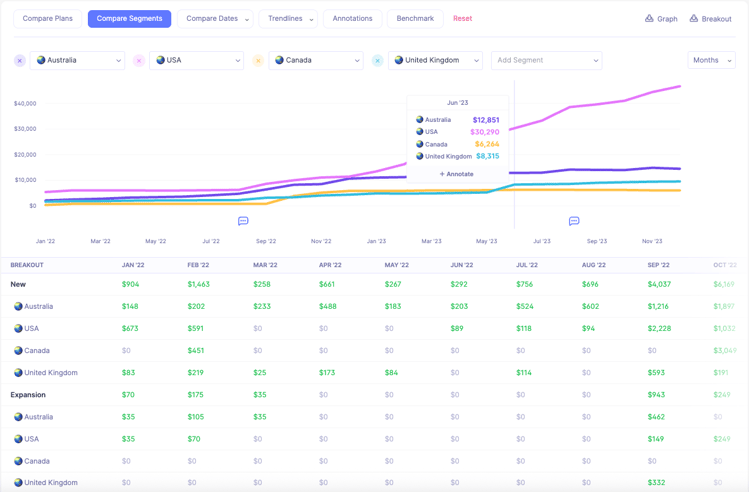
Comparing segments in Baremetrics
Baremetrics connects natively to Chargebee (plus Stripe, Braintree, Recurly, Apple, Google, and Shopify) and gives operators the day-to-day layer: MRR waterfall by day, churn and LTV, cohort retention, unlimited saved segments, Forecast Plus for runway/burn/CAC from QuickBooks or Xero, and Recover for failed-payment recovery where Stripe, Braintree, or Recurly is the gateway underneath ($129/month flat and publicly listed). Setup is about 30 minutes. Unlimited onboarding calls included.

