Table of Contents

Editor’s note: This post describes Baremetrics in 2019. The ARR figures, our data set and our own growth story below are as they were at the time.
Since the beginning of Baremetrics, especially when we started making our data public through Open Startups, I am regularly asked “What is normal?” around all sorts of data points. This led to the creation of Open Benchmarks, which lets you dig deeper in to all sorts of metrics about the SaaS industry at large.
But what it doesn’t really give insight in to is just how much of a slog it can be building a SaaS company. It’s called the long, slow SaaS ramp of death for a reason.
I get a lot of selfish feel-goods digging through our substantial data set and seeing what the trends are across nearly 1,000 SaaS companies, so I thought I’d start doing a sort of SaaS Data Deep Dive series here on the blog to see if it’s useful to folks.
Today, we’re going to take a look at Annual Run Rate (or ARR), which is just your monthly recurring revenue (MRR) multiplied by 12. It’s what businesses typically use when they talk about the size of their business, from a revenue standpoint.
How fast do SaaS companies reach $10,000 ARR?
In the 2019 data, getting to the first $10,000 in ARR, about $833 in MRR, is quite a trek. Later $10,000 milestones come much faster, but a year in, most SaaS companies are only doing $40,000 ARR, or about $3,333 in MRR.
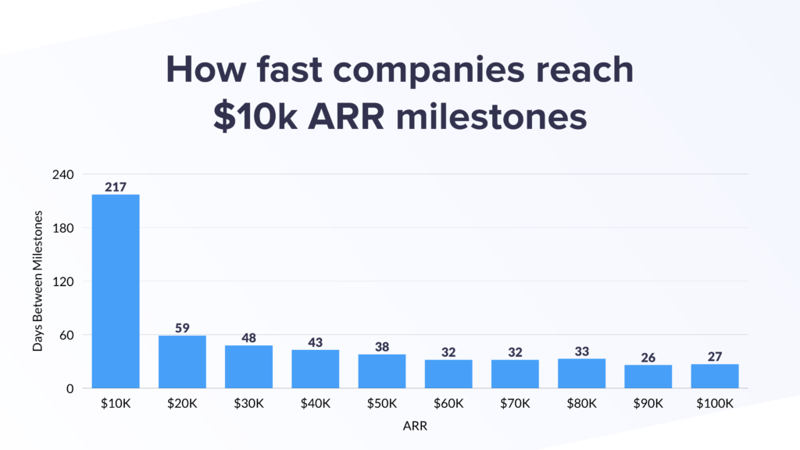 How fast companies reach $10,000 ARR milestones
An annual run rate of $10,000 means about $833 in MRR. That may not sound like much, but getting to that first $10k in ARR is quite a trek!
Once you pass that first hurdle, subsequent $10,000 milestones are reached at a much faster pace. But even then, many companies never get out of the “multiples of $10k ARR” realm as it can be demoralizing to keep pushing for that long.
On average, a year in, the graph shows that most SaaS companies are only doing $40,000 ARR (or, about $3,333 in MRR). That’s not enough to sustain a single person, let alone a team and it’s why so many SaaS tools never really get off the ground and become something bigger.
How fast do SaaS companies reach $100,000 ARR?
The first $100,000 in ARR is long and difficult, but things speed up after that: most companies double their ARR from $100k to $200k in a third of the time, thanks to the compounding effect of recurring revenue.
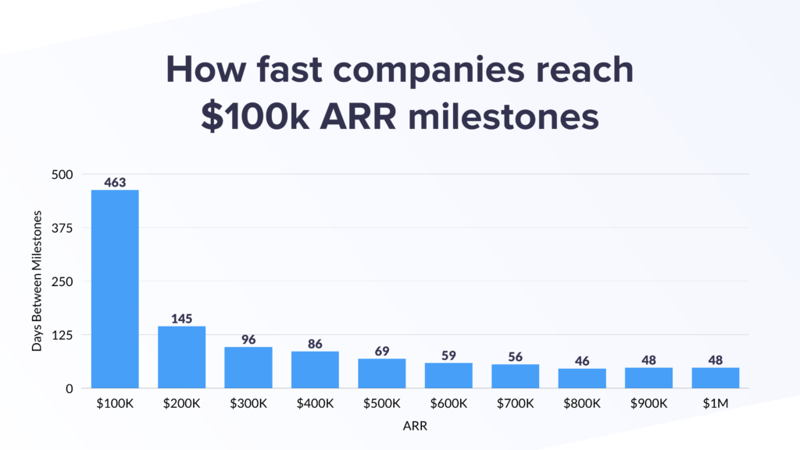 How fast companies reach $100,000 ARR milestones
Here’s the realm where things start to get slightly more interesting. At $100,000 ARR, you are likely at a point where at the very least you are working on it full-time, and you could probably have another employee or co-founder and maybe even some part-time folks.
But, as was the case with the $10k ARR milestones, the first $100k ARR is long and difficult. After that? Things speed up quite a bit. Most companies double their ARR from $100k to $200k in a third of the time!
To me, the $100k to $200k journey really highlights why SaaS can be a great business model. The compounding effects of customers continuing to pay you on a recurring basis makes growth much more stable.
How fast do SaaS companies reach $1,000,000 ARR?
In the 2019 data, it takes the average company nearly two years to reach $1M in annual recurring revenue, if it survives that long. Hitting $1M ARR brings more resources, but it does not mean every problem is solved from there on.
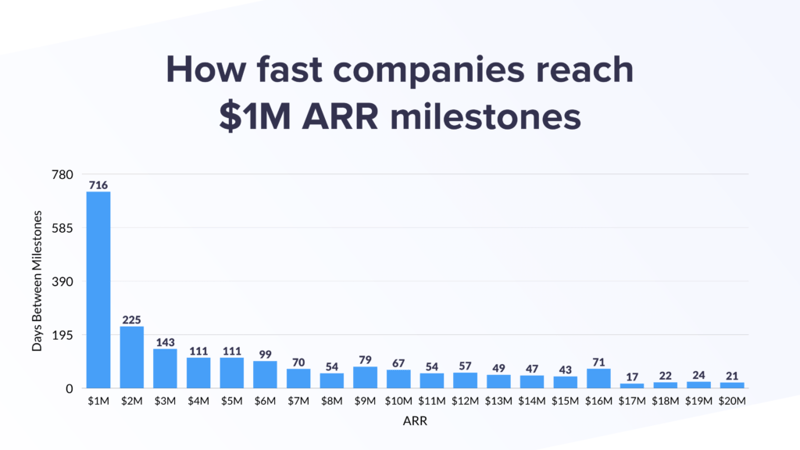 How fast companies reach $1,000,000 ARR milestones
$1M in annual recurring revenue! The holy grail! 😛 For many, hitting $1M ARR feels unachievable. It takes the average company nearly two years to get there, and that’s if they even survive that long.
The next $1M still can take quite some time, but after you hit that $1M ARR milestone, you likely have many more resources at your disposal.
Where it starts getting a little dangerous is if you start pouring fuel on the fire before you’ve really proven there’s a highly scalable business there.
Real talk: We here at Baremetrics have hit a bit of a plateau at about $1.2M ARR. For the past year, growth has largely been flat. We’re profitable, but not excessively so and would really love to figure out why things have plateaued. Lots of things in the works to address it and we’ve even hired a Head of Growth to focus solely on that issue, but I just wanted to reiterate why reaching $1M ARR doesn’t mean you’ve reached some pinnacle and it’s all roses from there on.
How long does 10x growth take for SaaS companies?
Reaching the later ARR milestones takes years, even for the companies that get there, and countless companies never do. Those latter milestones carry some confirmation bias, because the data only shows the companies that survived long enough to hit them.
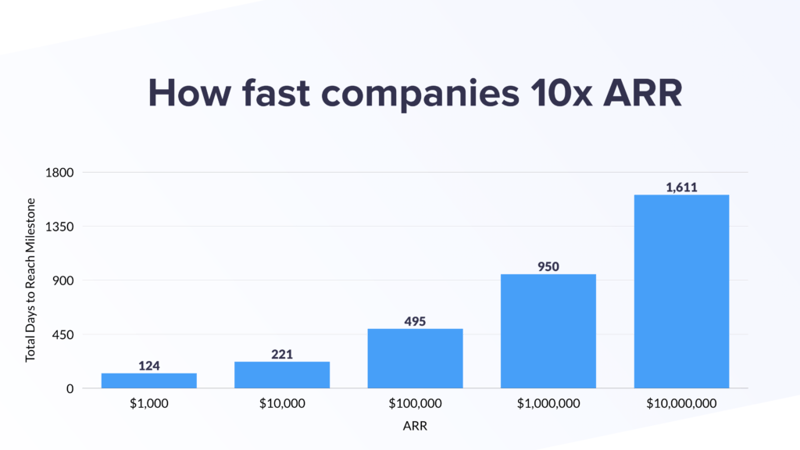 How fast SaaS companies 10x their ARR
The world of high-growth SaaS loves to talk about 10x’ing things and getting a taste of that delicious hockey stick growth. So here’s a chart that shows how long it can actually take.
Keep in mind, those latter columns have a bit of confirmation bias in that there are countless companies that never reach those milestones. But even the ones that do, it takes years.
That’s years upon years of founders sticking it out in a highly stressful environment where, more days than not, they’re probably privately second guessing every decision they make and wondering if it’s all worth it.
What do you think?
So, there we have it. What’s your experience been with ARR milestones at your company?
Also, what do you think of this data-deep-dive format? Should I do more of these? Let me know in the comments!

Frequently asked questions
How long does it take a SaaS company to reach $10,000 ARR?
In this 2019 data set, getting to the first $10,000 in annual run rate, about $833 in MRR, is the slowest milestone. A year in, most SaaS companies are only doing about $40,000 ARR, which is not enough to sustain a single person, let alone a team.
How long does it take to reach $1M ARR?
In this 2019 data set, it takes the average SaaS company nearly two years to reach $1M in annual recurring revenue, and that is only for the companies that survive that long. The next $1M can still take quite some time, even with more resources.
What is ARR?
ARR, or annual run rate, is your monthly recurring revenue multiplied by 12. It is the number businesses typically use when they talk about the size of their business from a revenue standpoint, so a business at $10,000 ARR is making about $833 in MRR.
Does growth speed up after the first $100k ARR?
In this 2019 data set, yes. The first $100,000 in ARR is long and difficult, but most companies then double their ARR from $100k to $200k in a third of the time. The compounding effect of customers paying on a recurring basis makes growth much more stable.
Why do so many SaaS companies stall before $1M ARR?
Because the early milestones are a slog. In this 2019 data set, a year in, most companies are at around $40,000 ARR, which cannot support a team, and the long ramp can be demoralizing. Pouring fuel on the fire before proving the business is highly scalable is also dangerous.