Table of Contents
The Quick Ratio of a SaaS company is the measurement of its growth efficiency. How reliable can a company grow revenue given its current churn rate? That’s the question the Quick Ratio metric answers. As with all metrics, there’s a big hairy asterisk that needs to be appended whenever we talk about what a metric “should” be or what’s “best”.
But first, let’s talk about how to calculate the Quick Ratio for your SaaS company.
To calculate your Quick Ratio you simply divide new MRR by lost MRR. The higher the ratio, the healthier the growth is at the company.
To put it in a formula: Quick Ratio = (New MRR + Expansion MRR) / (Contraction MRR + Churned MRR)
All MRR growth is not created equal. The types of MRR that make up your MRR growth really do matter.
- New MRR — MRR from new customers
- Expansion MRR — MRR from existing customers (upgrades)
- Contraction MRR — Lost MRR from existing customers (downgrades)
- Churned MRR — Lost MRR from canceled customers
Say a company has $10,000 in MRR growth. That growth could be made up of any combination of those types of MRR and the Quick Ratio shows you the difference in “growth efficiency” between them.
Let’s look at a few scenarios of how that company got its $10,000 in MRR growth and what the Quick Ratio would be.
Scenario A
$12,000 (New + Expansion) / $2,000 (Contraction + Churn) = Quick Ratio of 6
Scenario B
$15,000 (New + Expansion) / $5,000 (Contraction + Churn) = Quick Ratio of 3
Scenario C
$20,000 (New + Expansion) / $10,000 (Contraction + Churn) = Quick Ratio of 2
Scenario D
$50,000 (New + Expansion) / $40,000 (Contraction + Churn) = Quick Ratio of 1.25
All four scenarios result in $10,000 of Net New MRR, but Scenario A is vastly more efficient at growth as the company is adding the same amount of Net New MRR with much less effort.
What’s the right Quick Ratio?
There’s no shortage of opinions on what the “best” Quick Ratio is, but at the end of the day, the higher the number, the better. Earlier stage companies who are focused on growth-at-all-cost are generally considered to have “healthy” growth with a Quick Ratio of 4, but less than that doesn’t inherently imply that your company is failing or that you’ve got major issues.
Every business is different. There’s no magical number where you get bonus startup points. At the end of the day it’s just “reduce churn as much as possible”.
For the curious, you can see the quick ratios of hundreds of businesses on our live SaaS Benchmarks page!
How Baremetrics reports Quick Ratio
Baremetrics tracks Quick Ratio for you and includes it in Benchmarks. Its help center describes Quick Ratio as the best way to see the relationship between new customer acquisition and churn. A ratio below 1.0 means you're churning more revenue than you're adding. The further above 1.0, the better, though young companies commonly show a much larger Quick Ratio than established ones. Baremetrics Benchmarks groups you with companies that charge a similar amount per customer, so you can see whether churn or new-customer growth is the thing holding your ratio back.
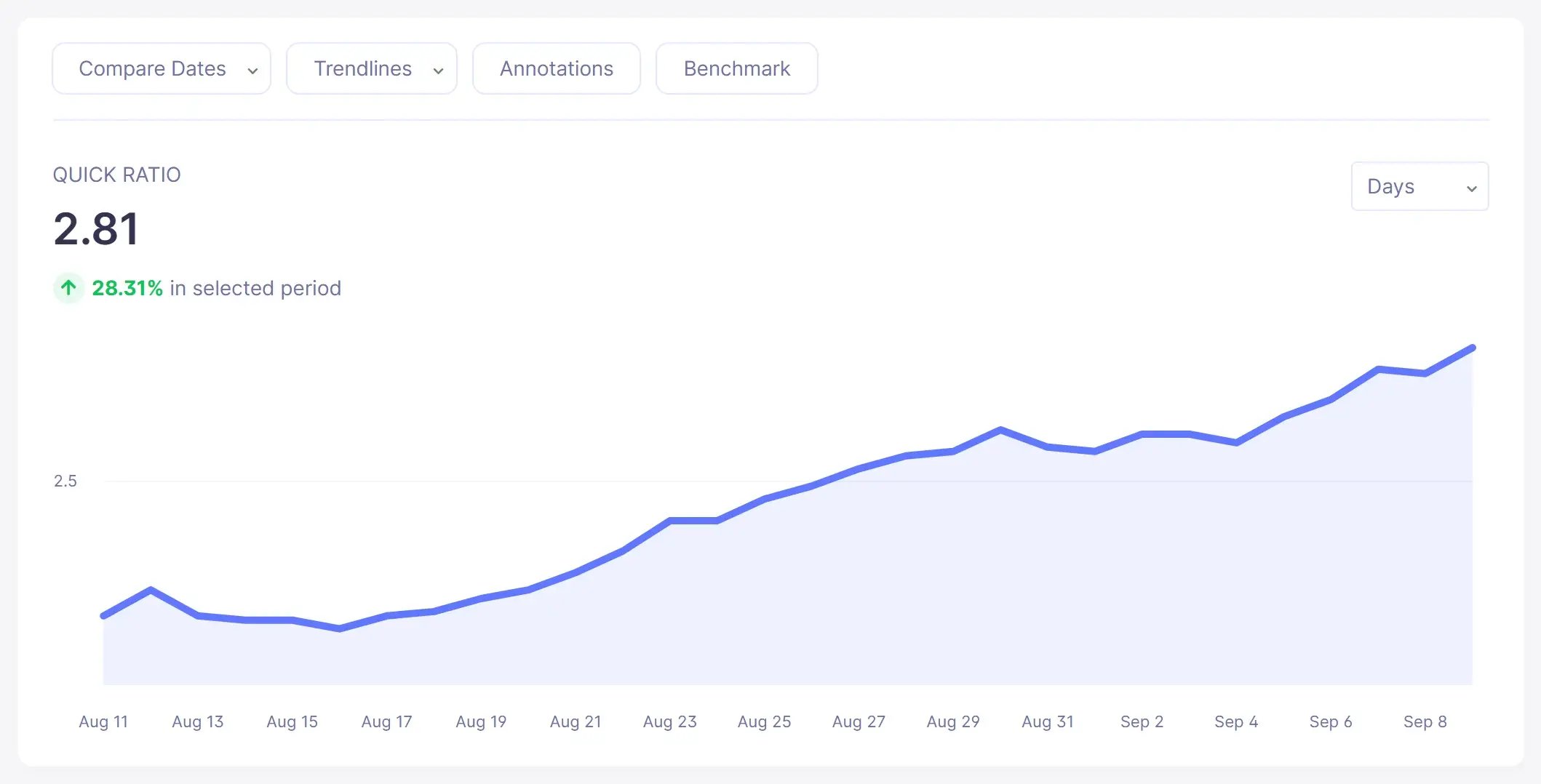
Screenshot shows sample demo data. Source: Baremetrics Help Center (Benchmarks).