
Table of Contents
SaaS businesses typically have an incredibly full tech stack. They typically have a combination of CRM, sales forecasting and enablement tools, marketing tools, customer service and help desk support platforms, cyber security tools, invoicing software, and so much more.
If you don’t have it already, revenue analytics must be added to that tech stack. You don’t just want to know where your traffic is coming from or their actions on your site, you want to understand how specific actions or triggers impact revenue-earning (or revenue-costing) events.
So today, we’re going to look at six of the best revenue analytics tools for SaaS businesses to help you find a perfect solution.
Last updated October 2026.
Why do SaaS brands need dedicated subscription analytics?
Revenue analytics platforms are any analytics tool that provides insights into what’s driving revenue for your company (and ideally gives some ideas for what can be optimized to maximize profit).
There are plenty of great revenue analytics platforms on the market, but we strongly recommend that SaaS brands specifically focus on subscription analytics platforms.
The majority of SaaS tools use subscription business models, which means that their revenue analytics platform must have subscription features. Plenty of revenue analytics platforms do not offer subscription-monitoring metrics like monthly recurring revenue (MRR), whereas subscription revenue analytics platforms will prioritize that data.
Subscriptions have their own unique metrics that you must track to optimize your customer journey and sell more— finding a tool that helps you do that is crucial.
Comparing tools?
Try Baremetrics on your own data before you decide
- Subscription metrics from Stripe, Braintree, Chargebee, Recurly, Apple, Google and more, in one dashboard
- Built-in failed-payment recovery and cancellation insights
- Forecasting with Forecast+
Start your free trial → Explore the live demo
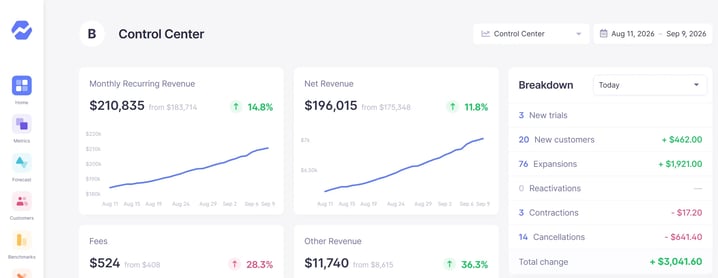
Screenshot shows sample demo data.
What are the best revenue analytics tools for SaaS companies?
The six revenue analytics tools below cover three different jobs: subscription analytics (Baremetrics, ProfitWell Metrics, ChartMogul), billing platforms with analytics built in (Chargebee, Stripe) and finance-grade revenue recognition (Maxio). The order is not a ranking, and every price was checked on the vendor's own site in October 2026.
| Tool | Best for | Standout capability | Starting price | Main limitation |
|---|---|---|---|---|
| Baremetrics | Startups and growing SaaS on Stripe and other billing tools | Metrics, failed-payment recovery, cancellation insights and forecasting in one tool | Free up to $180K ARR; Launch $49/month (Oct 2026) | Recover and Cancellation Insights are paid add-ons |
| Chargebee | Companies that want billing with analytics built in | RevenueStory analytics included with billing | $0/month + 0.80% of invoicing volume (Oct 6, 2026) | AI churn prediction and benchmarks are Enterprise-only |
| ProfitWell Metrics (Paddle) | Teams that want free metrics, or that bill through Paddle | Free metrics with benchmarks | Free (Oct 7, 2026) | Retain pricing outside Paddle Billing is unpublished |
| ChartMogul | SaaS teams that want metrics plus a built-in CRM | Benchmarks, forecasting and CRM on every plan | Free up to $120K ARR; Starter $69/month (Oct 7, 2026) | No failed-payment recovery |
| Maxio | Larger B2B companies with complex contracts | ASC 606 / IFRS 15 revenue recognition | $599/month (Oct 14, 2026) | Quote-only above $100K monthly billings |
| Stripe | Companies already billing on Stripe | Billing analytics and revenue recognition inside Stripe | 0.7% of Billing volume (Oct 14, 2026) | Usage-based MRR still in preview |
Prices change with revenue for most of these tools, so treat the starting price as the entry point, not what you will pay at scale.
What features does Baremetrics offer for revenue analytics?
Best For: Startups
Baremetrics is a revenue and subscription analytics tool that was designed specifically with startup SaaS businesses in mind.
We don’t just want to show you numbers, though, and let you try to fill in the blanks with best guesses and hypotheses about what it all means. We want to help you understand your business’s overall growth both throughout your financial history, but also by comparing your metrics with others from similar companies.
Baremetrics combines subscription metrics, revenue recovery, cancellation insights, and advanced forecasting features in one tool. You can access all of the information you need in a single dashboard so you can take action quickly.
We can help you:
- Track over 28 different SaaS-focused subscription metrics to really understand where your revenue is coming from (and how to optimize for growth)
- Receive accurate, reliable data; unlike other tools, we don’t inflate your numbers by including customers who have canceled, paused, or delinquent accounts
- Get cancellation insights to help you understand why customers are churning, and which cancellation drivers are costing you the most revenue
- Recover revenue by understanding why failed payments happen and how to resolve them,since many subscription companies lose an average of 9% of MRR a month due to failed payments, this is significant
Our software is designed to help you maximize revenue in actuality, not just in theory. Our Recover tool, for example, schedules follow-up emails, SMS, in-app banners and paywalls when a payment fails, and gives customers a hosted form to update their card, which reduces lost revenue and churn. Payment retries stay with your billing processor, such as Stripe.
Our forecasting features can help you assess likely revenue given past trends and current data, allowing you to plan for cash flow or identify opportunities for potential growth.
These features were all designed with startups in mind so we can give you the data and tools you need to maximize revenue and growth quickly.
Learn more about how Baremetrics works here:
Pros
- Subscription metrics, failed-payment recovery (Recover), Cancellation Insights and forecasting (Forecast+) in one product.
- Connects to Stripe, Braintree, Chargebee, Recurly, the Apple App Store, Google Play, Shopify, QuickBooks Online and Xero, plus a Universal Connector for other sources.
- A Free plan up to $180K ARR, and plans are never priced per seat.
- Public Open Benchmarks plus in-app Benchmarks that compare your metrics with companies at a similar ARPU.
Cons
- Recover and Cancellation Insights are add-ons on top of the base plan: Recover is +$129/month or 10% of recovered revenue, and Cancellation Insights is +$129/month.
- It is an analytics layer, not a billing system, so you still need Stripe, Chargebee or another billing tool to charge customers.
Pricing: Free up to $180K ARR. Launch is $49/month up to $360K ARR (month-to-month only), Growth starts from $69/month and Scale from $409/month, with Financial Planning included in Scale. Annual plans are up to 35% off. (Baremetrics pricing, as of October 2026)
What features does Chargebee offer for revenue analytics?
Best For: Companies who want to automate subscription billing and access basic analytics
Chargebee is a revenue growth management platform for subscription brands. Their revenue recognition software consolidates revenue data, analyzes it based on the recognition rules your business creates, and then automatically calculates revenue.

Compliance is always crucial when you’re looking at finance tracking, and Chargebee’s platform is in compliance with ASC 606/ IFRS-15’s five-step model. This software is an accountant’s dream, though it may not have all of the metrics that other dedicated subscription analytics tools offer.
Pros
- RevenueStory analytics is included on the Flow and Enterprise billing plans.
- Smart dunning is included in Chargebee Billing, and Cancel Insights is included in the Chargebee Growth Starter retention plan.
- Works with 40+ payment gateways.
Cons
- AI churn prediction and benchmarks are reserved for the Chargebee Growth Enterprise plan.
- The free Growth Starter plan is only available to Chargebee Billing customers.
- RevenueStory Standard allows up to five reports; unlimited reports need Premium.
Pricing: Flow is $0/month plus 0.80% of monthly invoicing volume, or $99/month plus 0.65%. Enterprise is priced on request. (Chargebee pricing page, as of October 6, 2026)
What features does ProfitWell by Paddle offer for revenue analytics?
Best For: Companies who want to automate subscription management + access analytics
Paddle is an optimization-focused subscription management tool first, and it comes with the added benefit of financial analytics. They have features to help you price products currently to increase revenue, and to help retain customers longer.
Their financial analytics tool, ProfitWell Metrics, breaks down the major subscription metrics SaaS businesses need to keep their eye on, including MRR, number of active vs. current customers, revenue per customers, and number of upgrades vs. downgrades.

There are some great automation features here designed to increase revenue, like the ability to automatically nudge free trial users to convert if they display certain behaviors, or setting alerts for high-risk relationships. Your sales team can use this information to close more deals, which can be a huge advantage.
Pros
- ProfitWell Metrics is free.
- Benchmarks your performance against 30,000 subscription and SaaS companies.
- Integrates with Stripe, Chargebee, Paddle and other billing tools, with Clearbit and FullContact enrichment for segmentation.
- Retain, Paddle's failed-payment and cancellation toolkit, is included at no extra cost for Paddle Billing customers.
Cons
- Retain pricing for companies that do not bill through Paddle is not published; Paddle asks you to book a demo.
- Metrics and Retain are separate products, so recovery and cancellation data do not come from the free Metrics plan alone.
Pricing: ProfitWell Metrics is free. Paddle Billing, which includes Retain, costs 5% + 50¢ per checkout transaction. (Paddle product and pricing pages, as of October 6–7, 2026)
What features does ChartMogul offer for revenue analytics?
Best For: Companies looking for automated revenue analytics
ChartMogul is a subscription-first platform that comes with multiple suits of tools, including a CRM and (of course) revenue analytics.
This platform looks at SaaS subscription metrics, importing, organizing, and analyzing data from the billing sources you’re already using. It has segmentation data, so you can see how different audience segments retain, churn, and behave over their lifecycle.

They effectively track major SaaS metrics like annual recurring revenue (ARR), customer lifetime value (LTV), and churn, and you can access the data on their desktop or mobile apps.
Pros
- Free up to $120K ARR, with industry benchmarks, forecast modeling and segmentation on every plan, including Free.
- A built-in CRM at no extra cost, plus an MCP server on all plans.
- Lists 65 integrations, 31 of them billing data sources.
Cons
- No dunning or failed-payment recovery product.
- Starter connects one billing system plus two custom or third-party sources; multiple billing systems need Pro.
- Data warehouse exports start at Pro, and ChartMogul AI is read-only for now.
Pricing: Free up to $120K ARR. Starter is $69/month billed monthly or $57/month billed annually, and Pro is $119/month billed monthly or $99/month billed annually, at the lowest ARR band. Prices rise with ARR, and Enterprise starts at $19,900/year. See our ChartMogul comparison. (ChartMogul pricing page, as of October 7, 2026)
What features does Maxio offer for revenue analytics?
Best For: Large enterprises with big budgets
Maxio, formerly SaaSOptics, is a great subscription management platform for large enterprises with big budgets. The price can be prohibitive for smaller or newer brands, but it does have plenty of great features worth investing in if you’ve got money to burn on your tech stack.
Maxio’s Revenue Recognition features in particular make it a great revenue analytics option. You can set up complex revenue recognition scenarios, configuring revenue recognition models as needed (even on a per-contract basis). You can apply an allocation rule to each contract, and it’s got auditing features built-in to protect your business if an audit is ever needed.
Pros
- ASC 606 and IFRS 15 revenue recognition with multiple revenue books, performance obligations and carveouts.
- Audit-ready reports such as contract details, roll-forwards and deferred revenue by transaction.
- Collections and dunning, usage-based billing and 20+ payment gateways on all plans.
Cons
- The entry plan starts at $599/month, and the Scale plan is quote-only.
- The Grow plan gets standard financial reports and revenue recognition; the advanced versions are on Scale.
- Both plans route through a sales demo rather than self-serve sign-up.
Pricing: Grow is $599/month for up to $100K in monthly billings. Scale, for over $100K in monthly billings, is priced on request. (Maxio pricing page, as of October 14, 2026)
What features does Stripe offer for revenue analytics?
Best For: Companies wanting primarily payment processing + analytics
Stripe is primarily a payment processing tool that many SaaS brands are likely already familiar with. It also comes with subscription management billing features, like recurring billing, usage billing, and multiple price-point options.
They also offer financial reports using accrual accounting methods to help you understand what’s happening with your revenue. You can monitor recognized and deferred revenue, as well as track month-over-month stats about number of disputes, refunds, and debt.
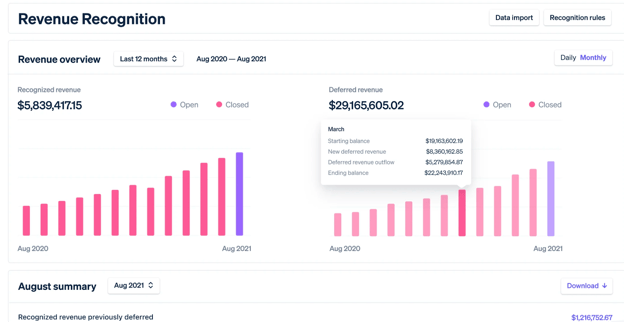
Stripe is an outstanding revenue analytics tool, but we feel that it’s most useful from an accounting point of view. You can get a great idea of what’s happening with your revenue, but some of the other tools on this list are geared more towards learning about the customer experience instead of being accountant-focused.
Pros
- Billing analytics in the Stripe Dashboard covers revenue, subscribers, trials and churn, with CSV exports such as MRR per subscriber and customer MRR changes.
- You can configure how MRR treats discounts and benchmark your metrics against similar businesses on Stripe.
- Stripe Revenue Recognition automates ASC 606 and IFRS 15 reports and journal entries, and can import non-Stripe data.
Cons
- Usage-based MRR is still a preview feature.
- Changes to MRR, churn or active-subscriber settings take 24–48 hours to appear.
- Stripe Billing is charged as a share of billing volume, so the cost grows with revenue.
Pricing: Stripe Billing pay-as-you-go is 0.7% of Billing volume. Revenue Recognition and Sigma are listed separately on Stripe's pricing page. (Stripe pricing and docs, as of October 14, 2026)
What should I look for in revenue analytics tools?
There are clearly plenty of great subscription revenue analytics tools that can benefit SaaS businesses, so knowing what you want and how to make a selection is key.
When considering different tools, we strongly recommend identifying key features or criteria you want to meet and then narrowing down the list of tools accordingly.
Make sure you account for the following:
- Budget alignment. Is the tool you’re considering affordable? oes it have all the features you need for the budget you have, or would you need additional tools or product add-ons?
- Scalability. Can the software you’re considering actually scale with your business?
- Features needed. Does it have the specific features you need? If you’re looking for a tool with detailed analytics, you may not want to choose a tool that treats analytics as a bonus add-on, offering limited metrics. Ideally, look for a tool that has actionable insights and features to help you capitalize on revenue growth.
- Data accuracy. Unfortunately, a lot of analytics tools do not guarantee accurate data. Many lump inactive or delinquent customers, for example, into MRR, even though that’s income you’re unlikely to ever see. Prioritize data accuracy, or the analytics aren’t as helpful as you’d think.
- Support availability. If you need any kind of support, you want to know you can get it. Read customer reviews to learn about each tool’s customer support— don’t just take the company’s word for it.
- Transparent pricing. Too many subscription tools have unclear or complicated pricing models, which can easily land you outside of your budget fast. Look for tools that offer transparent pricing.
Ready to get the data you need to maximize revenue growth for your SaaS subscription business? Start your free 14-day trial with Baremetrics now!
Frequently asked questions
What is the primary purpose of revenue analytics platforms?
Revenue analytics platforms provide insights into what drives revenue for a company and offer ideas for optimization to maximize profit.
Why is subscription analytics important for SaaS brands?
Subscription analytics is crucial for SaaS brands as it helps track unique metrics to optimize the customer journey and sell more, with features like monthly recurring revenue tracking.
What features does Baremetrics offer for revenue analytics?
Baremetrics offers features like subscription metrics, revenue recovery, cancellation insights, and advanced forecasting, all in one tool, to help maximize revenue.
What type of companies is Chargebee best for?
Chargebee is best for companies that want to automate subscription billing and access basic analytics, with compliance features like ASC 606/IFRS-15.
What type of companies is Maxio best for?
Maxio is best for large enterprises with big budgets, offering features like complex revenue recognition scenarios and auditing features.
Are there free revenue analytics tools for SaaS?
Yes. ProfitWell Metrics is free, ChartMogul is free up to $120K ARR, and Baremetrics is free up to $180K ARR. Prices were checked in October 2026. The free tiers differ in what they include: ChartMogul's Free plan connects one billing source, and Baremetrics charges extra for its Recover and Cancellation Insights add-ons.
Which revenue analytics tools include failed-payment recovery?
Baremetrics (Recover add-on), Paddle (Retain, included with Paddle Billing), Chargebee (smart dunning in Chargebee Billing) and Maxio (collections and dunning on all plans) all include failed-payment recovery. ChartMogul does not offer it. Recover costs +$129/month or 10% of recovered revenue on top of a Baremetrics plan. Paddle does not publish a Retain price for companies that bill elsewhere.
Which revenue analytics tools handle ASC 606 revenue recognition?
Maxio and Stripe Revenue Recognition both automate ASC 606 and IFRS 15 revenue recognition, and Chargebee's revenue recognition follows the ASC 606 / IFRS 15 five-step model. Subscription analytics tools such as Baremetrics, ChartMogul and ProfitWell Metrics focus on metrics like MRR, churn and LTV rather than accounting schedules, so finance teams often pair one of them with a revenue recognition tool.
