
Table of Contents

Stripe vs. Adyen is usually framed as a rivalry. It's more accurate to call it a sequence. Stripe is where modern internet businesses start: instant onboarding, flat predictable pricing, the best developer tooling in payments. Adyen is where a subset of them graduate: an enterprise processor (Spotify, Uber, eBay, Microsoft) that processed €1.4 trillion in 2025, built around dedicated merchant accounts and at-cost pricing that only makes sense at serious volume. If you're comparing the two, the useful question isn't "which is better?" It's "have I reached the volume where Adyen's model pays off?" — and there's a specific number for that below, plus one negotiation step to try first.
Two different machines
Stripe is an aggregator: you onboard instantly under Stripe's own acquiring license, and Stripe handles everything between you and the card networks. That's why signup takes minutes. And why pricing is one blended flat rate: 2.9% + 30¢ for US online cards, a number that already includes interchange, scheme fees, and Stripe's margin.
Adyen is a direct acquirer: every merchant gets a dedicated merchant account, connected straight to Visa, Mastercard, and local networks. That means underwriting — onboarding takes weeks, not minutes, and Adyen generally declines to underwrite small merchants at all. In exchange, you get Interchange++ pricing: roughly $0.13 per transaction plus the true interchange and scheme fees at cost, plus Adyen's markup. Nothing is blended. Every component is itemized on your invoice.
How Baremetrics tracks failed payments on Stripe
Baremetrics records a failed charge every time your payment provider attempts a charge that doesn't succeed. The Failed Charges page shows failed charges per day, how many customers are currently delinquent, and who is at risk because their card expires soon. By default, customers who stay delinquent for more than 30 days are treated as cancelled, and Data Settings lets you change that to 2 months or never. On Stripe, the Multiple Payment Attempts setting delays delinquency until multiple attempts have failed, which helps with debit payments such as Bacs in the UK. Recover then emails customers to update their card. Payment retries stay with your processor.
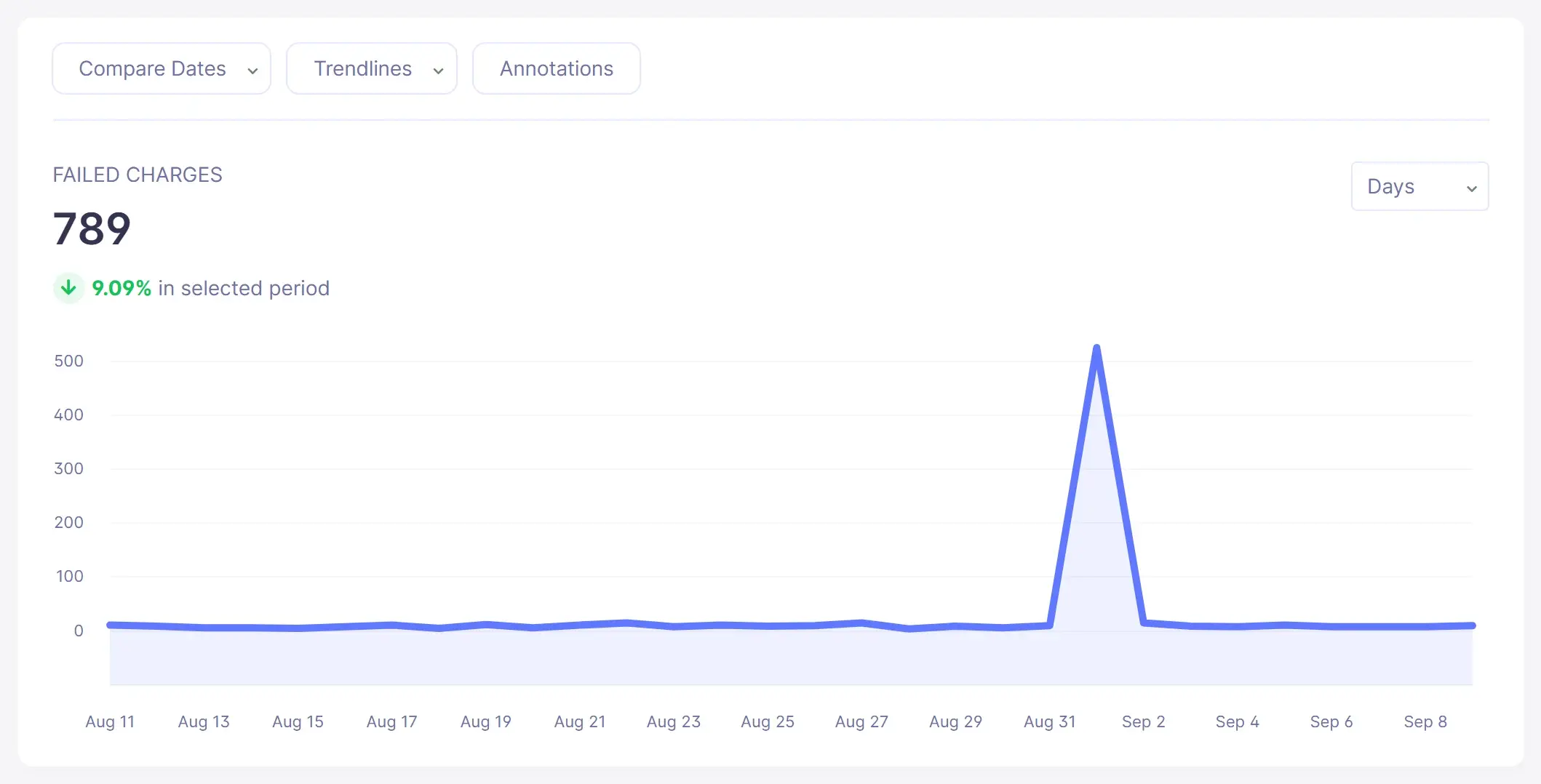
Screenshot shows sample demo data. Source: Baremetrics Help Center (Failed Charges, Data Settings, Stripe Integration Guide, What is Recover?).
What Interchange++ actually means for your bill
Flat-rate pricing charges you the same 2.9% whether your customer pays with a cheap debit card (true cost well under 1%) or a premium rewards card (true cost 2%+). Stripe pockets the difference on cheap transactions. That spread funds the simplicity.
Interchange++ passes true costs through. If your payment mix is debit-heavy or European (where interchange is regulated down to fractions of a percent), your effective rate under Adyen can land dramatically below 2.9%. If your mix is premium-US-credit-heavy, the gap shrinks. That's also the catch: your costs vary by card mix, region, and network (Adyen's own FX runs 0.6–1.2% over market by currency pair), which is transparent at scale and unforecastable without a finance team watching it. Add a monthly invoice minimum (contract-dependent), and the model simply doesn't fit low volume.
Other line items worth knowing: Adyen's chargeback fee runs around €7.50 plus scheme fees (varies by region) versus Stripe's flat $15 (refunded if you win the dispute). Payouts differ too. Stripe settles on a rolling ~2-day schedule, instant for 1%. Adyen typically pays out weekly or twice weekly.
The break-even, and the step to take before migrating
Third-party analyses in 2026 consistently put the crossover at roughly $750K to $1.2M in monthly card volume — sooner for debit-heavy or heavily European businesses. That's where Adyen's itemized model beats Stripe's flat rate by enough to justify the operational lift.
But here's the paragraph most comparisons skip: if you're spending $25K+/month in Stripe fees, ask Stripe for custom pricing before you migrate anywhere. Stripe quotes interchange-plus arrangements to merchants with provable volume — it just doesn't advertise them. A migration to Adyen costs months of integration, re-underwriting, and finance-team overhead; an email to Stripe sales costs nothing and frequently closes most of the gap. Do that math first.
Where Adyen genuinely wins regardless of price
Unified omnichannel. One contract and one integration covering online, in-app, and in-person payments, with one reporting system underneath. If you run physical retail alongside digital, field payments, or international POS, this is Adyen's home turf — and Stripe Terminal (capable but online-first) isn't equivalent. Enterprise reviewers also consistently praise RevenueProtect, Adyen's built-in risk suite. The recurring criticisms: setup complexity, enterprise-mediated support that lags Stripe's 24/7 self-serve, and IC++ bills that surprise teams without payments expertise.
If you're not at Adyen scale yet (most readers aren't)
Here's the honest close: if you're reading this at $50K or $200K a month in volume, Adyen isn't your next move. But payment costs probably still feel too high, and there's a lever most scaling companies pull too late. Failed payments cost more than processing spreads. Involuntary churn from expired and declined cards typically eats several percent of MRR — more than the entire Stripe-vs-Adyen fee gap at your size.
Baremetrics connects natively to Stripe and shows you exactly what's leaking: MRR movements, churn versus benchmarks, LTV by plan. Recover then automates card-update campaigns alongside your processor's retries — the median customer earns back roughly 8× its cost in a single month, per our May 2026 recovery benchmark. Optimizing the revenue you're already earning beats a processor migration you're not ready for. Try it free.

