
Table of Contents

For early-stage subscription businesses, dunning is the highest-ROI retention investment available — and the one most founders ignore until they can see the lost revenue compounding. Subscription businesses lose an average of 9% of MRR to failed payments. At early-stage, that share matters even more: every recovered payment is one less customer to re-acquire, one less hole in MRR projections, one less awkward "your card declined" conversation a founder personally has to have.
Cancel Timeshare — a small Stripe-native subscription business — recovered over $686 in failed payments in their first month of using Baremetrics Recover. Founder Charles Howard put it simply: "Within the first month of using Recover, it more than paid for itself. It's definitely impressive."
This guide covers what dunning solutions are, what startups specifically need from them (versus enterprise), which tools are worth your time at this stage, and how to set up an automated dunning system in under 30 minutes.
What is a dunning solution?
A dunning solution is the system that recovers failed subscription payments before they become permanent churn. It handles the retry logic, the customer-facing communications (emails, SMS, in-app reminders), and the escalation logic — automatically — so failed payments don't quietly become lost MRR.
For startups specifically, dunning matters more than it does at scale for one reason: every customer you lose at $50K MRR has a disproportionate impact on the metric. A single B2B SaaS account churning involuntarily because nobody got around to following up on the failed payment can take a measurable chunk out of your weekly MRR report. Recovering those payments isn't a nice-to-have at startup stage — it's load-bearing for the growth metric.
The original meaning of "dunning" comes from the practice of persistently demanding payment of a debt. The category name carries that baggage. Modern dunning solutions look nothing like debt collection — they look like customer-success communications that happen to address billing.
Why startups need dunning (more than they think)
Three reasons most startup founders end up adopting dunning automation earlier than expected:
1. You can't afford to lose 9% of MRR
Subscription businesses lose an average of 9% of monthly recurring revenue to failed payments. At $20K MRR, that's $1,800/month. At $100K, it's $9,000. At any stage, it's recoverable revenue you're leaving on the table.
For early-stage businesses where every dollar of MRR is the result of significant acquisition work, the math is brutal: customers who churn involuntarily cost you the full CAC to re-acquire, plus the involuntary-churn revenue itself, plus the lifetime value of the customer relationship. Recovering that customer through a $50/month dunning tool is a fraction of the cost of replacing them.
2. You don't have a dunning team — automation IS your dunning team
Mature subscription businesses can afford a finance ops person who manually chases failed payments. Startups can't. You have a founder doing their own billing, a CX person handling everything, and a tiny dev team trying to ship product.
Dunning automation isn't a productivity boost at startup stage — it's the difference between having a dunning function at all and not. The right tool runs end-to-end without anyone touching it after setup: failure detected, email sequence triggered, smart retries scheduled, in-app reminder served, all the way through to escalation.
3. Your CX motion is fragile and dunning is a major part of it
Most startups have a small, founder-adjacent CX team — sometimes literally the founder. Every customer interaction matters. Dunning emails sent in the wrong tone don't just fail to recover payments — they actively damage the customer relationship and amplify the wrong word-of-mouth.
This is where the dunning-as-CX framing matters most. At startup stage, the difference between "your payment failed (collections-tone email from no-reply@billing)" and "hey, looks like your card on file expired — quick fix here" is measurable in both recovery rate and customer sentiment. Tools that let CX own the tone (not finance, not engineering) outperform tools that don't.
What startups specifically need from a dunning solution
The vendor-evaluation criteria for startups look different from enterprise. The trade-off table:
| Requirement | Why startups need it | Why mature companies care less |
|---|---|---|
| Setup in under an hour | Founder/CX-team time is scarce; can't dedicate a sprint | Have ops bandwidth for deeper integration |
| Works with Stripe out of the box | Most early-stage subscription businesses are Stripe-native | Often have custom billing or processor diversity |
| Customisable email content without code | No engineering time to spare | Have content/marketing ops to support custom templates |
| Transparent ROI tracking | Need to justify the spend immediately | Can absorb the cost as overhead |
| No multi-tier pricing complexity | Predictable cost matters at small scale | Enterprise procurement can negotiate |
| A working default sequence | No time to design your own from scratch | Have the data to optimise their own |
Things startups don't need from a dunning solution (at this stage):
- Multi-currency or multi-language (most early-stage are USD-only, single language)
- Complex segmentation rules (the customer base isn't big enough to need them)
- Custom workflow builders (the default 7-email sequence is fine for now)
- Enterprise SSO / SOC 2 paperwork (defer until you actually need it)
Stripe Smart Retries is necessary but not sufficient
If you're a Stripe-native startup (and most early-stage subscription businesses are), Stripe Smart Retries is already running in the background — retrying failed charges at machine-learning-optimised times. Free, on by default.
What Smart Retries does well: invisible retry recovery. The card that failed at 2pm Friday succeeds at 9am Monday after the customer's payday clears. No customer action required. This is real recovery and you're already getting it.
What Smart Retries doesn't do:
- Send a customer-facing email when retries fail
- Let you customise the email content, tone, or sender identity
- Track which emails are actually recovering vs which are filler
- Handle escalation (pause vs cancel, manual outreach for high-value accounts)
- Personalise messaging by failure reason
- Send SMS reminders
- Provide attempted-recovery-rate analytics
In other words: Smart Retries handles maybe 30-40% of recoverable failed payments invisibly. The other 60-70% require customer-facing communication that Smart Retries doesn't offer.
SPI Media CEO Matt Gartland on the gap:
"I will always sing Stripe's praises, but we weren't impressed with the results of its dunning software. Having increased control with Baremetrics is essential. We're able to include SPI branding and change timeframes really easily with Recover."
For Stripe-native startups, the practical path is: keep Smart Retries on for the invisible-retry layer, add a dedicated dunning tool on top for the customer-communications layer. The two work together; they don't replace each other.
Vendor comparison for startups
Three categories to consider:
Native payment processor dunning (Stripe, Braintree, Recurly, Chargebee defaults)
Cost: Free, on by default. Capabilities: 3-5 generic emails, no SMS, minimal customisation, no analytics breakdown by step. Best for: Pre-revenue or very early-stage where you can't justify even $50/month. The catch: You'll outgrow it within months and the migration cost is friction you'll regret. If you're past $5K MRR and serious about retention, native is below the floor.
Baremetrics Recover
Cost: Available as an add-on to Baremetrics Metrics (which itself is built for subscription analytics at startup pricing). Capabilities: 7-email customisable sequence with SMS support, in-app reminders, paywalls, hosted payment-update URL, customer-segment exclusion, attempted-recovery-rate metrics, direct integration with Stripe/Braintree/Recurly/Chargebee. Best for: Any Stripe-native subscription startup at or above ~$5K MRR who wants dunning that pays for itself within month one. The case: In Baremetrics' May 2026 payment recovery benchmarks (119 US B2B SaaS companies), 95% saw the tool pay for itself within month one, and the median company earned an 808% return on its Baremetrics subscription. Cancel Timeshare (a small Stripe-native subscription business) recovered over $686 in their first 30 days.
Build your own
Cost: Engineering time + ongoing maintenance. Capabilities: Whatever you can be bothered to build. Best for: Subscription businesses with billing complexity that no off-the-shelf tool covers (unusual at startup stage). The catch: At early-stage, your engineering team's time is better spent on product than on building dunning infrastructure. The opportunity cost is almost always higher than the subscription cost of a dedicated tool.
What "setup in under an hour" actually looks like
A realistic timeline for adopting Recover at a Stripe-native subscription startup:
| Step | Time | What happens |
|---|---|---|
| 1. Connect Stripe to Baremetrics | 5 min | OAuth flow, pulls existing customer + payment data |
| 2. Review the default 7-email sequence | 10 min | Read through the included templates, tweak any wording that doesn't match your brand voice |
| 3. Set up sender identity + branding | 10 min | Add your logo, colors, sender name. No code. |
| 4. Configure segment exclusions (optional) | 10 min | Mark any internal accounts, beta users, or VIPs to exclude from automated emails |
| 5. Enable in-app reminders (optional) | 15 min | Add the JavaScript snippet to your app — recommended but not required for day-1 |
| 6. Turn it on | 1 min | Recover starts processing your existing failed payments immediately |
Total time: roughly 30-45 minutes from sign-up to live dunning. For most startups, the first recovery happens within the first week — often within the first 24 hours of the first email sequence going out.
Pre-dunning: the highest-leverage move for startups
The single highest-ROI configuration step for startup-stage businesses isn't post-failure dunning — it's pre-dunning.
Pre-dunning means emailing customers 30 days before their card on file is expected to expire, prompting them to update their billing details before any charge fails. Three reasons it works disproportionately well at startup stage:
- The customer isn't yet in a "something went wrong" mental state. The framing is helpful ("heads-up, your card expires next month"), not corrective. Open rates run 60-70%+ vs 20-30% for post-failure dunning.
- You catch failures before they affect the metric. A pre-dunning email that prevents a card expiry isn't visible in any "MRR recovered" report — but it's the cheapest possible save. Startup MRR metrics smooth out faster.
- No support load. When the card update happens before a failure, there's no "your service is interrupted" call. CX team thanks you.
Recover ships pre-dunning emails (30 days + 7 days before known expiry) as part of the default configuration. Open rates on these typically run 73%+ and click-through rates around 11% — well above industry SaaS email benchmarks.
What to measure (and what not to)
At startup stage, the metrics worth tracking aren't sophisticated:
- Total revenue recovered per month (in dollars) — the headline number. This is the one you'll quote when justifying the spend.
- Attempted recovery rate — the percentage of recovery attempts that succeed. Baremetrics introduced this as a standard metric in June 2025 specifically because the naive version ("recovered ÷ all failed charges") was contaminating the denominator. For the deeper methodology, see our dunning recovery rate guide.
- Pre-dunning save rate (qualitative) — how many cards got updated before a charge failed, vs how many customers were caught by the post-failure flow. Lower post-failure volume is success.
Metrics not worth tracking at startup stage:
- Recovery rate by failure reason cohort — the customer base isn't big enough for the segments to be statistically meaningful
- Email open / click breakdowns per individual step — wait until you have 6+ months of data before optimising step-by-step
- A/B test results on subject lines — your sample sizes are too small for the tests to converge in a useful timeframe
When to upgrade from startup-stage dunning
Three signals suggest you've outgrown startup-tier dunning configuration:
- You have multiple customer segments with materially different LTV or churn profiles (e.g., enterprise + SMB + freemium on the same dunning flow). Time to segment.
- A single failed-payment event causes you material operational pain (e.g., a $20K annual contract fails to charge and nobody noticed for two weeks). Time to add manual escalation paths for high-value accounts.
- You're at the point where you'd benefit from non-English dunning content (you've crossed into international markets).
At that point, the questions move toward the enterprise side of the dunning conversation — see our dunning solutions for enterprise guide for the next tier of considerations.
Baremetrics Recover
Stop losing customers to failed payments
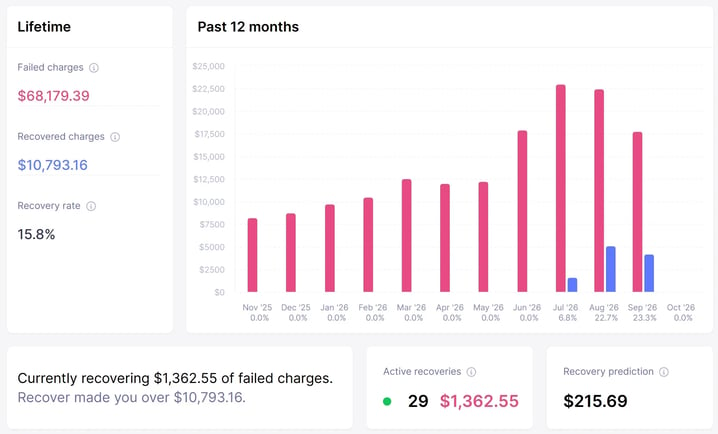
Recover automates the follow-up when a charge fails: customizable email + SMS sequences, in-app reminders and paywalls, card-expiry reminders, and a branded card-update form customers can complete in seconds. No custom code required.
Start your free trial → See how Recover works
Screenshot shows sample demo data.
FAQ
What's the best dunning solution for early-stage SaaS startups?
For Stripe-native subscription startups, Baremetrics Recover is the most common starting point — it pairs the dunning layer with subscription analytics under one roof, sets up in under an hour, and the median company in Baremetrics' May 2026 benchmarks sample earned an 808% return on its Baremetrics subscription in a single month. Cancel Timeshare, a small Stripe-native subscription business, recovered over $686 in their first month of using Recover. For pre-revenue or very early-stage, Stripe's built-in Smart Retries is the free baseline — but most startups outgrow it within months.
How much should a startup pay for dunning automation?
The right baseline is "less than 10% of what you'd otherwise lose to failed payments." For a $20K MRR business losing the average 9% of MRR to failed payments ($1,800/month), spending $100-200/month on dunning automation that recovers 60-80% of that loss is a clear positive. Baremetrics Recover (bundled with subscription analytics) typically pays for itself within month one for customers above $5K MRR.
Do I need dunning if I use Stripe?
Yes — Stripe Smart Retries handles the invisible-retry layer (failed charges that succeed when retried), but it doesn't handle customer-facing communications when retries fail. For most subscription businesses, that's where the larger share of recoverable revenue lives. 93% of Baremetrics Recover customers are on Stripe — they kept Smart Retries on and added Recover on top for the communications layer.
How long does it take to set up dunning for a startup?
30-45 minutes for most Stripe-native subscription startups using Recover. Steps: connect Stripe (5 min), review default email sequence (10 min), customise branding (10 min), enable segment exclusions (10 min, optional), turn it on. First recovery usually happens within the first week.
What's the difference between dunning solutions for startups vs enterprise?
Startups need fast setup, Stripe-native integration, working defaults, and predictable pricing. Enterprise needs multi-stakeholder workflow integration, SLAs, governance, custom segmentation, and procurement-friendly contracts. The capability surface is similar; the configuration depth and integration complexity differ significantly. See our enterprise dunning guide for the enterprise side.
Can I build my own dunning system instead of buying one?
You can — but at startup stage, the engineering time is almost always worth more than the subscription cost of an off-the-shelf tool. Building a working dunning system (with retry logic, customer-facing emails, in-app reminders, hosted update URLs, segment exclusions, and analytics) is a multi-week engineering project. Even at junior engineering rates, that's $10K+ in opportunity cost — well above the multi-year cost of a dedicated tool.
When should a startup invest in dunning?
The day you charge your first recurring subscription. The earliest dunning saves are usually the cheapest customer recovery any subscription business will ever get — and the customer-relationship damage from a poorly handled failed payment compounds over time. For pre-revenue stage, Stripe Smart Retries is the free floor; from first MRR onwards, a dedicated dunning tool typically pays for itself within month one.
Get started
Stripe-native subscription startups can typically set up Baremetrics Recover in 30-45 minutes and see first recovery within the same week. The full setup walk-through is covered in our dunning management guide, and the email cadence (the 7-email default sequence) is broken down in our dunning emails guide.

