Table of Contents
This is a benchmark report drawn from a sample of 119 typical US B2B SaaS companies using Baremetrics Recover during May 2026 — a representative subset of the Recover customer base. Across this sample, businesses collectively recovered about $1.24 million ($1,236,764) in failed payments in a single month, at a median attempted recovery rate of 12.7%. The median company in the sample earned an 808% return on their Baremetrics subscription that month, and 95% saw the tool pay for itself within month one.
This report is a look at what we found in that data — both the headline figures and the structural patterns underneath them — and what it suggests about the state of involuntary churn recovery in subscription businesses in 2026.
Where existing industry data on dunning is fragmented, self-serving, or methodologically loose, the figures below come from a defined sample (119 active Recover customers — typical US B2B SaaS companies), a defined month (May 2026), and a defined measurement methodology — attempted recovery rate, which Baremetrics standardised internally in June 2025 specifically to resolve the metric ambiguity that plagues most published "recovery rate" numbers.
Why this report exists
Most published benchmarks on dunning recovery are bad. They aggregate inconsistent metrics across non-comparable customer bases, use the wrong denominator, or come from vendors with a clear incentive to make the numbers larger. The result is that subscription operators trying to assess their own dunning performance have no reliable external reference point.
That's a problem, because the underlying question — how much revenue should I expect to recover from failed payments? — is genuinely important. Subscription businesses lose, on average, 9% of monthly recurring revenue to failed payments. For a business at $100K MRR, that's $9,000 a month — every month — walking out the door without any customer deciding to leave. The portion of that recoverable through dunning automation is large, but how large is heavily dependent on methodology, segment, and tooling.
This report does three things to try to be useful:
- Defines the sample precisely. Every figure below comes from a sample of 119 typical US B2B SaaS companies actively using Baremetrics Recover during May 2026. This is a representative subset of the broader Recover customer base — not the full customer base, and not a curated case-study group. We include the customers seeing modest results alongside the ones with outsized outcomes.
- Uses attempted recovery rate as the measurement. The naive metric ("recovered ÷ all failed charges") contaminates the denominator with failures the dunning system never attempted to recover. Attempted recovery rate (
recovered ÷ recovery attempts) is the honest version. Full methodology breakdown later in this report. - Surfaces the structural patterns, not just the headline. Median ROI matters less than the distribution. Stripe-only customer share matters less than what that share implies about where the dunning gap sits. The interesting findings are in the second-order patterns.
The headline numbers
For the sample of 119 typical US B2B SaaS companies using Baremetrics Recover across May 2026:
| Metric | Value |
|---|---|
| Total revenue recovered, single month | $1,236,764 |
| Total recovered charges | 10,999 |
| Dunning emails sent | 123,810 |
| Aggregate ROI (recovered ÷ Baremetrics subscription cost) | 2,793% |
| Mean per-customer ROI | 1,377% |
| Median per-customer ROI | 808% |
| Median attempted recovery rate | 12.7% |
| % of customers where Recover paid for itself in the month | 95% |
| % of customers with 5× ROI or better | 65% |
| % of customers with 10× ROI or better | 42% |
| % of customers running Stripe (alone or with others) | 94% |
Sample definition. The 119 figure is a representative sample of typical US B2B SaaS companies actively using Recover during May 2026 — not the entire Baremetrics Recover customer base. "Active" within this sample = customers with at least one attempted recovery during the month. A separate group of customers in the sample (13 accounts) had Recover enabled but no recovery activity in May 2026 — typically because they had no failed-payment events to attempt against. They are excluded from these per-customer calculations.
Three calibrations worth making about these numbers upfront:
On the denominator. The Baremetrics subscription cost used to calculate ROI above is the customer's total Baremetrics subscription — which for many customers includes the Metrics and Cancellation Insights products alongside Recover. The Recover-only ROI is materially higher than the figures shown. The conservative version is reported here because it's auditable.
On the mean vs the median. The mean ROI of 1,377% is pulled upward by a small number of outlier customers (top companies in the sample saw 5,000%+ single-month ROI). The median — 808% — is the "typical" outcome for a US B2B SaaS company in this sample, and is the right anchor for any business modelling its own expected outcomes.
On the time horizon. These are single-month figures. The compounding outcomes are larger: see the named customer cases later in this report, including a 3-year deployment that recovered $150,000.
The distribution of outcomes
Aggregate stats hide more than they reveal. Here's how the 119 companies in the sample distributed across ROI bands in May 2026:
| ROI band | Companies | Share |
|---|---|---|
| 1–100% (under-water) | 6 | 5% |
| 100–500% | 36 | 30% |
| 500–1,000% | 27 | 23% |
| 1,000–5,000% | 45 | 38% |
| 5,000%+ | 5 | 4% |
A few observations from this distribution:
- Most of the sample is well above breakeven. 95% of companies cleared 100% ROI in the month (only 6 of 119 were under-water). Among the under-water group, the most common cause is being new to Recover (less than 30 days of customer data accumulated) or having most of their failed-payment volume in segments that were intentionally excluded from the automated flow (more on segment exclusion later).
- The bulk of companies cluster between 100% and 5,000% ROI. That's a wide range and reflects genuine variation in failed-payment volume across the sample. The right framing for benchmarking is the median, not the mean.
- A small high-end tail. 4% of companies in the sample (5 accounts) saw ROI above 5,000% — meaningful but not the dominant story.
If you're benchmarking your own dunning performance against this sample, the right comparison is the median company at 808% ROI, not the mean at 1,377% nor the headline aggregate at 2,793%.
The Stripe story: 94% of the sample is on Stripe
The single most striking structural finding in the May 2026 sample is the concentration of Stripe usage. 112 of the 119 companies in the sample — 94% — run their billing on Stripe, either Stripe-only or Stripe alongside other processors.
That number says something useful about where the dunning gap sits.
Stripe Smart Retries — the invisible-retry layer that ships built into Stripe — handles a meaningful share of recoverable payments without any customer-facing communication. Card that failed at 2pm Friday succeeds at 9am Monday after the customer's payday clears. This is real recovery and Stripe customers are already getting it for free.
But Stripe Smart Retries doesn't handle the layer above the retry. When retries exhaust, when the failure type requires customer action (expired card, hard decline, geographic block), the recovery requires customer-facing emails, in-app reminders, SMS, hosted payment-update flows. None of which Smart Retries ships.
In practice, the 94% figure means: the customers actively investing in dedicated dunning tooling are overwhelmingly customers who already have Stripe Smart Retries enabled — and have concluded that Smart Retries alone leaves meaningful revenue on the table. That's not anti-Stripe positioning. It's the position Stripe-native businesses themselves arrive at after running Smart Retries for some time.
SPI Media CEO Matt Gartland, on the gap his team encountered:
"I will always sing Stripe's praises, but we weren't impressed with the results of its dunning software. Having increased control with Baremetrics is essential. We're able to include SPI branding and change timeframes really easily with Recover."
SPI Pro — Pat Flynn's subscription community — recovered $8,300 in their first 12 months of using Recover, on top of whatever Stripe Smart Retries was already recovering invisibly. The Recover ROI was 8.9× their Baremetrics subscription cost in that period.
The methodology: attempted recovery rate
The metric that matters for dunning measurement is attempted recovery rate: of the failed payments your dunning system actively attempted to recover, what percentage succeeded? Baremetrics standardised this metric internally in June 2025, alongside two supporting metrics:
- Attempted recovery charges — the count of failed payments the dunning system engaged with
- Attempted recovery amount — the dollar value of those attempts
- Attempted recovery rate — the percentage that recovered successfully
This is different from — and more rigorous than — the naive recovery rate measurement that most industry data uses.
Why naive recovery rate is misleading
Naive recovery rate divides recovered charges by all failed charges. This produces a number that's mathematically computable but practically meaningless, because the denominator includes failures the dunning system never tried to recover. Examples of failures that should not be in the denominator:
- A VIP customer's failed payment that was intentionally excluded from the automated flow (because they have a dedicated CSM relationship)
- A failed charge that succeeded via the payment processor's automatic retry layer before any dunning email fired
- A customer in active hardship negotiation, manually flagged out of dunning
- An enterprise customer on manual invoiced billing whose failed credit-card charge is irrelevant to their actual payment model
A naive recovery rate measurement blames the dunning system for failures it never engaged with — making it impossible to assess actual dunning effectiveness, and making cross-company comparisons meaningless.
Why attempted recovery rate is the honest metric
Recovered ÷ recovery attempts isolates what the dunning system actually did. It gives a per-attempt success rate that means the same thing across customer bases, billing models, and exclusion policies. It's the metric finance audit committees would survive scrutiny on.
If you're benchmarking your own dunning system against an external "industry recovery rate" that doesn't specify whether it's attempted or naive, the comparison is broken. Ask the source; if they can't answer, don't trust the number.
For a deeper breakdown of the measurement question, see our dunning recovery rate guide.
The CX thesis: dunning as customer experience
Beneath the metrics, the May 2026 sample reveals one structural pattern that doesn't show up in the headline figures but shapes everything underneath: the companies running the best dunning systems treat dunning as a customer-experience function, not a billing function.
That sounds like positioning fluff. It's not. The difference shows up empirically in how Recover is configured by the highest-performing customers in the sample.
The companies seeing 5,000%+ ROI in the May 2026 sample share consistent configuration patterns:
- Their dunning emails are sent from a named CX team person (e.g., "Sam from Product"), not from billing@ or noreply@
- Their email content reads conversationally, not as a notice
- They've configured customer-segment exclusion to keep VIPs and hardship cases out of the automated flow
- They use SMS as an amplifier on the later steps of the cadence, where email engagement drops
- They've removed adversarial language ("FAILED PAYMENT", "FINAL NOTICE") in favour of solution-framed messaging ("Quick fix needed for your subscription")
The customers struggling to clear 100% ROI share a different pattern. Their dunning sequences read as collections notices. Their tone defaults to billing-system language. They haven't configured exclusions. They're using a smaller subset of the channels available.
The implication is significant: dunning recovery is more limited by tone than by retry logic. The retry layer is largely solved by modern payment processors. The win available to most subscription businesses isn't a better retry algorithm — it's a better customer experience wrapped around the moment of failure.
"Nobody wants to hear that their credit card has failed and they're delinquent on something. Because Recover is so easy to use and customizable, it allows our CX team to handle the payment recovery process instead of marketing, which customers seem to appreciate." — Matt Gartland, CEO, SPI Media
This is why the most predictive factor of recovery rate isn't the dunning tool's underlying capabilities — it's the team's framing of what dunning is for.
What the data says about Recover's actual capabilities
The capabilities that the May 2026 sample actually used, ranked by how concentrated their usage was in the top-performing accounts:
1. 7-email customisable sequence
Recover ships a default 7-email sequence running from day 0 (within 24 hours of failure) through 13 days delinquent. The 13-day email is the most strategically important — it lands just before most subscription businesses suspend access at day 15. Top-performing customers in the sample customised this sequence substantially; under-performing customers used the defaults.
2. SMS as a first-class channel
SMS open rates are typically 90%+ versus 20-30% for email — particularly for the later steps in a recovery cadence where email engagement drops materially. The Recover SMS channel is a first-class layer alongside the email sequence, not a Twilio bolt-on. Top-performing customers used SMS for the day-7-and-beyond steps; the rest treated dunning as email-only.
3. Customer-segment exclusion (April 2026)
Shipped in April 2026 and available throughout the May 2026 measurement window. Allows excluding specific customer segments (VIPs, manual-billing enterprise accounts, hardship cases) from the automated dunning flow entirely. The companies in the sample who had this configured saw the cleanest attempted-recovery-rate numbers because their denominators weren't contaminated by failures they intentionally didn't pursue.
4. Hosted payment-update URL
A Baremetrics-hosted one-click billing update page that customers land on from the recovery email. Removes the friction of customers having to log into the parent product's billing portal. Customers who used this saw measurably higher click-to-update conversion than customers who routed recovery clicks through their own account-management flow.
5. In-app reminders + paywalls
A JavaScript-snippet layer that surfaces failed-payment alerts inside the customer's product (banner, modal, or paywall depending on configuration). The highest-converting placement for customers who are still actively using the product despite the failed payment.
6. Attempted recovery rate metrics (June 2025)
Not a recovery capability per se — but the measurement layer that lets customers see what's actually working. Customers who track attempted recovery rate by step and by failure reason consistently outperform customers tracking only headline recovery numbers.
Three named customer cases (full time-window arc)
Aggregate stats can be read against; specific customer outcomes are concrete. Three Recover customers across three different time windows, three different use cases, three different business models:
Cancel Timeshare — month 1: $686 recovered
Cancel Timeshare is a small Stripe-native subscription business helping people exit timeshare contracts. They started using Recover in March 2021 and recouped $686 in failed payments in their first month.
"Within the first month of using Recover, it more than paid for itself. It's definitely impressive." — Charles Howard, President, Cancel Timeshare
The case for early-stage / small subscription businesses: Recover doesn't require scale to deliver ROI. It works immediately, even on a modest customer base.
SPI Pro — year 1: $8,300 recovered, 8.9× ROI
SPI Pro is the membership community Pat Flynn launched on top of his Smart Passive Income media business. Their CX team uses Recover to handle dunning so the tone matches the wider customer relationship — not the Stripe-default billing voice.
Over 12 months, Recover recovered $8,300 in lost revenue, paying for itself 8.9 times over in that period.
Grokability — 3 years: $150,000 recovered, 38× ROI
Grokability — makers of Snipe-IT (asset management) and GoodForms (email verification) — is a B2B SaaS run founder-led by Alison Gianotto. They added Recover to their Baremetrics subscription because it let them handle analytics and dunning under one roof.
Over three years, Recover has recovered $150,000 in lost revenue for Grokability, an average of 38× ROI per month. That is one customer's result, not a sample average; the sample median is 808%.
The arc across the three:
Recover pays for itself in month one. Recovers thousands within year one. Compounds into six-figure recovery over multi-year deployments.
Different stages, different segments, same underlying pattern.
What this report implies for operators
If you're running a subscription business and looking at the May 2026 sample data above, four practical takeaways:
1. The $1.24M is the sample aggregate; the 808% median is the realistic expectation
An 808% median ROI on a Baremetrics subscription means the typical company in the May 2026 sample recovers ~8.1× their Baremetrics subscription cost in a single month. The aggregate figure ($1.24M across the sample) is informative but it scales with sample composition; the median ROI is the right number to anchor your own expected outcome against.
Don't model your own expected outcome against the headline aggregate or the outlier customers. Model against the median.
2. Stripe Smart Retries is necessary but not sufficient
If you're Stripe-native (and 94% of the May 2026 sample is), Smart Retries is doing real work — invisibly recovering temporary declines. Keep it on. But the sample data shows the companies also running a dedicated dunning layer on top of Smart Retries recover materially more than Stripe-only customers. The two work together.
3. The recovery you're capturing is dwarfed by the recovery you're attempting
For most subscription businesses, the gap between current recovery and possible recovery isn't small. The 9% of MRR figure isn't theoretical — it's typical. If your dunning system is your payment processor's defaults, you're likely capturing perhaps a third of what's possible. The remaining two-thirds is the customer-communications layer that Smart Retries and similar don't address.
4. Tone is the lever, not retry logic
The single highest-impact configuration change available to most subscription businesses isn't an algorithmic improvement to retry timing. It's switching the dunning tone from billing-system-default to CX-team-managed. The named-customer outcomes above all reflect this pattern. The technical capability matters less than the framing around how that capability is deployed.
How this benchmark gets updated
We plan to publish refreshed versions of this report annually using a comparable sample of typical US B2B SaaS Recover customers. The methodology stays consistent (attempted recovery rate as the metric, full-sample reporting not curated subsets, conservative denominator wording). Year-over-year comparisons in future releases will be a useful indicator of where the underlying dunning landscape is moving — particularly as AI-powered retry optimisation matures and as SMS channels become more standard.
If you want notification when the next release is published, start your free trial of Baremetrics — we'll include you on the release list automatically.
What's in this guide and where to go next
This report is the benchmark and methodology piece. For operational depth on the underlying topic:
- The complete dunning management guide — the strategy and framework: what dunning is, the 3-phase process (Prevention / Recovery / Escalation), and how to build a dunning system end-to-end
- How to improve your dunning recovery rate — the methodology piece: attempted recovery rate vs naive recovery rate, plus 9 tactical tips for lifting recovery
- How to write dunning emails that convert — the practical email side: subject line patterns, body templates, the 7-email cadence with sample copy per step, SMS amplification
- The complete guide to involuntary churn — the problem definition: voluntary vs involuntary taxonomy, benchmarks, prevention mechanisms
- Why subscription payments fail — the failure-reason explainer: four categories of failure, recoverability per category, what to do about each
Baremetrics Recover
Stop losing customers to failed payments
Recover automates the follow-up when a charge fails: customizable email + SMS sequences, in-app reminders and paywalls, card-expiry reminders, and a branded card-update form customers can complete in seconds. No custom code required.
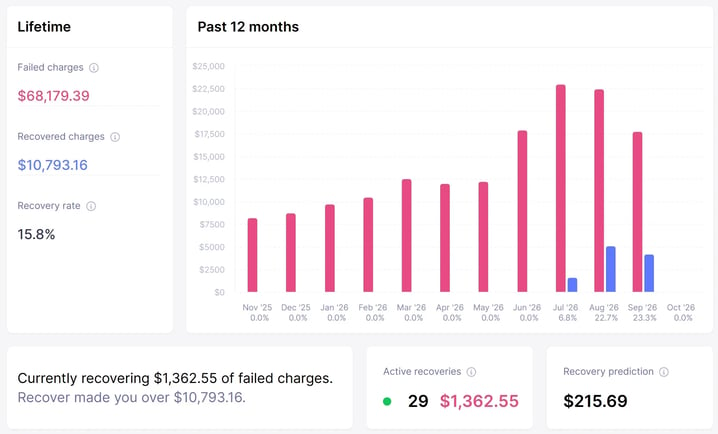
Start your free trial → See how Recover works
Screenshot shows sample demo data.
FAQ
What is a "good" dunning recovery rate?
The honest answer is that there's no universal benchmark — recovery rate depends on customer base, billing model, and which version of the metric you measure. Across a sample of 119 typical US B2B SaaS companies using Recover in May 2026, the median attempted recovery rate was 12.7% and the median month-over-month ROI on a Baremetrics subscription was 808%, with 95% of companies in the sample seeing the tool pay for itself within that month. Compare against your own attempted recovery rate over time rather than against external benchmarks of questionable methodology.
How much do subscription businesses lose to failed payments?
Baremetrics data across hundreds of subscription businesses shows the average company loses around 9% of monthly recurring revenue to failed payments. For a $100K MRR business, that's $9,000 a month — every month — walking out the door without any customer deciding to leave. The portion of that recoverable through dunning automation is large but heavily dependent on the system in place.
Why is "attempted recovery rate" the right metric and not the naive version?
Naive recovery rate (recovered ÷ all failed charges) contaminates the denominator with failures the dunning system never tried to recover — VIP customers excluded by policy, payments that resolved via processor retries before any dunning fired, hardship-flagged accounts. Attempted recovery rate (recovered ÷ recovery attempts) isolates what the dunning system actually did and produces a per-attempt success rate that's comparable across customer bases. Baremetrics standardised attempted recovery rate as the primary metric in June 2025 specifically because the naive version was producing misleading cross-company comparisons.
Does Stripe Smart Retries make a dedicated dunning tool unnecessary?
No — and the May 2026 sample data confirms it. 94% of the 119 US B2B SaaS companies in the sample are on Stripe, meaning the businesses paying for dedicated dunning are almost entirely customers who already have Smart Retries running. Smart Retries handles the invisible retry layer well (cards that fail at one time and succeed when retried at a different time). It doesn't handle the customer-facing communication layer — the emails, SMS, in-app reminders, and hosted payment-update flows that recover the failures Smart Retries can't fix algorithmically. For most subscription businesses, the gap between Smart Retries alone and Smart Retries + dedicated dunning is material.
What's the most important channel in a dunning sequence?
Email is the primary channel, but SMS earns its place as an amplifier on the later steps (day 7 onwards) where email engagement drops materially. SMS open rates are typically 90%+ versus 20-30% for email. The companies seeing the highest ROI in the May 2026 sample consistently used SMS on the day-13 lockout-warning step — typically the most valuable single message in any subscription dunning sequence.
Is the $1.24M figure typical or a one-off?
The $1.24 million figure is the aggregate single-month recovery across the sample of 119 US B2B SaaS companies using Recover during May 2026. It is not the total recovery across the entire Recover customer base, and should not be read as such. Future releases of this benchmark report will compare like-for-like sampled cohorts year-over-year to show trend data.
What does the 808% median ROI mean practically?
The median company in the May 2026 sample recovered 8.1× their Baremetrics subscription cost in a single month. For a business modelling expected ROI from adopting Recover, ~8× ROI in month one is the realistic projection for this sample — not the headline aggregate (2,793%) or the top-tier outliers (5,000%+). Your actual outcome will depend on failed-payment volume, billing model, and configuration choices.
Get started
If your subscription business doesn't currently have a structured dunning system, the median company in the data above recovered about 8.1× (808% ROI) its Baremetrics subscription cost in a single month. The realistic expectation for your business is closer to that number than to no recovery at all.