Table of Contents

Dunning software recovers subscription payments that failed for reasons the customer never chose: an expired card, a soft decline, a bank that blocked a charge. The best dunning software for your business depends less on the tool than on where it sits, because the tools on this list do four different recovery jobs and very few do all four.
Some dunning is already inside your billing system. Stripe Billing, Chargebee and Recurly all retry failed charges and email the customer without another vendor. Other tools sit on top of the biller and own the conversation with the customer instead: the emails, the SMS, the card-update page and the in-app prompt.
This comparison covers eight failed payment recovery tools, ordered by the kind of business each one fits rather than by rank. Two are built into a billing system most startups already use, three are layers that run on top of Stripe and its peers, two belong to full billing platforms, and one is a specialist retry engine for high-volume subscription companies.
Before the tool sections there is a map of the four recovery jobs against all eight tools, so you can see which gap each one closes before you read about it.
Key Takeaways
- Dunning software does four separate jobs: timing the retry, contacting the customer after a failure, warning them before a card fails, and giving them a fast way to update the card. Cancellation save flows are a fifth job some vendors bundle in.
- Retries and outreach are usually owned by different tools. Stripe Smart Retries, Chargebee Revive and Butter Payments decide when to re-charge a card. Baremetrics Recover, Churn Buster and Churnkey focus on what the customer sees.
- A retry cannot fix a hard decline. Stripe does not execute a retry after codes such as lost_card or stolen_card until a new payment method is added, so a card-update path matters as much as the retry schedule.
- Pricing models differ more than features do: included in your biller (Stripe Billing, Recurly, Paddle Retain on Paddle Billing), a flat MRR-based fee (Churn Buster from $269/month), a churned-revenue band (Churnkey Starter at $250/month billed yearly), or a revenue share (Butter Payments), as of October 2026.
- Start with what your biller already does. Add a dedicated layer when the default emails, branding or card-update flow are the part that is failing.
How we evaluated these dunning tools
Every tool was judged on the same five questions. Does it decide when to retry a failed charge? Does it contact the customer after a failure? Does it warn them before a card fails? Does it give them a way to update the card? And is its price published and datable, with limits documented by the vendor?
Features, limits and prices were checked against each vendor's own product page, pricing page or documentation on October 6 and 7, 2026. Where a vendor does not publish a capability or a price, this article says so rather than inferring one. Vendor outcome figures, such as a recovery rate, are quoted as the vendor's own claim and are not independently audited.
Baremetrics publishes this article and Baremetrics Recover is assessed on the same five questions, with its limits stated in its own Cons. The order is by buyer segment, from the simplest setup to the most specialised. It is not a ranking, and no position in it implies a verdict.
Two kinds of product were left out on purpose. Accounts-receivable collections tools chase unpaid B2B invoices rather than failed card charges. Card-network account updaters run inside the billing platforms covered here rather than as products you buy on their own.
Which dunning tool covers which recovery job?
Most arguments about which dunning tool works best are really about which recovery job is missing. A retry engine cannot help a customer whose card was stolen, and a beautiful email cannot help a payment that would have cleared on payday. The map below shows which job each tool documents itself doing.
| Tool | Retry timing | Outreach after a failure | Warning before a card fails | Card-update path | Cancellation save flow |
|---|---|---|---|---|---|
| Stripe Billing | Yes, Smart Retries | Yes, one email per failed payment | Yes, expiring card and renewal emails | Yes, hosted portal or your own page | Not published |
| Paddle Retain | Not published | Yes, translated and branded | Not published | Not published | Yes |
| Baremetrics Recover | runs alongside Smart Retries | Yes, up to 7 emails plus SMS | Yes, card expiry and annual renewal reminders | Yes, branded form, in-app banner and paywall | Separate add-on, Cancellation Insights |
| Churn Buster | Not published | Yes, Dunning product | Not published | Yes, card update page with ACH on Stripe | Yes, Cancel Flows |
| Churnkey | Not published | Yes, dunning campaigns | Not published | Not published | Yes, Cancel Flows |
| Chargebee | Yes, Revive or Smart Dunning | Yes, reminder emails | Not published | Yes, card update request on hard declines | Separate product, Chargebee Growth |
| Recurly | Yes, static or intelligent retries | Yes, an email per dunning step | Yes, renewal and trial-ending notices | Yes, hosted account management page | Pause subscriptions |
| Butter Payments | Yes, per-payment machine learning | Yes, Outreach product | Not published | Not published | Not published |
"Not published" means the vendor's own product, pricing and documentation pages do not describe the capability. It is not proof that the capability is missing, so confirm it with the vendor before you rule a tool out.
The pattern is clear. Billing platforms own retry timing because they hold the charge. Dedicated layers own the customer conversation because that is what they were built to change. If your problem is cards that expire unnoticed, a better retry schedule will not reach it.
Dunning software at a glance
Eight failed payment recovery tools, with the buyer each one fits, its entry price and the limitation most likely to matter to you. Prices come from each vendor's own pricing page, checked on October 6 and 7, 2026. Baremetrics prices are on its pricing page, which is linked rather than quoted here because plans are currently being tested.
| Tool | Best for | Standout capability | Starting price (as of October 2026) | Main limitation |
|---|---|---|---|---|
| Stripe Billing | Startups already billing on Stripe | AI-timed Smart Retries | Included in Stripe Billing | One generic email per failure |
| Paddle Retain | Companies on Paddle Billing | Automatic translation of recovery messages | Included with Paddle Billing | No published price on other billers |
| Baremetrics Recover | Stripe, Braintree or Recurly users wanting branded outreach | Email, SMS, in-app paywall and card write-back | Add-on, see Baremetrics pricing | Retry timing stays with your processor |
| Churn Buster | Teams wanting dunning run with a retention team | Managed dunning and cancel flows | $269/month for one product | Retry timing not described |
| Churnkey | Teams focused on cancel flows | MCP server that can publish flows | $250/month, billed yearly | Annual commitment on Starter |
| Chargebee | Companies running billing on Chargebee | Revive reads 200+ signals per failure | $0 plus 0.80% of invoicing volume | Revive lives inside Chargebee Billing |
| Recurly | Billing teams needing many segmented campaigns | Up to 50 dunning campaigns | Included on all Recurly plans | Multiple campaigns need Professional or Elite |
| Butter Payments | High-volume subscription companies | Per-payment ML retry models | Revenue share, no retainer | No self-serve price published |
Stripe Billing (Smart Retries and recovery emails)
Stripe Billing ships a full set of recovery features to every business already billing through it: AI-timed retries, failed-payment emails, expiring-card notices and automatic card updates. For a startup on Stripe it is the dunning you already have, and the baseline every other tool on this list is measured against.
What it does well
Retry timing. Stripe's documentation says Smart Retries uses AI and time-dependent signals to choose when to retry, with a recommended default of 8 tries within 2 weeks. You can set the window anywhere from 1 week to 2 months, and use no-code Automations to give different customer segments different retry policies.
Pros
- Nothing to install. Retries, emails and recovery analytics live in the Stripe Dashboard.
- Automatic card updates refresh a customer's card details when their bank issues a new number.
- Expiring-card notifications, renewal reminders and a trial-ending reminder 7 days before a free trial ends all link to a page where the customer can update their payment method.
- That link can point to the Stripe-hosted Customer Portal or to your own subscription page.
Cons
- The failed-payment notice is one email after each failed payment, per Stripe's customer email documentation, not a multi-step sequence written in your voice.
- Stripe does not execute a retry after hard decline codes such as lost_card, stolen_card or authentication_required until a new payment method is added.
- A custom retry schedule is limited to three retries.
Pricing
Revenue recovery features are part of Stripe Billing, priced on Stripe's Billing pricing page, which shows regional rates, as of October 7, 2026.
Best for
Early-stage companies on Stripe that have not yet measured how much revenue is failing. Turn every recovery setting on before you buy anything else.
Paddle Retain
Paddle Retain is Paddle's retention toolkit for failed payments and cancellations. Paddle describes it as built into Paddle Billing at no extra cost, and it can also run on another billing system through a JavaScript snippet. It suits companies that already use Paddle as their merchant of record.
What it does well
Localisation. Paddle's Retain page says it translates all recovery messaging automatically, which matters when customers pay in many countries and languages.
Pros
- No extra cost for Paddle Billing customers, who get failed payment recovery and cancellation tools in one product.
- Works with an existing billing stack without changing payment providers, per Paddle.
- Branded recovery experience, configured in a few clicks according to Paddle.
- Paddle claims Retain cuts customer churn by 25-30%, a vendor figure rather than an audited one.
Cons
- No price is published for businesses billing outside Paddle; the route is a demo request.
- Retry timing, pre-failure reminders and the card-update flow are not described on the Retain page, so they need confirming in a demo.
- The free route depends on moving billing to Paddle Billing, priced at 5% + 50¢ per checkout transaction.
Pricing
Included for Paddle Billing customers. Not published for other billing systems, as of October 6, 2026.
Best for
Software companies selling internationally through Paddle, where translated recovery messages are worth more than a custom sequence.
Baremetrics Recover
Baremetrics Recover is a failed-payment recovery add-on to Baremetrics subscription analytics. It contacts customers whose payments failed through email and SMS sequences, in-app reminders and a paywall, and a branded card-capture form.
What it does well
The customer conversation. Per the Recover feature page, a failed charge in Stripe or Braintree triggers a sequence of up to 7 customisable emails, sent on days 0, 3, 7, 13, 15, 20 and 30, from any member of your team. SMS can be blended in. Two card expiration reminders go out 30 and 7 days before expiry, plus two annual renewal reminders.
Pros
- 10+ turnkey email and SMS sequences come pre-loaded and can be edited.
- An in-app banner appears when a delinquent customer logs in, and becomes a paywall after a grace period you choose, installed with a JavaScript snippet.
- The card-capture form can run on a Baremetrics subdomain or your own domain with your branding, and writes the new card back to Stripe, Braintree or Recurly.
- Recover is switched on inside the Baremetrics dashboard, using the payment processor connection already set up for MRR and churn reporting.
- Guarantee: “Recover more than your Baremetrics cost or your next month is free.”
Cons
- Recover does not hold a retry engine of its own. It runs alongside Stripe's Smart Retries, so plan on retry timing staying with your processor.
- Card write-back covers Stripe, Braintree and Recurly only. On other gateways the emails and in-app messages still work, but the customer's new card is not written back automatically.
- It is an add-on, so it requires a Baremetrics account rather than running on its own, although users can have a sole subscription to just Recover without paying for Metrics.
- Cancellation saves are a separate add-on, Cancellation Insights, not part of Recover.
Pricing
Recover is an add-on to a Baremetrics plan, with a 14-day free trial. Current plan and add-on prices are on Baremetrics pricing.
Best for
Subscription businesses on Stripe, Braintree or Recurly whose processor emails are not getting customers to update their cards, and who want recovery reported beside their revenue metrics.
Churn Buster
Churn Buster sells dunning and cancel flows run with a retention team. It sits on top of the billing platform rather than replacing it, and supports Stripe, Shopify, Braintree, Recharge and other subscription platforms. It suits teams that want help running recovery as well as software to run it.
What it does well
Service alongside software. Churn Buster says its retention team has worked on this problem since 2013, across 1,000+ accounts, and its Sentiment AI groups exit feedback by segment.
Pros
- Month-to-month, with no contract and no commissions, per Churn Buster pricing.
- A free Measure plan includes the Churn Buster MCP server, read-only and available on every plan.
- Stripe customers can add a bank account through ACH on the card update page, added in May 2026 per its product updates.
- Broad ecommerce coverage: Shopify, Recharge, Loop, Skio, Smartrr, Awtomic and Subbly, plus Stripe and Braintree.
Cons
- Entry price for one paid product is $269/month, and running both dunning and cancel flows starts at $430/month.
- Price rises with MRR, at roughly 0.1% of MRR per product.
- Its pricing and product pages do not describe its retry timing, so ask how retries are handled on your processor.
Pricing
Measure is free. Dunning or Cancel Flows starts at $269/month and both start at $430/month, scaling with MRR. An optional advisory engagement costs $2,500, credited if you adopt the tools within 90 days, as of October 6, 2026.
Best for
Subscription and ecommerce teams on Stripe or Shopify-based platforms that want a managed recovery programme rather than a self-serve tool.
Churnkey
Churnkey is a retention platform best known for cancel flows, with dunning campaigns alongside. It prices on your average monthly churned revenue and supports Stripe, Chargebee, Maxio, Paddle and Braintree. It suits teams that want voluntary and involuntary churn handled in one tool.
What it does well
Automation through AI agents. Churnkey's MCP page says its MCP server can read retention data, build Cancel Flows and dunning campaigns, run experiments and publish changes live, which goes further than a read-only connection.
Pros
- 14-day trial with no credit card required, per Churnkey pricing.
- The open-source SDK and MCP server are free on every plan.
- The Intelligence plan adds Adaptive Offers, an Account Agent, Feedback AI and AI-powered translations.
- Churnkey states it can recover up to 89% of failed payments, a vendor ceiling rather than a typical result.
Cons
- Starter is billed yearly and limited to teams with less than $5k a month in churn volume.
- Core, Intelligence and Enterprise are quote-based, for $10k+ in monthly churn.
- Security is stated as SOC-2 Type I, where some buyers will ask for Type II.
Pricing
Starter is $250/month billed yearly. Higher plans are quoted on average monthly churned revenue, fixed for 12 months, as of October 6, 2026.
Best for
Teams whose bigger problem is customers choosing to cancel, who want dunning in the same tool as their cancel flow.
Chargebee (Revive and Smart Dunning)
Chargebee is a subscription billing platform with two built-in recovery modes: Revive, a machine learning retry engine, and Smart Dunning, a rules-based option. Because both run inside Chargebee Billing, they suit companies that already bill on Chargebee or are choosing a billing platform now.
What it does well
Retry decisions with billing context. Chargebee says Revive reads 200+ signals per failed payment, including invoice history, plan value and funding cycles, to decide whether and when to retry each transaction.
Pros
- Smart Dunning reads gateway error codes, holds retries on hard declines while requesting a card update, and retries soft declines up to 12 times.
- A custom schedule allows up to 5 retries on the days you choose.
- Covers cards, wallets, direct debit, offline and one-time payments.
- Smart dunning is included in Chargebee Billing, which connects to 40+ payment gateways, per Chargebee pricing.
Cons
- Revive works inside Chargebee Billing, so it is not an option if your billing runs elsewhere.
- Cancellation saves sit in a separate product, Chargebee Growth, with AI churn prediction gated to its Enterprise tier.
- Pre-failure card expiry reminders are not described on the retries page.
Pricing
Billing on the Flow plan costs $0 plus 0.80% of monthly invoicing volume, or $99 plus 0.65%, with smart dunning included. Enterprise is custom, as of October 6, 2026.
Best for
Companies choosing or already running Chargebee Billing, who want retry decisions made by the system that holds the invoice.
Recurly
Recurly is a subscription billing platform whose Dunning Management is available on every plan. Every site gets a default dunning campaign, and merchants on Professional and Elite plans can create up to 50 targeted campaigns for different plans or customer segments. It suits billing teams that want to tune recovery by segment.
What it does well
Segmented campaigns. Recurly's documentation describes separate dunning cycles for declined automatic payments, past-due manual invoices and payments that fail after a free trial, each with its own email templates and schedule.
Pros
- Each dunning step links to its own email template, and the default Payment Declined email links to the customer's hosted account management page.
- When Account Updater is active, Recurly keeps running it on accounts with overdue invoices and attempts collection indefinitely.
- Dunning settings are versioned, and campaign analytics let you compare versions and campaigns over time.
- You choose the end-of-cycle action, including never auto-failing an invoice.
Cons
- Multiple campaigns require the Professional or Elite plan.
- Campaign changes do not affect invoices already in dunning, so a new sequence only reaches new failures.
- Stopping collection on an invoice does not cancel the subscription; that is a separate step.
Pricing
Dunning Management is included on all Recurly plans. Plan prices are on Recurly's pricing page, as of October 7, 2026.
Best for
Companies billing on Recurly with several plans or segments that each need a different collection approach.
Butter Payments
Butter Payments is a specialist failed payment recovery service that builds machine learning retry models for each customer business. It integrates with the payment processor and subscription platform, including Stripe, Recharge and in-house billing systems. It suits high-volume B2C and subscription companies with enough failures to train a model on.
What it does well
Per-payment decisions. Butter says it processes each failed payment individually rather than in batches, and pairs hundreds of data points about the failure with details of your business to pick a retry strategy.
Pros
- Revenue share contracts with no retainer fees, so it earns only on recovered revenue.
- Works with custom, in-house billing as well as Stripe and Recharge.
- States SOC 2 Type 2 and PCI DSS Level 2 compliance, with no PII needed.
- Separate products for outreach, scoring which failed payments are recoverable, and disputes.
Cons
- No self-serve price is published; onboarding starts with a sales conversation.
- A revenue share costs more as recovery grows, unlike a flat fee.
- Its headline claim of 10%+ ARR growth is a vendor figure, not an audited benchmark.
Pricing
Revenue share, with no retainer fees. No rate is published, as of October 7, 2026.
Best for
Large consumer subscription businesses where retry timing, not customer messaging, is the biggest source of lost revenue.
How do you choose dunning software?
Choose by the recovery job you are failing at, not by the longest feature list. Look at your failed payments first. If most are soft declines that clear later, retry timing is the gap. If most are expired or replaced cards, the gap is reaching the customer and getting a new card on file.
Before buying anything, switch on everything your billing system already includes. Then add one layer at a time:
- On Stripe and just starting out: Stripe Smart Retries plus Stripe's failed-payment and expiring-card emails.
- On Paddle Billing: Paddle Retain, at no extra cost.
- Customers ignore the processor's emails: a dedicated outreach layer such as Baremetrics Recover, Churn Buster or Churnkey.
- Cancellations hurt more than declines: Churnkey or Churn Buster, which pair cancel flows with dunning.
- Choosing a billing platform now: compare Chargebee Revive and Recurly's segmented campaigns as part of that decision.
- High transaction volume and a custom billing stack: a specialist retry engine such as Butter Payments.
Whichever you choose, measure it. The step-by-step dunning management guide covers how to build the sequence and measure recovery rate properly, how to write dunning emails covers the copy, and the subscription payment recovery benchmarks show what recovery rates look like in practice. Startups can start with dunning solutions for startups.
Baremetrics Recover
Stop losing customers to failed payments
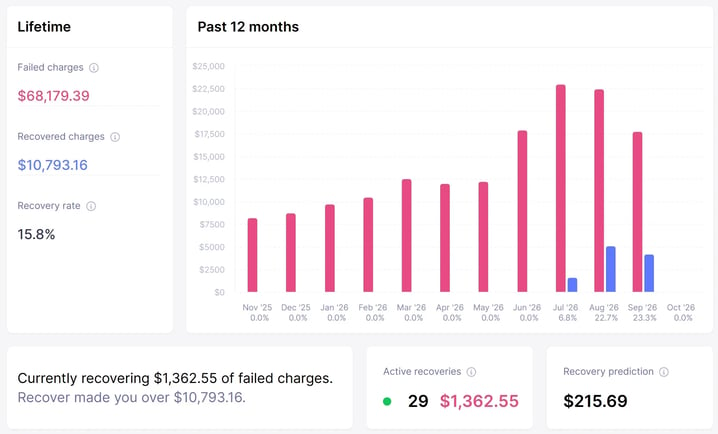
Recover automates the follow-up when a charge fails: customizable email + SMS sequences, in-app reminders and paywalls, card-expiry reminders, and a branded card-update form customers can complete in seconds. No custom code required.
Start your free trial → See how Recover works
Screenshot shows sample demo data.
Frequently Asked Questions
What is dunning management software?
Dunning management software automates the recovery of subscription payments that failed, by retrying the charge, contacting the customer and helping them update their card. Some of it is built into billing systems such as Stripe Billing, Chargebee and Recurly. Other tools, such as Baremetrics Recover, Churn Buster and Churnkey, sit on top of the biller and focus on the customer-facing messages and card-update flow.
What are the best dunning management software options for small businesses?
For a small business, start with the dunning your billing system already includes, then add one layer if customers are not updating their cards. On Stripe that means Smart Retries plus Stripe's emails. Paddle Billing customers get Paddle Retain at no extra cost. Baremetrics Recover adds branded email and SMS sequences and an in-app paywall, Churnkey Starter costs $250/month billed yearly, and Churn Buster has a free Measure plan, as of October 2026.
What tools or systems are recommended for managing failed payment recoveries?
Use a retry engine and a customer outreach tool together, because they fix different failures. Retry engines include Stripe Smart Retries, Chargebee Revive and Butter Payments. Outreach and card-update tools include Baremetrics Recover, Churn Buster, Churnkey and Paddle Retain. A hard decline such as a stolen card needs a new payment method from the customer, which no retry schedule can supply.
How does Churn Buster integrate with payment platforms like Stripe?
Churn Buster runs on top of Stripe rather than replacing it, adding dunning and cancel flows to the subscriptions Stripe already bills. It also supports Shopify, Braintree, Recharge, Loop, Skio, Smartrr, Awtomic and Subbly. Since May 2026, Stripe customers can add a bank account through ACH on the Churn Buster card update page. Its MCP server is read-only and included on every plan, including the free one.
Is Stripe Smart Retries enough on its own?
Smart Retries handles retry timing well, but it does not write a multi-step sequence in your voice or put a prompt inside your product. Stripe sends one email after each failed payment and does not execute retries after hard declines until a new payment method is added. Tools such as Baremetrics Recover are built to run alongside Smart Retries and handle the customer contact.
Can you recommend reliable payment recovery services?
The established options depend on your billing system: Stripe Billing, Chargebee and Recurly include recovery, while Baremetrics Recover, Churn Buster, Churnkey, Paddle Retain and Butter Payments add to it. Churn Buster says its team has run retention since 2013 across 1,000+ accounts. Butter Payments works on a revenue share with no retainer. Ask any vendor how it measures recovery before you compare its claims.