Table of Contents
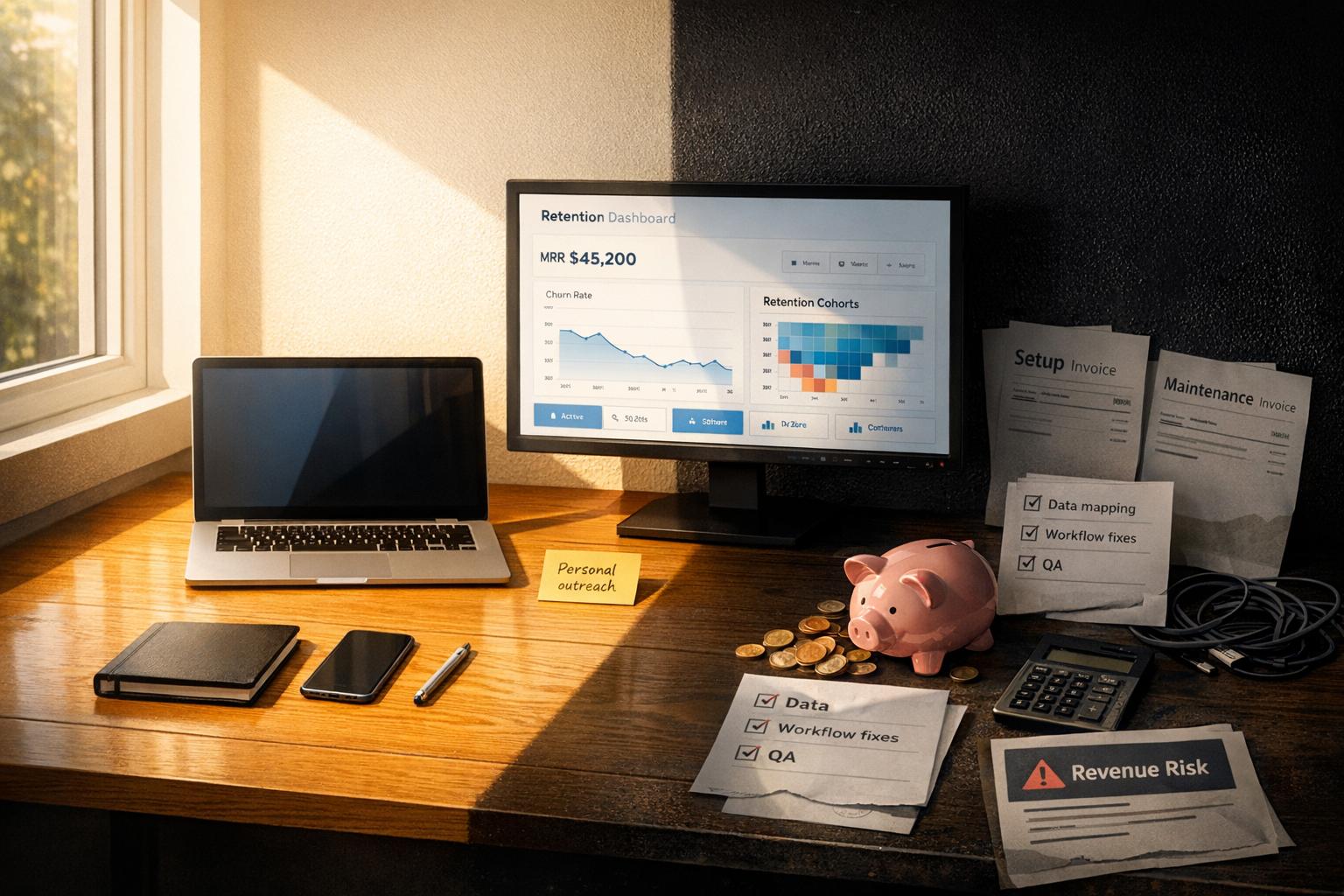
Retention automation promises to reduce customer churn for SaaS businesses with tools like automated onboarding, in-app tours, and payment recovery systems. While the benefits sound appealing - like boosting profits by 7% with just a 1% improvement in retention - hidden costs can make automation more expensive and less effective than expected. These include:
- High setup costs: Initial implementation can cost $10,000–$50,000, especially if systems like CRMs and usage logs aren’t integrated.
- Recurring expenses: Monthly fees range from $1,500–$2,000, with additional maintenance costs of $700–$5,000.
- Revenue risks: Poorly executed automation can lead to "silent churn", where 56% of dissatisfied customers leave without complaining.
- Operational inefficiencies: Manual oversight is still required, with IT teams spending 101 hours annually per app on average.
Automation also risks alienating customers with impersonal messages and rigid systems, which can harm loyalty and trust. Striking a balance between automation and human interaction is critical to controlling costs and improving retention.
Key Insights:
- Failed automation: Up to 40% of churn stems from payment failures, yet overly rigid systems can push customers away.
- Customer dissatisfaction: 72% of users prefer human interaction and are willing to pay more for it.
- Hybrid approaches work best: Combining automation with personalized outreach can recover 10–30% more revenue and reduce churn by 15–25%.
Retention automation works best when paired with tools like Baremetrics, which help track metrics, personalize outreach, and manage costs effectively.
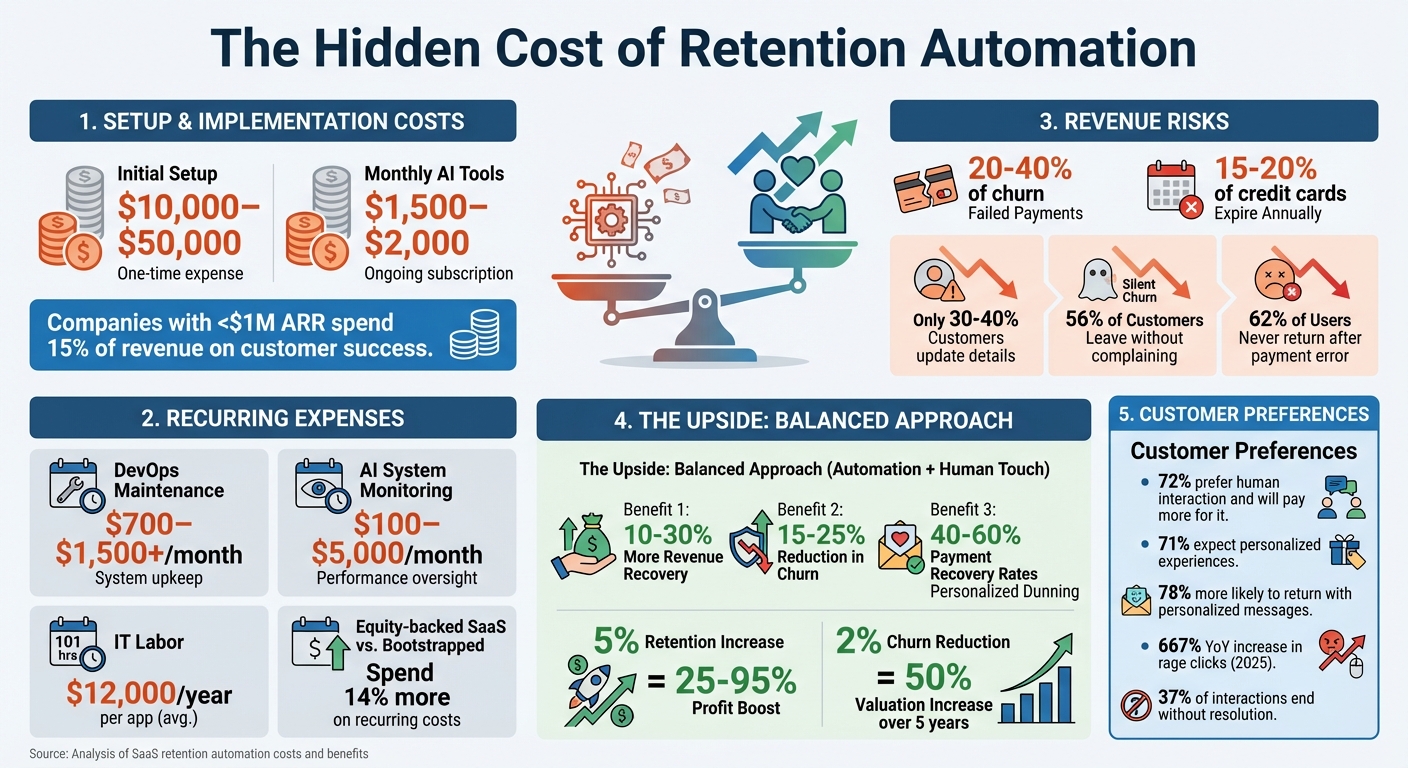
Hidden Costs of SaaS Retention Automation: Key Statistics and Financial Impact
The Financial Costs of Retention Automation
Setup and Implementation Expenses
The initial costs of retention automation tools are just the tip of the iceberg. Basic AI churn prediction tools typically range from $1,500 to $2,000 per month. But the real financial strain often begins long before the software is operational.
For instance, if your product usage logs are isolated from your CRM, you'll need to create a SQL-ready environment. This process may involve compiling up to five years’ worth of historical data and months of technical labor, which can cost between $10,000 and $50,000 upfront. Such historical data is often critical for achieving accuracy rates of 87–95%.
"If your CRM is a mess and your product usage logs are siloed, a $2,000-per-month tool may quickly become a costly error." - Allen Seavert, Founder, SetupBots
Implementation also requires significant input from your internal teams. Customer Success, IT, and technical support staff are typically involved in training and onboarding processes. When you account for their salaries, benefits, and the opportunity cost of pulling them away from their usual responsibilities, the expenses can escalate rapidly. For companies with less than $1 million in ARR, around 15% of revenue is often allocated to customer success efforts, which includes these implementation costs.
Even after setup, recurring costs and ongoing management will continue to add to the financial burden.
Recurring Maintenance and Subscription Fees
While monthly subscription fees are predictable, maintenance costs can be a wildcard. For self-hosted platforms, the expenses shift from software licenses to internal labor. Tasks like DevOps maintenance and security updates can cost approximately $700 to $1,500+ per month.
AI-driven retention systems also need continuous monitoring to maintain performance. Over time, model accuracy can degrade, requiring ongoing adjustments. This maintenance can add anywhere from $100 to $5,000 per month. If you're using custom AI agents with API tokens, costs can fluctuate based on usage - ranging from $0.01 to $0.03 per 1,000 tokens - which introduces unpredictability in your budget.
These recurring costs can strain your budget, especially if your Customer Retention Cost (CRC) begins to approach your Customer Lifetime Value (LTV). When this happens, you're spending almost as much to keep customers as they're bringing in. Notably, equity-backed SaaS companies tend to spend about 14% more on customer success compared to bootstrapped firms.
Lost Revenue from Failed Automation
Beyond the direct costs, failed automation efforts can eat into your revenue. A significant portion of SaaS churn - 20–40% - stems from failed payment processing. For example, 15–20% of credit cards expire annually, yet only 30–40% of customers update their payment details. Without a robust dunning automation system, this preventable churn can quickly add up.
Some companies, however, have demonstrated how automation can recover lost revenue. In 2023, Retool used automated smart retries to recover more than $600,000 in revenue. Similarly, Deliveroo recovered approximately $130 million that same year using similar technology.
But automation isn’t foolproof. "Silent churn" - when dissatisfied customers leave without raising complaints - remains a hidden issue. This accounts for 56% of customer departures. Automation may misclassify these losses as "deflected tickets", obscuring the true revenue impact. Meanwhile, human-led teams often outperform automation in capturing subtle customer signals, achieving 76% higher win rates on expansion revenue. This underscores the importance of balancing automation with a personal touch in retention strategies.
sbb-itb-18a9912
Operational Challenges and Inefficiencies
The Need for Manual Oversight and Intervention
Retention automation might seem like a hands-free solution, but in reality, it requires constant attention. Teams must actively monitor campaigns, tweak retry schedules, and address errors that automated systems can't handle. On average, IT teams spend 101 hours per app annually on manual tasks, costing around $12,000 per year for a single SaaS application.
This becomes even more complicated when systems encounter what experts call the "Unhappy Path." While automation can manage straightforward tasks like password resets, it struggles with more nuanced issues, such as disputes over billing or service interruptions. For example, distinguishing between soft declines (like insufficient funds) and hard declines (like stolen cards) requires human input. Without this intervention, retrying payments on accounts that can’t be recovered wastes resources.
"You're not architecting systems... You're a human API, bridging the gap between HR and vendors who refuse to build proper integrations." - Jay Srinivasan, CEO, Stitchflow
Even advanced recovery tools, which can improve recovery rates by 12% to 47%, demand about 15 hours of manual optimization per month during the initial implementation phase. Your team must constantly monitor performance - tracking declines in recovery rates, adjusting messaging strategies, and ensuring automated systems don’t frustrate customers by trapping them in ineffective loops.
These manual demands often lead to even bigger challenges when integrating with payment platforms.
Integration Problems with Payment Platforms
When retention automation operates independently of your payment processor, issues like "reconciliation drift" can arise. This occurs when customers receive payment reminders for invoices they've already settled. The misalignment between the system deciding the next action and the one processing payments creates confusion and inefficiency.
If your business uses multiple payment processors - such as Stripe, PayPal, and Adyen - the complexity multiplies. Each processor operates in isolation, leading to fragmented recovery efforts and inconsistent messaging. To maintain synchronization across platforms, your team must spend significant time manually managing dunning processes and analytics.
Custom integrations can also create technical headaches. Your engineering team has to manage webhooks, ensure idempotency to avoid duplicate charges, and correctly map intricate JSON fields. Overly aggressive retry schedules can even trigger issuer velocity blocks, where banks automatically decline future transactions from your account. This is especially costly when 62% of users who encounter a payment error never return to the site.
Higher IT and Labor Expenses
The operational workload doesn’t end with the initial setup. Some vendors intentionally limit automation features to their higher-tier plans, forcing businesses to pay more. For instance, Figma restricts SCIM-based provisioning (used for automated access control) to its Enterprise plan, which costs 266% more than the Pro plan. Similarly, Slack’s Business+ plan, which includes SCIM, costs 71% more than its Pro plan. Without these features, IT teams are left to manually manage tasks like user offboarding and access control.
| App | Annual IT Labor Hours (per 500 employees) | Total Hidden Management Cost |
|---|---|---|
| Monday.com | 190 hours | $13,597 |
| Slack | 119 hours | $9,318 |
| Figma | 112 hours | $11,347 |
Even orchestration tools like AWS Step Functions come with usage-based fees that add another layer of complexity. Meanwhile, 72% of subscription business leaders express concerns over churn cutting into their revenue. Yet, juggling multiple data sources often leaves them with incomplete or inaccurate insights into why customers are leaving.
How Over-Automation Affects Your Customers
Impersonal Messages That Drive Customers Away
Automated retention emails can create a disconnect with customers. When messages feel robotic, customers stop seeing your business as a partner and start viewing it as just another faceless company.
The numbers back this up. In 2025, there was a staggering 667% year-over-year rise in "rage clicks" on mobile interfaces, often tied to poorly implemented AI. Even worse, 37% of customer service interactions ended without resolution, and nearly half of customers (47%) reported frustration from having to repeat themselves.
Take Klarna, for example. After replacing 700 customer service roles with an AI assistant in 2023, the company's customer satisfaction plummeted. CEO Sebastian Siemiatkowski admitted in mid-2025 that "cost unfortunately seems to have been a too predominant evaluation factor... what you end up having is lower quality." Klarna eventually began rehiring human agents to create a hybrid support model.
"When we replace authentic connection with algorithms, we can jeopardize relationships, weaken brand credibility, and ultimately stall sustainable growth." - Adelina Peltea, CMO, Usercentrics
The real damage often flies under the radar. While internal metrics like CSAT scores might look fine, frustrated customers are venting on platforms like Reddit and X about "gaslighting bots" that offer repetitive, unhelpful responses. This hidden dissatisfaction, sometimes called "Shadow NPS", shows how much brand trust is eroding outside your dashboards. Meanwhile, 72% of consumers say they’re willing to pay extra for a premium service that guarantees human interaction.
This growing gap between automated messaging and authentic customer needs is even more apparent in payment recovery systems.
When Automated Dunning Pushes Customers Out
Automated payment recovery systems can do more harm than good when they lack nuance. These rigid systems often treat all customers the same, whether it’s a loyal customer with a rare payment error or someone with a history of missed payments. This one-size-fits-all approach risks alienating even your best customers.
Involuntary churn from failed payments makes up 20–40% of total SaaS churn. Acting too quickly - like cutting off access after a single failed payment - can damage trust. Often, these failures stem from simple issues like expired credit cards, which impact 15–20% of cards annually and account for nearly 30% of all failed payments.
Some companies are learning to adapt. In 2024, Zenchef, a restaurant management platform, recovered 60% of unpaid accounts by introducing smarter dunning logic. Co-founder Julien Balmont emphasized that moving away from rigid automation was crucial. A high-value client with years of spotless payments deserves a friendly reminder - not an aggressive warning.
The "Loop of Doom" is another major pitfall. Customers can get stuck in endless automated responses that ignore their unique circumstances, leading to frustration and, yes, more rage clicks. Automated billing apologies often come across as insincere - what some call the "Uncanny Valley" of apologies - because algorithms lack the authority to make genuine amends.
"A client was nearly leaving due to the automated renewal reminder message the moment they lodged a support request. That discontinuity of context and timing demonstrated to me how harmful one-size-fits-all automation can be." - Jack Johnson, Director, Rhino Rank
The Cost of Replacing Personal Touch with Automation
Over-reliance on automation can erode customer loyalty, shifting relationships from collaborative to purely transactional. And the consequences are measurable.
In November 2023, UK supermarket chain Booths removed self-checkout systems from most of its stores after customer complaints about their inefficiency and impersonal nature. Managing Director Nigel Murray explained: "We pride ourselves on great customer service and you can't do that through a robot." The move back to staffed checkouts improved customer experience and even reduced theft.
IBM faced a similar issue in 2024 when it automated 94% of HR inquiries with an AI tool called AskHR. After attempting to eliminate phone and email support entirely, employee satisfaction nosedived, with a Net Promoter Score of -35 for the remaining 6% of sensitive workplace issues. IBM was forced to reinvest in human staff for complex cases.
The financial stakes are high. Boosting customer retention by just 5% can increase profits by 25% to 95%. Meanwhile, acquiring a new customer can be up to 50 times more expensive than retaining an existing one. When customers leave due to impersonal automation, they often share their negative experiences with 9 to 15 other people.
Automation works well for straightforward tasks like password resets - what experts call the "Happy Path." But when things get complicated, like billing disputes or service failures, customers crave human connection. Over-automation in these critical moments not only drives customers away but also increases the cost of acquiring new ones. Striking the right balance between automation and personal interaction is essential for long-term success.
How my clients pay me $665/mo and NEVER cancel...
How Baremetrics Helps Balance Automation and Personalization
Baremetrics offers a range of tools designed to combine the efficiency of automation with the warmth of personalized customer interactions, addressing the common downsides of one-size-fits-all automation.
Baremetrics Recover for Effective Dunning
Baremetrics Recover automates the customer side of payment recovery while adding a personal touch through tailored email and SMS sequences, in-app reminders and a hosted card-update form. Based on Baremetrics internal data, Recover’s general recovery rate is 35–40%. Failed payments put around 9% of MRR at risk for the average subscription business, and they are often mishandled by generic automation. Baremetrics Recover avoids this pitfall by sending human-like reminders, which are integrated with platforms like Stripe, while the retries themselves stay with your payment processor.
Tushar Mahajan, CEO at Statusbrew, shared: "Recover helped us reduce our churn and save over $10k+ in less than 3 months." Recover also sends card-expiry reminders before a card fails, so some failed payments never happen at all. Recover is an add-on to any Baremetrics plan; see current prices on the pricing page.
While Recover is effective for dunning, Baremetrics also provides tools to understand why customers leave, helping further refine retention strategies.
Using Cancellation Insights and People Insights
Cancellation Insights helps businesses analyze why customers cancel by categorizing feedback into reasons like "too expensive" or "lack of features." This feature enables targeted follow-ups for high-value customers. Available as an add-on to any plan (see pricing), it collects feedback through in-app widgets and email. Ben Bartling of Zoomshift noted, "The Cancellation Insights feature is a no-brainer. It replaced our in-house solution in less than an hour, and it provides exactly the insights we need."
People Insights takes this a step further by tracking individual customer behaviors, revenue contributions, and lifecycle stages. This allows businesses to create dynamic customer segments, such as "at-risk high-spenders", and deliver personalized outreach to these groups.
These insights pave the way for better revenue prediction and refinement of automation strategies.
Revenue Forecasting to Spot Automation Weaknesses
Forecast+ uses your historical MRR and churn data to project revenue trends, so you can model how a change in dunning recovery or churn would affect future revenue and spot automation gaps early.
Scenario planning lets you compare outcomes side by side, such as lower churn from a hybrid strategy or higher renewal rates from blending automation with human interaction.
How to Reduce the Hidden Costs of Automation
Cutting hidden automation costs requires a mix of performance tracking and blending automation with targeted human outreach. Many SaaS companies overspend due to inefficiencies in their automation systems. By keeping a close eye on performance and strategically incorporating personal outreach, you can lower these costs and improve customer retention. Here are three strategies to help you fine-tune your automation and make it more effective.
Track Automation ROI with Baremetrics Dashboards
To see if your automation efforts are worth it, focus on metrics like Customer Retention Cost (CRC) and Net Revenue Retention (NRR). CRC accounts for all the expenses tied to retaining customers, including software subscriptions, customer success team salaries, loyalty programs, and renewal incentives.
Baremetrics dashboards can help you track actionable metrics like MRR uplift, churn recovery rates, and downgrade prevention - going beyond surface-level data such as email open rates. Companies using formal cost-benefit frameworks for automation report 45% better financial results. Testing automation against manual outreach through holdout groups can also uncover areas where automation might be falling short. This data-driven approach helps tackle inefficiencies and prevent revenue loss.
Combine Automation with Personal Outreach Using Segmentation
Let automation handle routine tasks while reserving personal outreach for high-value or at-risk customers. Businesses that focus on personalized experiences see 40% more revenue than those that don’t. Use Baremetrics People Insights to segment your customers - for example, flagging groups with declining usage or repeated billing issues - and customize your communication.
Additionally, 78% of customers are more likely to return when they receive personalized messages. Set up automated triggers to detect engagement drops or billing risks, prompting either further automated actions or direct personal outreach. This balance between automation and personalization keeps retention costs under control while improving customer satisfaction. Regularly review these segments to ensure timely and relevant interventions.
Set Up Alerts and Monitor Benchmarks
Real-time alerts can help you catch problems early, such as engagement drops, stalled onboarding, billing risks, or negative sentiment. Studies show that only 1 in 26 unhappy customers will speak up, while the rest quietly leave. To avoid losing these customers, set up multi-interval triggers at 120, 90, 60, and 30-day renewal periods. If a customer's health score dips below a certain threshold or they submit a support ticket, pause automated sequences immediately.
"If there is no meaningful touch for 30 days, the client is marked as 'at risk.' Since we started using this rule two years ago, the number of refusals has gone down by around 15 percent" - Andrew Romanyuk, Senior Vice President of Growth at Pynest.
Keep an eye on cancellation surveys for terms like "ignored", "no response", or "too expensive", and audit workflows regularly to ensure they remain effective. Automated systems typically require 15–25% of their initial implementation cost annually for maintenance, so routine reviews are key to preventing waste. With proactive monitoring, automation can shift from being a cost burden to a powerful retention tool.
Conclusion
Retention automation, as we've seen, comes with hidden costs that demand careful management. The key lies in finding the right balance. The most successful companies don't view automation and personalization as opposing forces. Instead, they integrate the two, automating repetitive tasks while reserving human interaction for critical, high-impact moments. This approach helps control expenses without compromising the customer relationships that fuel long-term growth.
The financial upside of this balance is undeniable. For example, reducing churn by just 2% can increase a company's valuation by 50% over five years, while a 1% reduction can boost profits by roughly 7%. These numbers highlight the importance of tracking the right metrics. Metrics like Net Revenue Retention, churn recovery rates, and Customer Retention Cost should guide your strategy to align with growth objectives.
Shifting from reactive to proactive retention is what sets thriving SaaS companies apart from those constantly putting out fires. Automation plays a crucial role here, helping identify early warning signs - like drops in engagement or billing issues - so you can intervene before customers decide to leave. Acting on these signals early creates opportunities for meaningful, personalized follow-ups.
And don't forget: 71% of consumers now expect personalized experiences. Automation should enhance personalization, not replace it. By setting up smart triggers, you can determine when to continue automated workflows and when to pause for a human touch. Regularly monitoring and adjusting these workflows - ideally on a quarterly basis - ensures your systems stay effective and aligned with performance data.
A well-executed retention strategy combines automation and personalization seamlessly. This integrated approach not only uncovers and manages the hidden costs of retention automation but also transforms retention into a driver of growth. By tracking ROI, segmenting customers thoughtfully, and scaling what works, you can turn retention from a financial burden into a powerful engine for compounding revenue.
Baremetrics Recover
Stop losing customers to failed payments
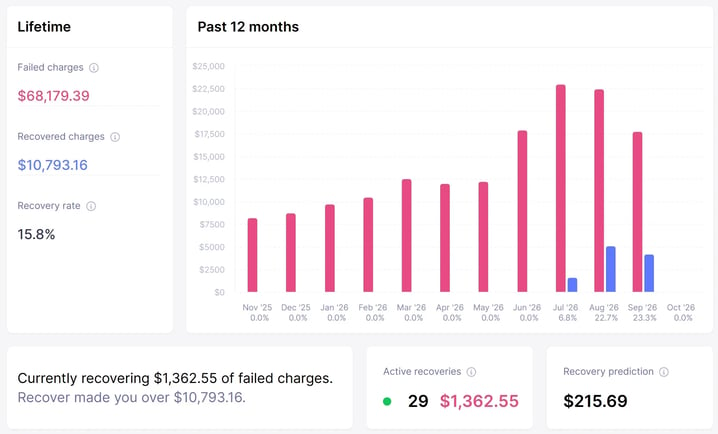
Recover automates the follow-up when a charge fails: customizable email + SMS sequences, in-app reminders and paywalls, card-expiry reminders, and a branded card-update form customers can complete in seconds. No custom code required.
Start your free trial → See how Recover works
Screenshot shows sample demo data.
FAQs
How do I know if retention automation is worth the cost?
To figure out if retention automation is worth the investment, take a close look at its return on investment (ROI). Pay attention to key metrics like how much it reduces churn and boosts profitability. Think about its ability to spot at-risk customers early and the cost savings from automating retention tasks instead of relying on manual efforts. Compare these advantages with the initial and ongoing expenses to see if it supports your business objectives.
What are the biggest hidden costs teams miss during implementation?
Teams often miss the less obvious costs tied to onboarding, such as delays in achieving value, customer dissatisfaction, increased mistakes, and higher day-to-day expenses. These challenges can quietly eat away at profits and make growth harder to achieve. That’s why careful planning during the onboarding phase is so important.
When should a human take over from an automated workflow?
When automation falls short of meeting customer expectations or creates frustration, it's time for a human to step in. Some clear warning signs include dropping resolution rates, repeated complaints from customers, or dissatisfaction during transitions between automated systems and live agents.
Human involvement becomes essential in situations that are complex, emotionally charged, or high-stakes - like handling complaints or engaging with high-value clients. By stepping in, humans ensure that automation serves as a tool to enhance, not replace, the personal touch that builds trust and keeps customers satisfied.