Table of Contents

Trial conversion rate measures how many trial users become paying customers, expressed as a percentage. It’s calculated using this formula:
(Converted Trial Users ÷ Total Trial Users) × 100
For SaaS businesses, this metric is essential - it reflects product appeal, impacts revenue growth, and lowers customer acquisition costs. Here's what you should know:
- Opt-in Trials (No Credit Card Required): Convert ~25% of users.
- Opt-out Trials (Credit Card Required): Convert ~50–60% of users.
- High Conversion Rates: Linked to faster revenue growth (+23%) and higher customer lifetime value (+21%).
Factors like trial length, onboarding experience, user engagement, and pricing models heavily influence conversion rates. Tools like Baremetrics simplify tracking and help identify trends, optimize strategies, and improve performance.
Trial conversion rates vary by industry:
- B2B SaaS: Median 18.5–25%, top performers 35–45%.
- B2C SaaS: Typically 10–20%, with some reporting up to 57%.
- Enterprise SaaS ($100K+ ACV): Median ~5%, top performers ~12%.
Improving your trial conversion rate involves refining onboarding, tracking user behavior, and using analytics to pinpoint opportunities for growth.
How to Increase Your SaaS Trial Conversions Without Developer Involvement | Audrey Melnik
sbb-itb-18a9912
Track this automatically
See your real trial conversion — connect Stripe in one click
Skip the spreadsheet. Baremetrics calculates MRR, churn, LTV and dozens of other subscription metrics straight from your billing data, and keeps them up to date.
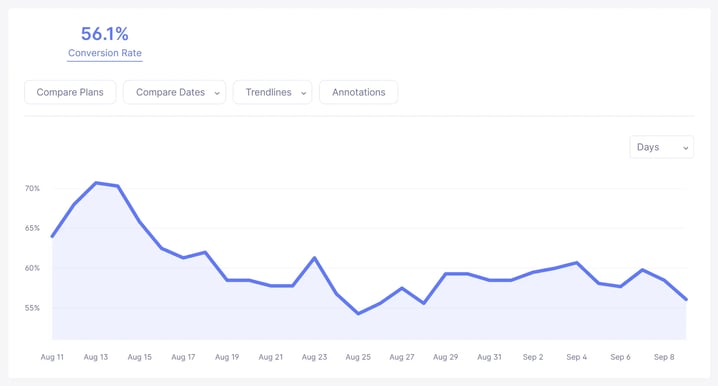
Start your free trial → or explore the live demo
Screenshot shows sample demo data.
How to Calculate Trial Conversion Rate
The formula is simple: (Number of Trial Users Who Convert to Paid / Total Number of Trial Users) × 100%. This calculation gives you a percentage that reflects how many trial users transition into paying customers.
Baremetrics offers a slightly different method for tracking: a 30-day rolling average. The formula here is: (Number of converted trials in the past 30 days / Number of new trials in the past 30 days) × 100. This method smooths out daily fluctuations, providing a clearer picture of conversion trends.
Key Variables in the Formula
The numerator in the formula represents the number of trials that successfully converted to paid subscriptions within a specific timeframe. The denominator is the total number of trial accounts started during that same period.
Consistency in data tracking is essential. Clearly define when a trial begins and what qualifies as a conversion. For instance, some platforms only count a conversion after the first invoice is paid, even if the customer cancels shortly after. Without consistent tracking, factors like duplicate accounts or inactive users can distort your conversion rate.
Cohort analysis is a helpful tool for understanding conversion rates based on trial start dates. This method accounts for the fact that conversions might happen later in the trial cycle. Keep in mind that conversion rates for recent cohorts may shift as more users from those groups convert over time.
Using Baremetrics for Automated Calculations
Baremetrics simplifies the process by automating trial conversion rate calculations in real-time. The platform uses the trial lengths defined by your paid plans or allows you to manually set trial periods for free plans through the Plan Management page.
The Trial Insights feature tracks active, new, converted, and canceled trials using up-to-the-minute data. It also categorizes trials based on criteria such as potential value or trials nearing their end, helping your sales team focus on the most promising leads. Additionally, you can compare the performance of different trial plans side-by-side to identify which pricing tiers or trial structures yield better conversion rates.
"The Trial Insights feature was a big deal for us, our conversion tracking from our free trial was an ad-hoc mess." – Charlie, Co-founder, Hosted Graphite
To ensure meaningful insights, Baremetrics requires at least 10 trials and 30 days of data before generating Trial Insights. These automated tools provide a solid foundation for refining and improving your trial conversion strategies.
Why Trial Conversion Rate Matters for SaaS
Trial conversion rate is a crucial metric for SaaS businesses. It tells you if your product is solving real problems, how well you're allocating your marketing budget, and whether your business model can support long-term growth. That single percentage can reveal a lot about your product's value and your company's trajectory.
Signs of Product-Market Fit
A high trial conversion rate is one of the clearest signs of product-market fit. SaaS companies that have achieved this typically see conversion rates between 15% and 25%, while the best performers push beyond 30%. Breaking these numbers down by customer segment can sharpen your marketing strategy. For example, analyzing conversion rates by user type helps pinpoint which audience segments value your product the most. This allows you to focus on attracting "best-fit" customers who are more likely to stick around as long-term subscribers.
"Conversion rate is a key factor in building a sustainable growth model." – David Skok, Venture Capitalist
Impact on Revenue and Customer Acquisition Costs (CAC)
Trial conversion rates don’t just affect signups - they directly influence your bottom line. Let’s say you spend $100 to acquire a trial user. If only 10% of those users convert, your customer acquisition cost (CAC) balloons to $1,000 per paying customer. But if you boost that conversion rate to 20%, your CAC drops to $500, effectively halving the expense.
The revenue impact is equally striking. A modest 5-point increase in trial conversion can drive a 50% boost in revenue from the same number of trial signups. Companies with higher-than-average conversion rates also report 23% faster revenue growth compared to their competitors. Even better, trial-converted customers tend to deliver 21% higher lifetime value than those acquired through other methods. Using advanced tracking tools can help you uncover these valuable insights.
Tracking with Baremetrics Features
To optimize your trial conversion rate, you need accurate tracking tools. Platforms like Baremetrics provide features like cohort analysis, which lets you monitor how conversion rates change over time and measure the effects of product updates or onboarding tweaks. You can also use segmentation to break down conversion data by variables like company size, industry, or geography, helping you identify your highest-performing customer segments. Custom dashboards allow you to track the metrics that matter most, giving you the ability to spot dips in conversion rates before they start cutting into your monthly revenue.
Factors That Affect Trial Conversion Rate
Many elements influence whether trial users decide to become paying customers. By understanding these factors, you can pinpoint where to focus your efforts for the most impact.
Trial Length and Onboarding Experience
The length of a trial and the quality of onboarding play a big role in conversion rates. Shorter trials (7–14 days) are ideal for straightforward products, as they create urgency and allow users to quickly understand the core features. On the other hand, longer trials (21–30 days) are better suited for more complex tools that need time to integrate into users' workflows and fully showcase their value.
For example, mobile apps with trials lasting between 5 and 32 days tend to convert at 44–45%, while trials lasting just 1–4 days see a lower conversion rate of 30%.
The onboarding experience also matters. Features like interactive walkthroughs, tooltips, and guided tours help users hit important activation milestones, reducing confusion and increasing engagement. A great example is Blinkist, which boosted its trial conversion rate by adding clear push notifications to remind users when their trial was ending. This transparency built trust and encouraged more users to convert to paid plans.
These foundational elements help create an environment where users can see the product's value quickly and easily.
User Engagement and Activation Metrics
Tracking user engagement and activation milestones is essential for predicting conversions. Key actions - like inviting a teammate or completing a core feature - can signal which users are most likely to convert.
Keeping an eye on in-app behavior also lets you step in with helpful resources, like self-service articles or video tutorials, to address any pain points quickly.
Once you understand user behavior, pricing strategies and segmentation can further refine your approach.
Pricing and Targeted Segmentation
Pricing models and segmentation strategies significantly influence trial conversion rates. For example, opt-out trials (which require a credit card upfront) tend to attract high-intent users, resulting in conversion rates between 48.8% and 60%. In contrast, opt-in trials (no credit card required) typically convert at a lower rate of 18.2% to 25%. The trade-off? Opt-out trials may reduce the total number of signups due to the added friction, but the leads you do get are more likely to convert.
Here's a quick comparison of different trial models:
| Trial Model | Conversion Rate | Pros | Cons |
|---|---|---|---|
| Opt-in (No card) | ~25% | High signup volume | Lower user intent |
| Opt-out (Card required) | 50–60% | High user intent | Fewer trial starts |
| Freemium | 1–10% | Large user base | Low urgency to upgrade |
Segmentation is another key factor. Breaking down conversion data by factors like company size, industry, or location can reveal patterns. These insights help you tailor your messaging and focus on the groups most likely to convert.
Trial Conversion Rate Benchmarks by Industry
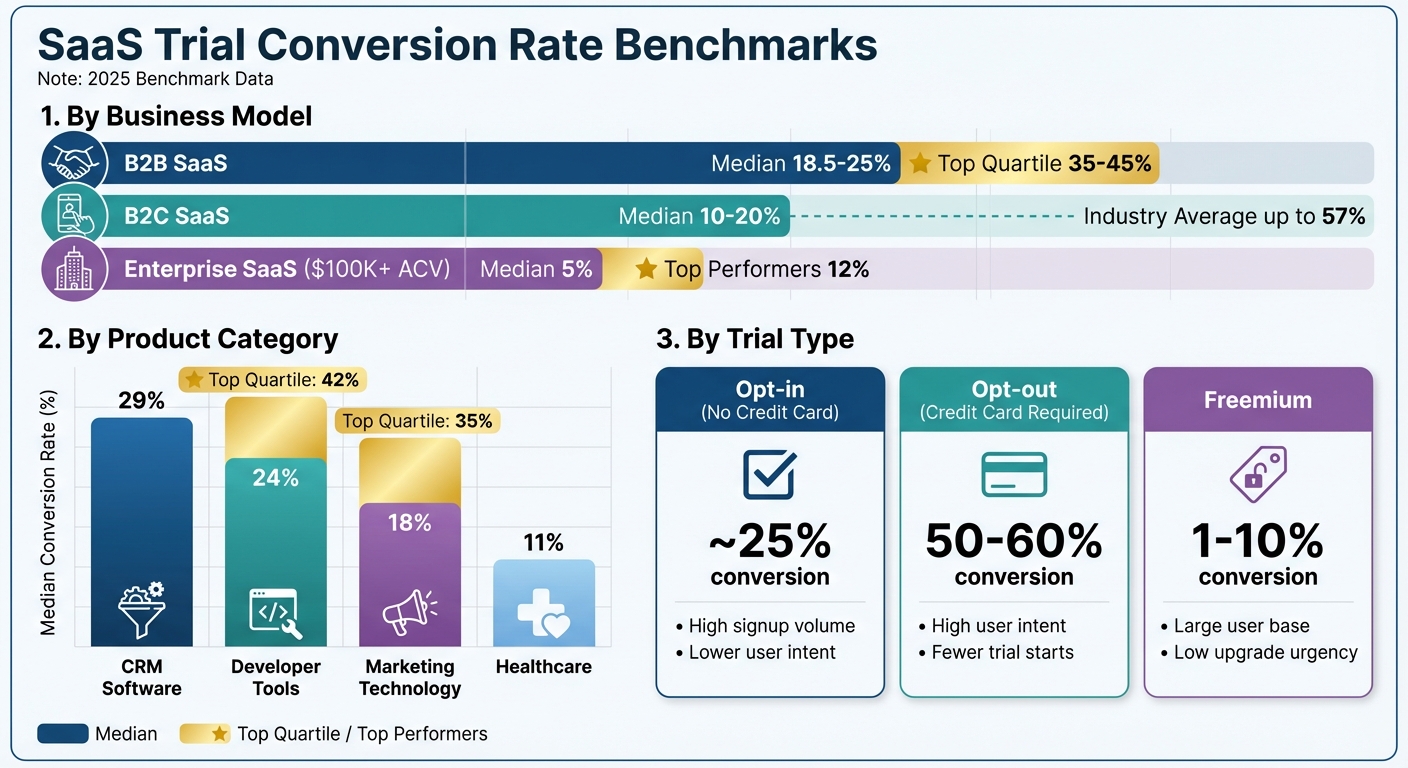
SaaS Trial Conversion Rate Benchmarks by Industry and Business Model
Understanding trial conversion rate benchmarks is essential for setting realistic goals and identifying areas for improvement. These rates differ significantly based on your business model, target audience, and the complexity of your product.
Benchmarks by SaaS Type
Conversion rates in SaaS can vary widely depending on the segment. For B2B SaaS companies, median trial-to-paid conversion rates typically range between 18.5% and 25%, with the top 25% achieving rates between 35% and 45%. In 2025, the median conversion rate for B2B SaaS stands at 18.5%.
In contrast, B2C SaaS businesses usually see lower conversion rates, averaging between 10% and 20%, though some reports suggest the industry average could be as high as 57%. This wide range reflects the diversity of consumer-oriented products and pricing models.
For Enterprise SaaS companies with high Annual Contract Values (ACV) of $100,000 or more, the median conversion rate is around 5%, with top performers reaching up to 12%. These lower rates are understandable since higher-priced products often require extended evaluation periods and involve multiple decision-makers.
The type of product also influences conversion rates. For example, CRM software leads with a conversion rate of about 29%, followed by Developer Tools at 24%, Marketing Technology at 18%, and Healthcare products at 11%. These differences highlight how quickly users can experience value and integrate specific tools into their workflows.
| SaaS Segment | Median Conversion Rate | Top Quartile (Top 25%) |
|---|---|---|
| B2B SaaS | 18.5% – 25% | 35% – 45% |
| B2C SaaS | 10% – 20% | 57% (Industry Avg) |
| Enterprise ($100K+ ACV) | 5% | 12% |
| CRM Software | 29% | – |
| Developer Tools | 24% | 42% |
| Marketing Tech | 18% | 35% |
Using Baremetrics Benchmarks
Tools like Baremetrics can help you measure and refine your trial performance with precision. The platform calculates your trial conversion rate using a 30-day rolling average and tracks Trial Value, which estimates the revenue potential of your current trial pipeline.
Baremetrics also lets you break down conversion rates by pricing tier or plan type. This is particularly valuable, as conversion benchmarks can vary significantly between basic plans and enterprise offerings. By leveraging these insights, you can fine-tune your trial strategies to align with industry standards and optimize performance.
How to Improve Trial Conversion Rate with Baremetrics
Baremetrics simplifies trial conversion tracking by automating insights and presenting actionable data. These insights help you identify areas for improvement and focus your efforts where they matter most.
Trial Insights and Custom Dashboards
The Trial Insights dashboard organizes your trials into priority segments, such as "highest value" and "ending soon." This helps your team zero in on the most critical opportunities at the right time. The dashboard also provides real-time metrics, including conversion rates (calculated as a 30-day rolling average), average trial length, and the number of active or new trials - all in one place.
With the "Compare Plans" feature, you can analyze how different trial plans perform side-by-side. This visual comparison highlights which pricing tiers or trial structures yield better conversion rates. For example, if one plan consistently falls short, it may indicate a need to refine onboarding processes or adjust pricing for that group. As Charlie from Hosted Graphite shared:
"The Trial Insights feature was a big deal for us, our conversion tracking from our free trial was an ad-hoc mess"
You can also act on trials nearing expiration that have a high Trial Value by sending personalized outreach or offering discount codes.
Segmentation and Cohort Analysis
Segmentation takes trial insights a step further by helping you focus on high-value users. Baremetrics allows you to sort trials by metrics like value or expiration date, ensuring your team prioritizes the most promising leads while avoiding wasted effort on low-potential ones. For example, trials that are about to expire can be flagged, giving your team a clear list of actions for timely follow-ups.
Revenue Forecasting and Growth Insights
By tying trial conversions directly to revenue, Baremetrics helps you focus on optimizations that drive measurable growth. Using your conversion rate and Trial Value, the platform models the revenue potential within your current trial pipeline. Even minor improvements in conversion rates can lead to noticeable revenue increases, and Baremetrics' forecasting tools quantify this impact based on recent trends. This direct connection between trial performance and revenue projections strengthens the case for investing in areas like onboarding, product development, or sales strategies.
Conclusion
Trial conversion rate serves as both a clear indicator of product-market fit and a major contributor to long-term revenue growth. Companies with higher conversion rates often see faster revenue growth compared to their peers. The gap between average performers (15–20% conversion rates) and top performers (30% or more) often boils down to how well they track, interpret, and act on trial data.
Automated tracking creates a feedback loop that continuously improves your product and marketing efforts. By refining your approach to conversion tracking, you can sharpen your overall business strategy.
Focusing on specific metrics like activation rates and feature adoption is key. For instance, trial users who complete critical activation steps within the first three days are 3–4 times more likely to convert compared to those who don't. Similarly, SaaS companies that routinely perform cohort analysis see roughly an 18% higher conversion rate than those that skip this practice. Tools like Baremetrics make these insights actionable by linking trial performance to revenue forecasts.
Baremetrics simplifies trial data analysis by segmenting users based on lifetime value and urgency, helping teams prioritize high-value leads and prevent churn. With features like Trial Insights, cohort analysis, and revenue forecasting, Baremetrics connects trial performance directly to revenue outcomes. This enables businesses to justify investments in areas like onboarding, product improvements, and sales strategies. Even small boosts in conversion rates can be quantified, highlighting their impact on revenue growth.
Improving trial conversion is an ongoing effort. Focus on defining clear conversion windows, streamlining your onboarding process, and using analytics to pinpoint where users drop off. By adopting these data-focused strategies, you’ll shorten the time it takes for users to see value in your product and create a reliable growth engine for your SaaS business.