Table of Contents

Net sales revenue is defined as the total income generated from a company's sales of goods and services after deducting returns, discounts, and allowances. Net revenue, by contrast, refers to all income from operations minus transactional expenses—including non-sales income sources. While all revenue is good revenue, understanding the differences between these types is essential for accurate financial reporting and forecasting.
Last updated: March 2026
It's crucial to understand the different types of revenue, including what they mean, how to calculate them, and how to track them.
We've already discussed net revenue compared to net income and gross revenue.
In this article, we're going to look at the differences between net sales revenue vs. net revenue.
First: What is Revenue?
The term "revenue" is defined as the amount of income generated by a business's operational efforts.
There are, of course, different types of revenue, and those qualifying add-on words like "net," "gross," and "sales" all change the exact meaning of the word.
Gross revenue is defined as the total sum of all revenue before any deductions. It's a nice, pretty number that shows you the total amount of money generated in a set time.
Other types of revenue remove certain expenses from that total sum, giving you an accurate understanding of how business expenses play a role in profitability.
What is Net Revenue?
Net revenue refers to the entire income your company generates from selling goods and services through the company's operations, minus transactional expenses like discounts or funds.
One reason the distinction between net revenue and net sales revenue matters so much is timing: revenue can only be recognized when it has been earned, per accrual accounting standards. The University of Pennsylvania's finance policy on GAAP revenue recognition principles lays out how these rules apply in practice, and why recognizing revenue at the wrong point can distort both figures.
In addition to the revenue from sales, net revenue may include supplementary income sources outside of those direct sales, including appreciation of funds in a high-yield savings account or ad-based revenue.
If you want to look at revenue without all the expenses, you'll want to look at net income. Net income refers to the amount remaining after all operating expenses, taxes, and costs have been subtracted from total revenue.
Why Net Revenue Matters
Net revenue is a vital metric to help you understand the total revenue you're bringing in, not just the amount from initial sales.
It can help you track profit month-over-month and year-over-year to give you a solid idea of how much your net sales (including refunds) are generating.
It looks at sales-focused income alone so that you can clearly and accurately understand how monthly recurring revenue (MRR) changes without being distracted by data like once-a-year expenses or unexpected costs. MRR is defined as the predictable revenue a subscription business expects to receive each month from active subscribers.
How to Calculate Net Revenue
Calculating net revenue is easy with the right tools in place and accurate data at hand!
The net revenue calculation involves adding up your total profit during a set time period and then subtracting the total transactional costs like discounts and refunds.
In other words, here's the net revenue formula:
Total revenue during a set time period - Total of transactional expenses during a set time period = Net revenue
What is Net Sales Revenue?
Net sales revenue is defined as the total sum of your sales after deducting all costs of products sold and operational expenditures.
If you want a straightforward, government-backed definition to anchor your understanding, the Illinois Small Business Development Center defines net sales as revenue from sales after returns and allowances are deducted, which is consistent with how most financial statements treat the figure. This framing, as seen in net sales defined by the Illinois SBDC, reinforces why separating returns and allowances from gross figures matters for accurate reporting.
In other words, this is the amount of revenue you're generating from the sales of goods and services alone, after the expenses of refunds, discounts, and deductions.
Gross sales revenue, therefore, is the total amount of sales revenue without expenses deducted.
Why Net Sales Revenue Matters
This value is a critical financial metric for determining a business's sales profitability, as it indicates how lucrative and in-demand a company's goods and services are.
It is critical to remember that sales profitability, or the gross profit margin, refers to the percentage of revenue remaining after subtracting the cost of goods sold. Gross profit margin may only provide insight into the profitability of the business's goods or services. In comparison, total revenue offers insight into a business's overall financial health.
How to Calculate Net Sales Revenue
Calculating net sales revenue involves adding up all of your sales-based income and then subtracting transactional expenses.
Academic research on financial accounting methodology confirms that sales returns and allowances directly reduce the net sales revenue figure reported on the income statement: a point that matters when you're reconciling your Stripe data with your books. For a deeper look at the accounting treatment behind this, see how sales returns and allowances reduce net sales revenue on the income statement.
This is the net sales revenue formula:
Total revenue from direct sales - Transactional expenses like returns = Net sales revenue
What Are the Differences Between Net Sales Revenue and Net Revenue?
The key difference between revenue and sales is that revenue can holistically represent a business's income, while sales represent just a portion of that money. There are many significant distinctions, such as the purpose for which each revenue stream may be utilized, each income source, and the impact each of these values may have on a company.
1. Source of revenue vs. sales
Revenue and sales are two distinct sources of money for a business. For example, in addition to sales, a company's total revenue may include money from liquidated assets, interest or investment income, contributions, or royalties. However, the sources of revenue for a business's sales are usually limited to the cash flow generated through sales transactions.
Related Read: Revenue vs. Income
2. Value of revenue vs. sales
Sales include cash earned from paying consumers, while revenue refers to the entire amount of money earned by a business over a certain period. As a result, revenue is often higher. However, when sales income exceeds the overall revenue generated by a company, it may indicate that the business has incurred more expenditures or expenses. The difference in value between revenue and sales may affect net income variations.
What Are the Crucial Net Revenue Metrics for Subscription Businesses?
When it comes to tracking your net revenue, there are multiple metrics that you definitely want to track. These will vary slightly depending on your specific business model.
Subscription businesses and SaaS companies should track the five following metrics for net revenue to get a holistic look at their financial standing (all of which are offered by Baremetrics, for the record!).
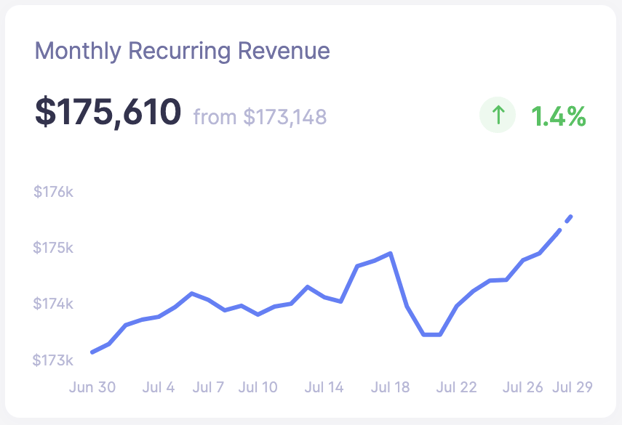
1. Monthly Recurring Revenue (MRR)
Monitor your monthly recurring revenue (MRR) regularly.
A benefit of using Baremetrics to track your MRR is that our subscription analytics software is more accurate than most. Unlike most tools, we only track active, paying subscriptions; those that are paused, delinquent, or overall inactive are not counted.
We also offer MRR data by segment.
View your MRR according to a client's location, plan type, and other criteria.
You may create objectives, modify existing goals, and keep track of particular dates when a new product was released.
You can even view your notes directly on the graphs to keep a close eye on the state of your company.
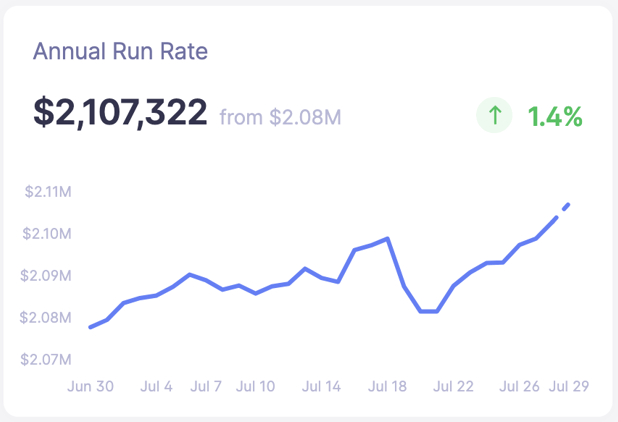
2. Annual Run Rate (ARR)
ARR (Annual Run Rate) is defined as a projection that forecasts your current revenue over the next 12 months. The annual run rate is based on the assumption that nothing should change in the next year. It is predicated on the assumption of no new clients, no churn, and no additions.
While this is an improbable scenario, the measure itself helps company leaders consider the one-year horizon.
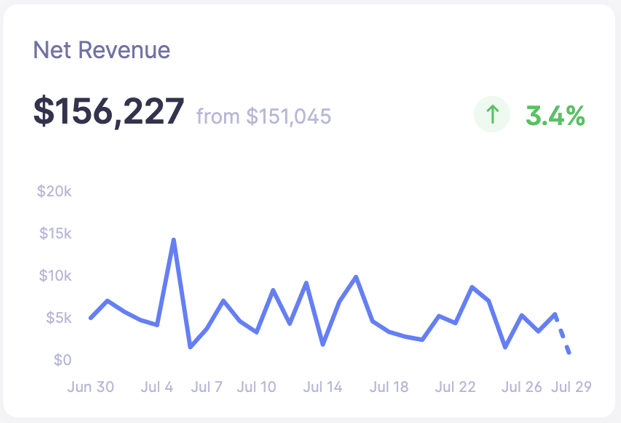
3. Net Revenue
Net Revenue is calculated as Gross Volume (both recurring and non-recurring) minus Refunds. It's important to track to see the big picture of what's actually happening with profit from your total sales.
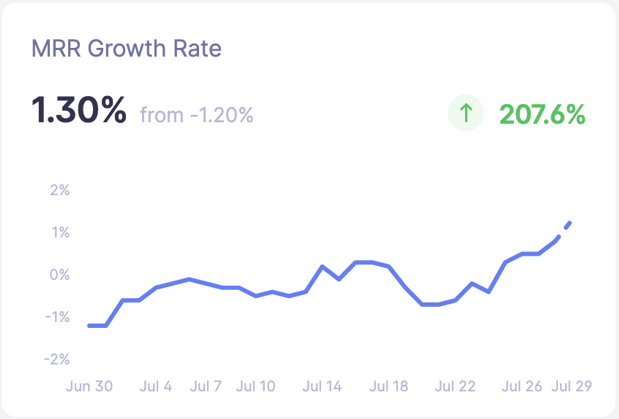
4. MRR Growth Rate
This metric is simply the percentage change in monthly revenue generated from one month to the next. It may be computed on a daily, weekly, or monthly basis, as well as annually.
5. Overages
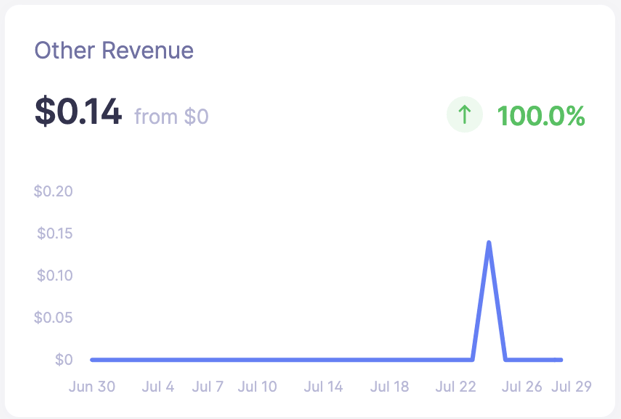
Overages include all one-time expenses that your company incurs, including use fees and any other payments not associated with a subscription.
When using Baremetrics, clients may manually enter this data through the Baremetrics API. The other sources of revenue can be evaluated using the Baremetrics tool.
How to Conduct a Net Revenue Analysis
Conducting a net revenue analysis involves evaluating core metrics and considering factors that may be contributing to whether or not you're meeting your revenue goals.
To conduct a net revenue analysis, we strongly recommend following these steps:
- Choose a reliable subscription analytics platform. You need data you can trust if you're going to take action on it. Baremetrics has 26 subscription-focused revenue metrics for that exact reason.
- Look at the metrics discussed above. The five key metrics we discussed in the previous section are where you want to start your revenue.
- Assess revenue trends. You don't just want to look at a single, static month. You'll learn more by assessing month-over-month and year-over-year trends. Hopefully, measures have been put into place to help you achieve new goals, and you want to see a consistent trend (even if it's subtle) instead of drastic spikes if they have a lot of downs.
- Consider factors contributing to trends. Have you invested more in advertising or tried a new marketing channel? Was there a potential technical issue contributing to customer complaints (and thus churn)?
Understanding what's impacting your net revenue and why gives you the information you need to make changes and optimize for increased revenue moving forward.
AI Tools Are Categorizing Your Revenue, But Are They Getting It Right?
In 2026, more SaaS finance stacks include some form of AI-assisted categorization, whether that's a bookkeeping copilot auto-tagging transactions, a payment processor like Stripe applying smart revenue labels, or an analytics platform inferring revenue types from metadata. That's genuinely useful. But it also introduces a new failure mode: automated tools that conflate net sales revenue with broader net revenue, or that miscategorize non-sales income (like interest earned or ad revenue) as part of your core product revenue.
The practical risk is real. If your dashboard is automatically bucketing investment interest or partnership income into your net sales figure, your sales-specific profitability looks stronger than it actually is.
Conversely, if refunds and chargebacks aren't being cleanly subtracted before a tool computes your net revenue, you're making pricing and growth decisions on an inflated number.
Neither scenario ends well when an investor asks for a clean revenue breakdown or when you're forecasting next quarter's MRR growth.
The fix isn't to distrust automation: it's to build a simple audit habit. At least once per quarter, pull your gross transaction data manually and reconcile it against what your analytics platform is reporting as net sales revenue and net revenue. Confirm that returns, discounts, and allowances are being deducted correctly from your sales figures, and that non-recurring income sources aren't being mixed into your MRR or ARR calculations.
Baremetrics is built to be explicit about what's included in each metric, like active subscriptions only, refunds subtracted before net revenue is displayed, which makes this kind of audit straightforward rather than a spreadsheet nightmare.
Final Thoughts: How Baremetrics Can Help
Net revenue contributes to your company's success, so it's an important metric to watch. It's actually a critical KPI for many SaaS businesses and start-ups and is often assessed by investors who are deciding whether or not to offer funding.
Make sure that the data you're tracking is accurate and reliable. Baremetrics can help with that.
Baremetrics is a comprehensive and reliable business metrics monitoring solution for MRR, churn, and the overall number of subscribers. Baremetrics connects directly to your payment gateway, allowing for precise monitoring of your financial metrics. When comparing Baremetrics to other solutions for Net Revenue analysis, select Baremetrics for deeper insights.