Table of Contents
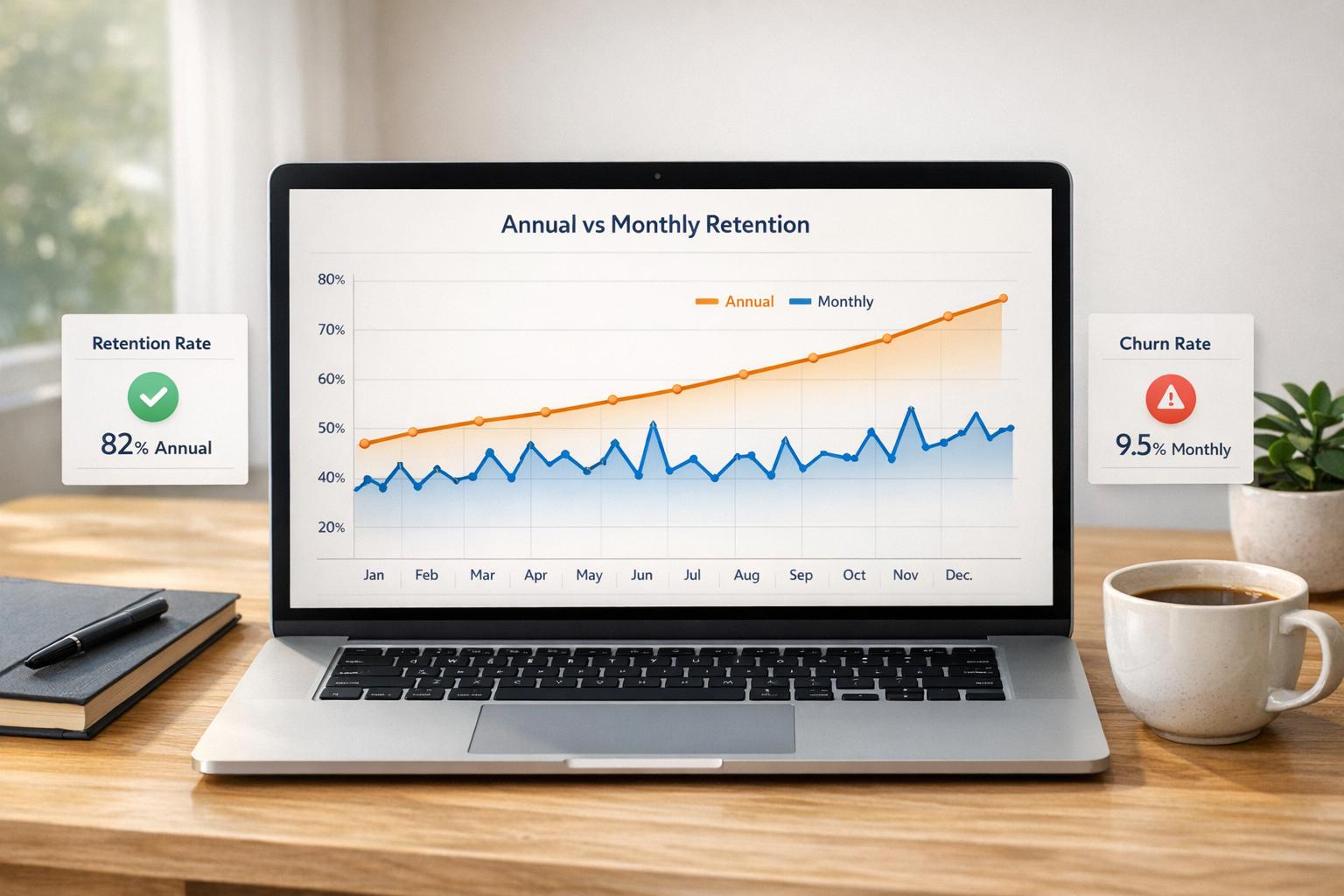
Annual billing is the better pricing model for retention than monthly billing. Annual plans retain about 92% of customers after 12 months versus 68% for monthly plans, and cut involuntary churn by up to 95% because customers face one payment a year instead of twelve. Monthly billing wins on acquisition - roughly 50% higher initial conversion - but creates 12 renewal decisions a year and accounts for about 85% of all SaaS churn. Most SaaS companies offer both and use a 15-20% annual discount to nudge upgrades.
- Retention Rates: Annual plans retain 92% of customers, while monthly plans retain only 68%.
- Churn: Monthly billing leads to higher churn (8.5%-12% per month) compared to annual billing (3.1%-7% per year).
- Cash Flow: Annual plans provide upfront revenue, improving growth opportunities, while monthly plans spread revenue over time.
- Customer Behavior: Annual subscribers are more committed and less price-sensitive, while monthly users are more likely to cancel.
Last updated May 2026.
Quick Comparison
| Metric | Monthly Pricing | Annual Pricing |
|---|---|---|
| Retention | 68% | 92% |
| Churn Rate | 8.5%-12% per month | 3.1%-7% per year |
| Lifetime Value | Baseline | 40%-45% higher |
| Upfront Revenue | No | Yes |
| Customer Commitment | Short-term | Long-term |
Bottom Line: Annual pricing boosts retention and provides financial stability, while monthly pricing offers flexibility but increases churn risk. Choose based on your business stage and target audience.
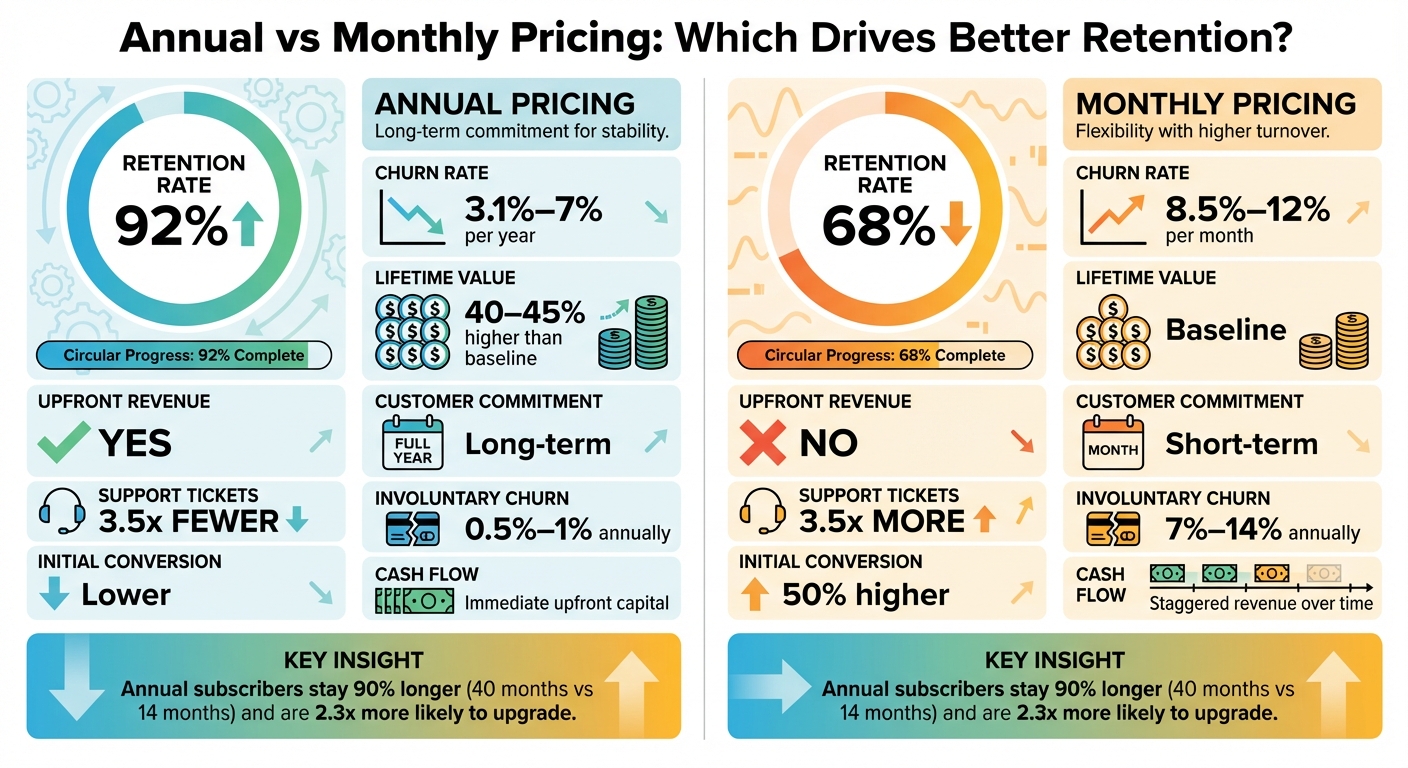
Annual vs Monthly Pricing: Retention Rates and Key Metrics Comparison
How do annual and monthly subscription costs differ?
Monthly plans charge a smaller amount 12 times a year, which lowers the upfront cost and lifts initial conversions by roughly 50%. Annual plans charge the full year in one payment - usually at a 15-20% discount - so the effective monthly rate is lower while the commitment is higher. The difference reshapes both budgeting and cash flow for each side of the transaction.
For the customer, monthly billing is easier to approve and fits a pay-as-you-go budget, but it requires 12 repeat approvals a year. Annual billing is a single, larger line item that aligns with yearly budget cycles and procurement, which is why about 42% of B2B SaaS buyers prefer it when a discount is offered. For the business, annual plans deliver 12 months of revenue immediately, while monthly plans spread that same revenue across the year and delay CAC payback to 5-10 months.
Why does annual billing improve retention?
Annual billing improves retention by collapsing 12 yearly renewal decisions into one. That single decision point drives 92% retention with annual plans compared to 68% with monthly billing, and it removes the repeated cancellation prompts that make monthly customers three times more likely to cancel within the first 90 days. Fewer decision points means stronger customer loyalty.
How much does annual billing lift retention?
Switching to annual billing simplifies decision-making for customers, reducing it to just one choice per year instead of twelve. This shift has a big impact: 92% retention with annual plans compared to 68% with monthly billing. The difference is striking - monthly users are three times more likely to cancel within the first 90 days, leading to an average churn reduction of 75% overall. By limiting decision points, annual billing helps secure customer loyalty.
How does annual billing strengthen cash flow?
Annual billing doesn't just improve retention; it also strengthens cash flow. With annual plans, you receive 12 months of revenue upfront, essentially acting as an interest-free loan from your customers. This upfront cash can significantly boost growth. Companies where 60% or more of revenue comes from annual contracts grow 1.8x faster than those relying on monthly billing. Why? Because the immediate influx of funds can be reinvested in customer acquisition and retention strategies within the same quarter.
"Prepaid annual contracts create 'negative working capital' - effectively letting customers finance your company's growth at zero interest." - Tomasz Tunguz, Venture Capitalist
A great example of this strategy in action is Adobe Sign (formerly EchoSign). Under Jason Lemkin's leadership, the company hit cash-flow positive status at around $5M ARR by leveraging prepaid annual contracts to fuel growth even before recognizing the revenue. Operationally, annual billing also cuts costs - one payment transaction instead of twelve reduces processing expenses by 12x and significantly lowers the effort spent on managing failed payments.
Why do customers choose annual plans?
When offered a discount, 42% of B2B SaaS customers prefer annual billing. But it's not just about saving money. Annual billing aligns with business buyers' budget cycles, making procurement smoother and eliminating the hassle of monthly expense approvals. Plus, annual subscribers are 2.3x more likely to upgrade within their first year, treating the product as a long-term investment rather than a short-term trial.
The psychology behind this is fascinating. Paying upfront for a year creates a "sunk cost effect", where customers feel motivated to get the most out of their investment. While 44% of users initially feel "locked in" by annual plans, only 9% regret the choice after renewal. Over time, that initial commitment transforms into satisfaction as they see the value of their decision. These behavioral shifts also influence how and when churn happens.
How does annual billing change churn patterns?
Annual billing significantly reduces involuntary churn by cutting down payment attempts from 12 per year to just one. This can lower failure-related churn by up to 95%. The trade-off is that annual billing can delay churn signals, masking product issues that monthly billing would flag sooner.
For instance, Buffer's internal data revealed that monthly customers churned at 7% per month, while annual customers had an equivalent monthly churn of only 2.4%. This difference resulted in annual subscribers staying an average of 40 months, compared to just 14 months for monthly users - a 90% higher lifetime value. To offset delayed churn signals, you'll need robust feedback systems to catch and address problems early.
How Baremetrics handles annual and monthly plans
Baremetrics normalises every non-monthly plan to a monthly amount before it enters MRR, so a customer paying $120 on an annual plan adds $10 to MRR for the next 12 months. Annual plans use the same churn formula over 365 days: cancelled customers in the last 365 days ÷ active customers 365 days ago. Annual plans less than a year old don't show up on churn dashboards yet, so annual churn also surfaces later in your reporting. Moving a customer onto an annual plan with free months included counts as a downgrade, because it reduces MRR. Compare Plans in the Baremetrics dashboard lets you check monthly and annual plans separately.
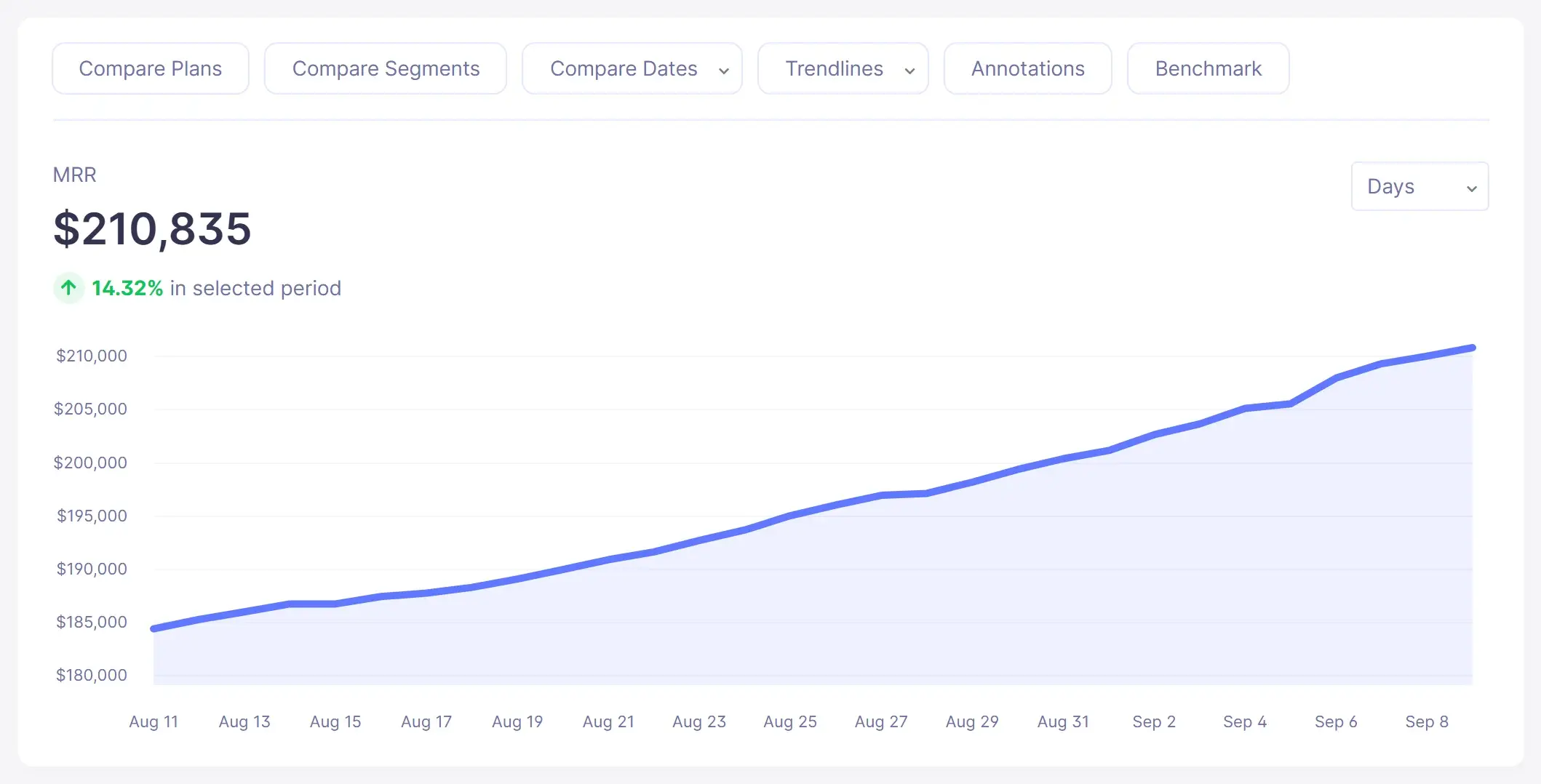
Screenshot shows sample demo data. Source: Baremetrics Help Center (Monthly Recurring Revenue, User and Revenue Churn, Cancellations and Downgrades).
When is monthly pricing the better choice?
Monthly pricing is the better choice for early-stage products, SMBs, and trial-led funnels that need a low entry price and fast feedback. Its lower upfront cost lifts initial conversions by about 50%, and quick cancellations within 30-60 days surface product-market-fit problems early. The cost is higher churn: monthly subscribers face 12 renewal decisions a year and make up roughly 85% of all SaaS churn.
How does monthly billing affect retention?
With monthly billing, customers face 12 opportunities a year to reconsider their subscription - making cancellations more likely. This setup encourages a short-term commitment mindset, where minor issues can lead to cancellations. In fact, only 68% of monthly subscribers stick around after a year. Monthly churn rates typically range from 8% to 12%, with the highest risk occurring during the first three months.
What does monthly billing mean for cash flow?
Monthly billing spreads revenue over time, delaying customer acquisition cost (CAC) payback to anywhere between 5 and 10 months. This slows down the ability to reinvest. It also leads to operational challenges, like a 3.5x increase in billing support tickets and higher refund volumes. Additionally, payment failures contribute to annual involuntary churn rates of 7% to 14%.
Why do customers choose monthly plans?
Monthly plans are attractive because they lower upfront costs, increasing initial conversions by roughly 50%. This makes them particularly appealing to small and medium-sized businesses (SMBs), individuals, and trial users. However, the flexibility of monthly billing can lead to subscription fatigue. About 36% of customers cancel periodically to manage their budgets. These behaviors heavily influence churn dynamics in monthly billing models.
What do monthly churn patterns look like?
Dissatisfied monthly subscribers often cancel within 30 to 60 days, providing immediate feedback on whether the product meets their needs. In SaaS businesses, monthly subscribers account for a staggering 85% of all churn events. Churn risk increases by 14% right after a free trial ends, and 42% of monthly customers cite unpredictable budgets as their main reason for canceling. While monthly billing highlights issues in real time - offering valuable insights into product fit - it also presents a constant challenge for retention efforts.
What role do discounts play in annual vs monthly pricing?
Discounts are the main lever that moves customers from monthly to annual plans. Most SaaS companies offer a 15-20% annual discount, and framing it as "two months free" - about 17% - converts better than showing a raw percentage. The goal is to make the annual saving feel concrete enough to overcome the larger upfront payment.
Presentation matters as much as the number. Making annual the default plan keeps 40-60% of customers on annual, versus under 20% when monthly is the default. Aim for 40-60% of new subscriptions on annual plans; if you are below 30%, the discount is probably too small or the annual option isn't prominent enough. Standard discounts range from 10-25%, with 17% the most common anchor.
Annual vs monthly pricing: pros and cons
Each model presents distinct advantages and challenges that affect both customer retention and cash flow. Annual billing favours retention and growth; monthly billing favours acquisition and feedback speed. The side-by-side table below summarises the trade-off.
| Metric | Monthly Pricing | Annual Pricing |
|---|---|---|
| 12-Month Retention | 68% | 92% |
| Average Churn Rate | 8.5%-12% per month | 3.1%-7% per year |
| Lifetime Value Impact | Baseline | 40%-45% higher |
| Involuntary Churn | 7%-14% annually | 0.5%-1% annually |
| Support Ticket Volume | 3.5x more billing tickets | 16%-50% reduction |
| Initial Conversion | 50% higher | Lower due to sticker shock |
| Cash Flow | Staggered revenue | Immediate upfront capital |
| Feedback Speed | 30-60 days | Masked until renewal |
| Economic Volatility | 23% higher during downturns | - |
What are the pros and cons of annual billing?
Annual billing's strengths are retention and growth. One payment a year reduces involuntary churn by up to 95%, the upfront cash accelerates growth by about 33%, and annual customers report Net Promoter Scores 19 points above monthly subscribers. The downsides are a higher upfront price that causes "sticker shock" for newer products, and masked dissatisfaction that can create a "renewal cliff" if engagement drops before renewal.
"Annual contracts are essentially interest-free loans from your customers that allow you to grow faster without dilution." - Patrick Campbell, Founder of ProfitWell
What are the pros and cons of monthly billing?
Monthly billing's strengths are low entry cost and fast feedback. A lower commitment makes it easier for customers to start - especially for early-stage products - and cancellations within 30-60 days are a clear product-market-fit signal. For startups under $1M ARR, monthly billing can drive growth as high as 131% year-over-year. The downsides are higher churn (8.5-12% per month), 3.5x more billing support tickets, 7-14% annual involuntary churn from payment failures, and revenue that is 23% more volatile during downturns.
Watch: how to price your SaaS to drive growth
How do you decide which billing model fits your business?
Match billing to your stage and buyer. Choose annual billing for established products selling to mid-market or enterprise buyers, where retention, upfront cash, and procurement cycles all favour a yearly commitment. Choose monthly billing for early-stage products, SMBs, and trial-driven funnels that need a low entry price and fast product-fit feedback. Most companies run both and use a 15-20% discount to move committed users to annual.
Industry patterns follow the same logic. Enterprise and B2B SaaS lean annual to match procurement budgets - about 42% of B2B buyers prefer annual when offered a discount, and Adobe Sign reached cash-flow positive at roughly $5M ARR on prepaid annual contracts. Consumer, SMB, and trial-led tools lean monthly for the low entry price, as Buffer's large monthly base shows. If you're unsure, launch monthly to learn fast, then introduce a discounted annual plan once you can prove retained value.
How does billing frequency affect revenue forecasting?
Billing frequency changes both the shape and the predictability of revenue. Annual billing front-loads cash and smooths forecasting: you collect 12 months upfront, and companies with 60% or more of revenue on annual contracts grow about 1.8x faster. Monthly billing produces a steadier but slower stream, delaying CAC payback to 5-10 months and adding volatility that runs about 23% higher during downturns.
The forecasting risk with annual plans is hidden churn - revenue looks stable until a wave of renewals comes due. Track cohort renewal rates and net revenue retention, not just monthly recurring revenue, so a "renewal cliff" doesn't surprise your model. Tools like Baremetrics surface cohort retention, churn, and MRR movements in real time so you can forecast each billing model accurately.
Baremetrics Forecasting
Forecast revenue from your real subscription data
Financial forecasting for SaaS companies: modeling, forecasting and scenario planning in one tool, including hiring plans, built on the metrics Baremetrics already tracks.
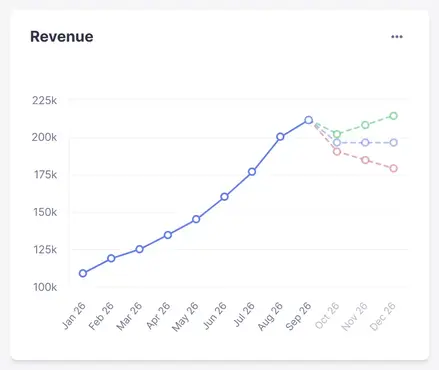
Start your free trial → See how Forecasting works
Screenshot shows sample demo data.
Frequently asked questions
Is annual or monthly pricing better for retention?
Annual pricing is better for retention. Annual plans hold about 92% of customers after 12 months versus 68% for monthly plans, and reduce involuntary churn by up to 95% because there is one payment attempt a year instead of twelve. Monthly billing converts more new customers but accounts for roughly 85% of all SaaS churn.
What is the most common annual discount for SaaS?
The standard annual discount ranges from 10-25%, with about 17% - framed as "two months free" - the most common. Aim for 40-60% of new subscriptions on annual plans; below 30% usually means the discount is too small or the annual option isn't presented prominently enough.
How do annual and monthly plans affect budgeting?
Monthly plans fit pay-as-you-go budgets with a low, repeatable charge but need 12 approvals a year. Annual plans are a single larger line item that aligns with yearly budget cycles and procurement, which is why about 42% of B2B buyers prefer annual when a discount is offered.
Which billing model is easier to forecast?
Annual billing is easier to forecast quarter to quarter because cash arrives upfront, but it can hide churn until renewals come due. Monthly billing is more volatile month to month yet surfaces churn immediately. Track cohort renewals and net revenue retention to forecast either model accurately.
Should I offer both monthly and annual plans?
Yes - most SaaS companies offer both. Monthly lowers the barrier to entry and speeds up feedback, while a 15-20% annual discount moves committed users to a yearly plan. Making annual the default keeps 40-60% of customers on annual versus under 20% when monthly is the default.
Conclusion
Deciding on the right pricing model comes down to where your business stands and what you aim to achieve in the long run.
For established products targeting enterprise or mid-market customers, annual billing provides a solid foundation. It ensures stability, improves retention rates (92% compared to 68% with monthly billing), and delivers upfront capital to fuel growth.
On the other hand, monthly billing works well for early-stage companies or those focusing on cost-conscious users. It's ideal for products in their initial phases or for small businesses and individuals with tight budgets. Monthly plans encourage quicker customer acquisition and provide faster feedback on product performance.
Many SaaS companies strike a balance by offering both plans. They often include a 15-20% discount to encourage annual commitments while keeping the flexibility of monthly billing. This approach allows businesses to cater to different customer needs while nudging monthly users toward annual plans once they've experienced enough value.
To make informed decisions, use tools like Baremetrics to monitor real-time dashboards and cohort analyses. These insights help you understand how each model affects retention, churn, and cash flow, enabling you to fine-tune your pricing strategy for sustainable growth and stronger customer loyalty.