
Table of Contents
Company growth rate is defined as the percentage increase in a company's revenue over a specific time period, typically measured monthly or annually. According to Paul Graham, VC and co-founder of Y-combinator, if there is one metric every founder should know, it is the company growth rate. The growth rate measures a company's revenue increase and potential to expand over a set period. To gain insights into your company's growth rate, sign up for Baremetrics and start tracking today.
Last updated: March 2026
Why Should You Know Your Company's Growth Rate?
Understanding your company's growth rate is crucial. It's a vital indicator of a company's health and potential, especially for startups. In other words, a company's growth rate indicates profitability and sustainability. The percentage indicates how rapidly a company grows and its projected growth over time. It can be calculated at any stage and presented at a weekly, monthly, or annual rate, depending upon the company's industry and stage of growth.
Investors are particularly interested in companies with high growth rates, which suggests a strong market fit and the potential for significant returns. By tracking your growth rate with Baremetrics, you can also make informed strategic decisions about product development, marketing, and staffing. A low growth rate can signal areas where the company needs to improve its efficiency or effectiveness.
How Do You Calculate Company Growth Rate?
There are various ways to calculate the growth rate depending upon which industry the company is involved in, the current capabilities of the company, the current funding phase, and the age of the company, among other factors.
While there are several options, this simple formula can be used to calculate revenue growth rate on a monthly basis:
 (Month 2 Revenue - Month 1 Revenue) / Month 1 Revenue * 100%
Revenue growth rate refers to the month-over-month percentage change in a company's revenue and is the most common way to express growth rate. Alternatively, you can ditch the confusing spreadsheets and endless calculations. Baremetrics automates growth tracking, giving clear, real-time insights with a single click. Instantly, you can get the data you need to make informed decisions. Try Baremetrics for Free!
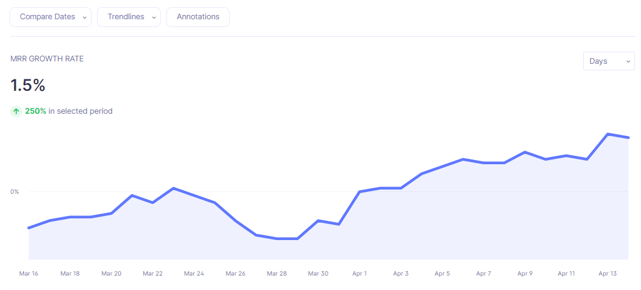 Growth Rate Metric inside Baremetrics
What Other Factors Affect Growth Rate?
There are different approaches and several other considerations that can be taken into account when calculating the growth rates of a company. For example, experts suggest starting the math with a company's expenses and checking "key ratios" such as the operating profit margin and the "headcount per client" (i.e., the number of employees per client).
Other rules of thumb include doubling cost estimations for advertising and tripling estimations for legal and insurance costs, as these categories often incur hidden expenses or vary from provider to provider. In addition, you can monitor customer service time to give a starting point for estimating future labor costs as the business grows. It is also suggested that you calculate conservative and aggressive growth rates to provide to investors.
Other considerations that should be considered when determining a growth rate include the retention rate, which refers to the percentage of customers who continue paying over a given period, marketing techniques and their efficacy, product seasonality, and the stage of company expansion. Any one of these, or a combination thereof, could affect the growth rate.
It is also important to keep in mind that…
- Businesses built from the ground up will tend to have greater growth rates, as zero to any amount of revenue is a large increase.
- Growth rates will vary for different industries.
- Factors like setup times, adoption speed, sales cycles, and market opportunities will also vary based on the growth stage.
How Can You Leverage the Growth Rate Metric?
A company can use its growth rate for the following purposes:
- To secure funding from investors or lenders, who use the metric to evaluate the startup's current and potential growth.
- To develop operational and staffing plans that will best benefit the future of the company. Since the growth rate can be calculated on a weekly, monthly, or longer basis, it is easy to see how small alterations in pricing, staffing, or other day-to-day minutiae can have a very dramatic impact on outcomes.
- To determine how best to allocate resources. If the business grows too quickly and initial resources are used up without a plan or it grows too slowly and resources are wasted, costing money, then a company can be negatively affected or shut down.
Investors also use the growth rate metric to forecast growth and understand the potential return on investment. So, showing investors both short-term and long-term growth rates is imperative for startups.
Why? Because, a new business may not generate revenues that considerably affect its financials in the first year. However, the business may project to see growth during that time and begin to show a return on investment within two or more years.
What Is a Good Growth Rate?
Growth rates vary from industry to industry. For example, in industries that are currently billed as the "hottest" for startup companies and expansion, some examples of average growth rates include:
- 2.4% annually for fitness companies
- 30.4% annually for drone companies
- 24.6% annually for fraud detection companies
However, as a general benchmark, companies should average between 15% and 45% of year-over-year growth. According to a SaaS survey, companies with less than $2 million annually have higher growth rates.
How Should You Manage Your Growth Rate?
Growth rates measure a company's revenue increase and potential to expand. Therefore, your growth rate should be a key focus in your business. After all, you will need it to help plan future resource use and draw in investors looking for startups with potential.
While growth rates vary by industry, several growth strategies can grow your revenues significantly. Use growth strategies and tools like revenue forecasting and revenue dashboards from Baremetrics to stay on top of your metrics.

