Table of Contents

In order to grow, your SaaS business needs a solid system for finding and converting qualified leads.
All of your lead generation efforts will yield two types of leads: inbound and outbound leads. This article covers the differences between these two types of leads, as well as tactics you can use to attract more.
Build a CRM-based inbound lead system.
Inbound Leads vs. Outbound Leads
Inbound Leads
Inbound leads are prospects that initiate contact with your business through a specific marketing channel. It could be a piece of educational content on your website, social media posts, or even a direct referral from your existing customers. Inbound leads fall under three different categories depending on the intent discerned from their level of engagement.
-
Marketing qualified leads: These have performed simple actions like website visits and completing a lead capture form in exchange for an online resource.
-
Sales qualified leads: These are leads who show interest beyond consuming content. For instance, inquiry about pricing and package offers.
-
Product qualified leads: These are leads who have used your brand’s product, maybe on a free trial or a freemium offer, and have gotten more invested.
Outbound Leads
Outbound leads are prospects who do not reach out to a business; instead, the business reaches out to prospects typically through a cold call, email, or even social selling.
These leads probably don’t even know the business; they haven’t signed up for any marketing offer.
Outbound lead prospecting aims to persuade leads to use a service or a product. Examples of outbound lead generation tactics include TV commercials and radio ads.
What is lead generation?
Lead generation is the process of initiating customer interest to turn that interest into a sale. It means turning strangers and prospects into people who have an active interest in your company’s offers.
The methods of generating leads usually come from advertising or non-paid sources like organic search engine results or web referrals.
What are lead generation tactics to pull in more inbound leads?
The inbound lead generation methodology works by connecting with prospects by providing value as they move through different stages in the sales funnel.
Before you can initiate a customer relationship, you’ll need to understand who you are trying to connect with and their pain points.
Keeping your buyer persona in mind, you’ll create content that’s relevant to them and relates to the context of their current situation.
Your prospects will have different levels of understanding on the best ways to overcome their challenges and achieve their goals. You’ll need to understand their position in the buyer’s journey from awareness of the problem to consideration of potential solutions and then decision-making.
Your lead generation tactics will mostly use different variations of content, conversations, and offers to attract interested prospects and convert them into leads. Prospects become leads when they share their contact information with you. Sharing their contact information implies that they may want to do business with you.
Whether it’s B2B or B2C, inbound lead generation tactics include four factors.
-
Lead capture: This is the process of saving information that your prospects provide you with when they convert into leads. The information may include the prospect’s name and contact information and relevant details about them or their organization, for instance, business name, role, and the number of employees at the company.
-
Lead magnets: This is a beneficial resource that motivates prospects to provide their information and become leads—for instance, gated content like an e-book.
-
Lead qualification: This is the process of using the lead’s information to predict their readiness and willingness to make a purchase. Lead qualification gauges a lead’s interest, decision timeframe, budget, and authority within their organization. An example of a qualifying question could be, “What is your ideal timeline for implementation?”
-
Lead segmentation: Grouping leads based on their information, habits, and activities (e.g., job title, the lead magnet that attracted them, all the pages they visited, and where they existed on your website).
To fulfill each of these factors, consider using these reliable lead generation tactics below.
1. Create gated content
Gated content is an online resource that’s only available when a prospect fills out a form. Contrary to blog posts, gated content is locked. Your prospects must complete a lead capture form to access the content.
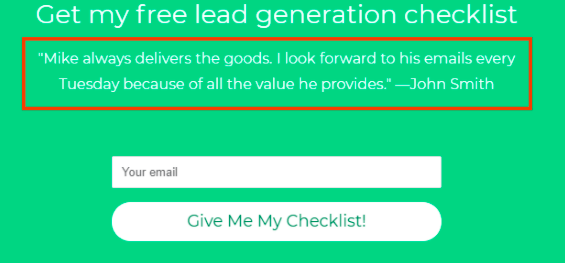
This lead generation tactic is effective because it gives the prospects a valuable resource for free while attracting prospects interested in topics related to your brand or offerings. This tactic also qualifies the lead as they fill in all the form fields to download the resource. Gated content assets often include:
-
White papers
-
E-books
-
Guides
-
Reports
-
Courses
-
Worksheets
-
Online tools
Track essential business metrics
Get deep insights into MRR, churn, LTV and more to grow your business
2. Create newsletters
Another great way to use written content as a lead magnet is by creating an engaging newsletter that incentivizes interested prospects to connect and stay in touch with your business. This tactic keeps you top of mind with customers and allows them to receive promotions for your products and services. With personalized newsletters, you can drive prospects further down the purchase funnel. Content for your newsletter might include:
-
New blog posts
-
Updates about your products or services
-
Special offers
-
Upcoming events
-
Recommended reading from other thought leaders
3. Create freemium offers or free trial
You can capture inbound leads by offering prospects a free trial or freemium product. Prospects who sign up for free trials or freemium products indicate some level of interest. These prospects are checking out your value proposition or aren’t ready to make a purchase. Once free trial users sign up, you can convert them into paying customers later by teasing paid features and delivering drip email campaigns that promote upgraded accounts.
4. Host an event
Lead generation tactics can be applied both online and off. Host an offline or online event to attract and serve your target market while capturing their contact information through event registration. Also, use live events as opportunities to connect with customers in real-time so that you can answer questions, respond to objections, learn about your audience, and actively guide prospects through the sales funnel. A few event options to consider are:
-
Webinar
-
Workshop
-
Seminar
-
Meetup
-
Conference
5. Use SEO to target keywords at the top of the funnel
With keyword research, you can target keywords at the top of the purchase funnel in multiple ways. Use those keywords on your blog post and web copy to attract your prospects and nudge them toward your lead magnets. Plan to target the terms and phrases that your prospects search for, and use what you find to:
-
Create valuable evergreen content optimized for the target terms.
-
Create a topic cluster blog strategy around the target keywords.
-
Target practical terms in search engine marketing.
-
Write guest blog posts on sites where your ideal customers subscribe.
Ensure that you follow best practices for SEO to increase your chances of showing up on the first search engine result pages. Your webpage search engine visibility is proportional to the interest and traffic you’ll generate from potential leads.
6. Utilize chatbots
Your marketing teams have a lot on their plates and won’t always have the time and effort to dedicate to lead generation — That’s precisely why they need some help. Chatbots can be incredibly helpful for lead generation. In fact, 55% of businesses that use chatbots regularly have generated high-quality leads, and 65.1% of businesses that have implemented chatbots are SaaS companies.
Chatbots are great for building rapport with prospects since they are available 24/7. When implementing chatbots, ensure you set them up to match your brand personality and function as automated extensions of your marketing and sales team.
How can you track leads?
While you apply these inbound lead generation tactics, the volume of leads in your sales pipeline will increase. That said, you’ll need to also invest time in getting them to become customers. You’ll typically need to collect all your leads in one place so that you can keep track of various metrics.
When you track leads in one place, you’ll monitor metrics like how many leads you got from a specific channel, the number of qualified leads so far. With these metrics, you can easily assign leads to your company representatives.
A best practice in tracking leads is the use of automation workflows. There are a series of activities you’ll carry out when engaging inbound leads, like adding leads to specific lists and sending follow-up emails. Automating some of these activities ensures that your engagement process is accurate and timely.
Tracking leads with Baremetrics
Baremetrics gives you an intuitive dashboard that lets you track inbound leads in great detail using the People Insights feature. On the dashboard, you gain clear visibility to a broad set of client metrics.
Assuming one of your leads starts a free trial on your platform, the Baremetrics dashboard begins tracking and displaying the various data points. If you want to see free trials canceled this month or even customers from New Jersey, People Insights gives you all the answers.
You can go deeper with Baremetics and segment your customers, bringing meaningful and comparative insights to your dashboard. You can create custom segments, categorize your customers by region, and compare revenue across different locations with the Segmentation feature. Furthermore, you can quickly see metrics like expansion and recurring MRR or even churn rate for any customer segment, all with the Baremetrics Segmentation tool.
Use Baremetrics to monitor your business metrics
Beyond tracking leads with Baremetrics, you can monitor essential business metrics like monthly recurring revenue, your customer attrition rate, and even the cost of acquiring new customers. Baremetrics lets you dig deep into the details of what’s driving growth and also compare business performance with previous months. You can also make well-informed forecasts about hiring, expansion, and accurate budgeting.
While you monitor your business metrics, Baremetrics automatically connects to your payment gateways and collects all your financial metrics in one place, revealing insights that help you make practical decisions that move your business forward.
Try the Baremetrics free trial now and get all of your business metrics up on a dashboard today.
You can also play around with this live demo of Baremetrics and check out its functionalities without logging in at all.
All the data your startup needs
Get deep insights into your company’s MRR, churn and other vital metrics for your SaaS business.