Table of Contents
Customer lifetime value (LTV) measures how much money, on average, your business gets from each customer before they churn. This guide shares four Google Sheets LTV models, based on revenue churn, user churn, discounted cash flow and gross margin, for tracking LTV, ARPU, churn rate and customer lifetime monthly.

This post is for early-stage startup founders and CEOs looking for a simple way to track their customer lifetime value (LTV) and analyze the overall health of their business.
If that sounds like you, keep reading for some helpful Google Sheets LTV models that will help you keep track of this important metric month over month and how to derive the insights you need for your business to succeed.
Why is customer lifetime value important?
As a refresher, LTV is a crucial metric to help evaluate how much money on average your business gets from each customer before they leave you (known as churn).
“LTV really is the representation of what is keeping the business going, i.e. how much money you’re getting over time,” says Luke Marshall, CEO at Baremetrics.
Customer lifetime value is often utilized as a lighthouse metric for SaaS startups because it can help inform key longer-term business decisions, like how much money to allocate towards marketing efforts. It also makes you focus more closely on your churn metric.
To be able to glean the most amount of insights from LTV, we recommend you measure your LTV by segment. This is because it will help you more easily spot patterns and overall trends across various plans that you offer.

For example, you'll generally find that lower cost plans, have a higher churn rate than your high cost plans. Therefore, you’ll see a lower LTV for those plans.
Identifying your high LTV clients and having a deep understanding of why they are sticky can help refine your ICP. It can also help you know not only how to keep those high-value clients engaged, but also how to attract similar ones.
For these reasons, your customer lifetime value is a key metric to keep track of.
Now, how exactly do you keep track of it? We’re so glad you asked…
Why use a spreadsheet LTV model?
A spreadsheet LTV model makes sense when you're just starting out and manual tracking isn't a pain yet. Baremetrics' CFO advisor built four Google Sheets that track LTV, ARPU, churn rate and customer lifetime each month.
By now, you have a good idea of how crucial your lifetime value is, so it’s time to get to calculating it.
While it's easier to view your LTV in Baremetrics, sometimes you have to get down and dirty in a Google Sheet or Excel because either:
- you’re just starting out and need something familiar
- manual tracking isn't a complete pain (yet)
We get it 100%. So we devised a workaround.
Our awesome CFO advisor, Swapnil, created the four spreadsheets below to help you track your LTV, ARPU, Churn Rate, and Customer Lifetime each month and get revenue/user churn insights manually.
While not as nice as real-time Baremetrics insights, we're sure it'll do the job in a pinch!
Please make sure to make a copy of the Google Sheets below to update with your own numbers.


What is the revenue churn LTV model?
The revenue churn LTV model calculates customer lifetime value from revenue churn, estimating how long customer revenue will last and its total over a customer's lifetime. It suits B2B SaaS with tiered pricing, upselling and expansion strategies.
Before getting started, be sure to make a copy of each of the models shared below.
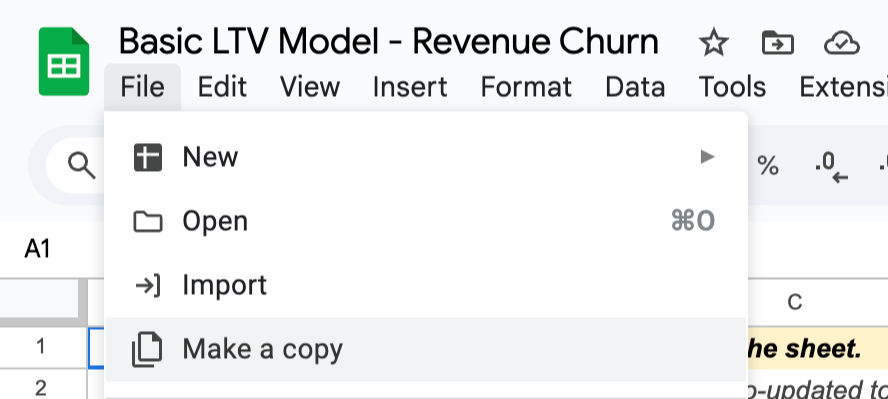
Create a copy of the model from File > Make a copy
Our first basic LTV model template calculates the customer lifetime value (LTV) based on revenue churn. It helps estimate how long customer revenue is likely to last and the total revenue that can be generated over a customer’s lifetime.
The model focuses on revenue retention rather than user retention — making it more suitable for businesses with tiered pricing, upselling, and expansion strategies (e.g., B2B SaaS).
Use cases:
- Best for businesses where revenue retention matters more than user retention.
- Ideal for B2B SaaS or subscription models with multiple pricing tiers and upselling opportunities.
What is the user churn LTV model?
The user churn LTV model calculates customer lifetime value from user churn, estimating how long customers stay and the total revenue they generate. It focuses on user retention and suits B2C subscription models or products with flat pricing tiers.
![Basic LTV Model [User Churn]](https://baremetrics.com/hs-fs/hubfs/Basic%20LTV%20Model%20%5BUser%20Churn%5D.png?width=751&height=381&name=Basic%20LTV%20Model%20%5BUser%20Churn%5D.png)
Our second basic LTV model calculates the customer lifetime value (LTV) based on user churn. It helps estimate how long customers are likely to stay and the total revenue they will generate over their lifetime.
The model focuses on user retention rather than revenue retention and is most suitable for businesses with consistent or low pricing tiers, such as B2C subscription models.
Use cases:
- Best suited for businesses where user retention matters more than revenue retention.
- Ideal for B2C subscription models or products with flat pricing tiers.
How Baremetrics calculates LTV
The Baremetrics dashboard uses the user churn model: LTV = average monthly recurring revenue per customer ÷ user churn rate. User churn is measured over a rolling 30 days (cancelled customers in the last 30 days ÷ active customers 30 days ago), and customers who are delinquent for more than 30 days count as cancelled. Only paying subscribers count as active customers, so free users, trial users and customers on 100% off coupons stay out of both inputs. Use the spreadsheet models on this page when you need a revenue-churn, discounted or margin-adjusted view. The Baremetrics LTV chart gives you the user-churn baseline.
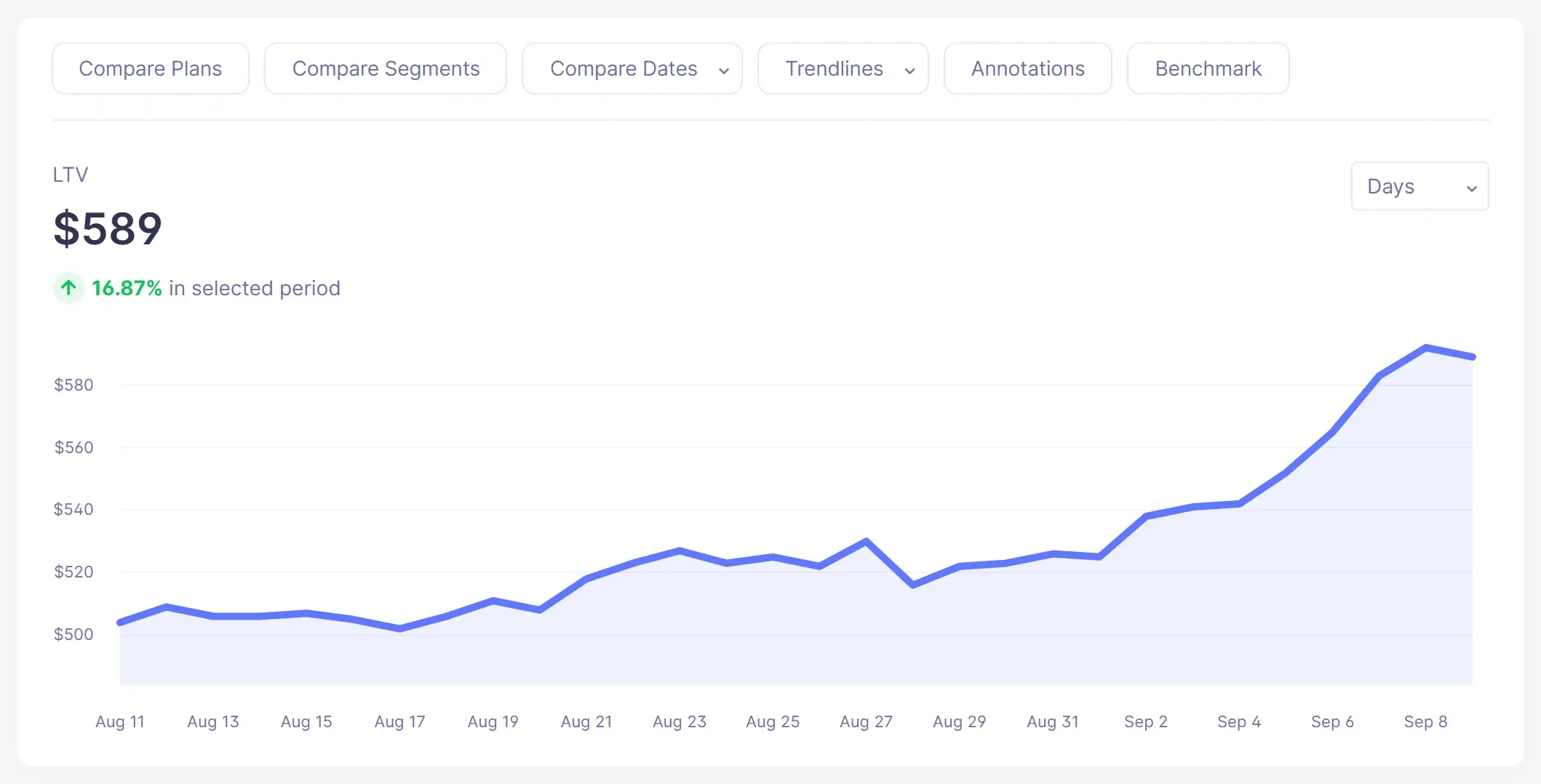
Screenshot shows sample demo data. Source: Baremetrics Help Center (LTV: Lifetime Value, User and Revenue Churn, Active Customers).

What is the discounted cash flow (DCF) LTV model?
Our discounted cash flow (DCF) LTV model calculates the customer lifetime value (LTV) based on revenue churn while adjusting for the time value of money.
Traditional LTV models assume that cash flows from customers are equally valuable over time — which isn’t true due to inflation and opportunity cost.
The DCF model incorporates a discount rate to reflect the reduced value of future cash flows, providing a more realistic measure of customer value.
Use cases:
- Best for businesses where profitability and long-term growth are more important than short-term gains.
- Ideal for late-stage SaaS companies or businesses with established customer bases and predictable cash flows.
- Useful for VCs and investors focused on unit economics and cash flow sustainability.
- Helps assess whether future cash flows are sufficient to justify customer acquisition costs (CAC).
Stop wasting time on countless spreadsheets. Get a 14-day free trial of Baremetrics now.

What is the margin-adjusted LTV model?
The margin-adjusted LTV model calculates customer lifetime value from revenue churn while adjusting for gross margin, so it reflects each customer's true contribution to profitability after the cost of sales. VCs and investors focused on unit economics prefer it.
Our margin-adjusted LTV model calculates the customer lifetime value (LTV) based on revenue churn while adjusting for gross margin.
It helps estimate how long customer revenue is likely to last and the total revenue that can be generated over a customer’s lifetime after accounting for the cost of sales.
Incorporating gross margin refines the calculation to reflect the true contribution of each customer to the business’s profitability.
Use cases:
- Best for businesses where revenue retention matters more than user retention.
- Ideal for B2B SaaS or subscription models with multiple pricing tiers and upselling opportunities.
- Incorporating gross margin gives a more realistic view of the long-term value of each customer.
- Preferred by VCs and investors who focus on unit economics and profitability rather than just top-line growth.
Summary
LTV isn't just a boring business term — it's essentially a roadmap that shows you where to spend your money, who your best customers are, and how your business can grow.
By paying attention to this vital metric, you can turn plain old data into smart plans that help your business move forward.
We know the startup journey isn't easy, but we believe in your vision. When the time is right and you need a partner to help take your business to the next level, Baremetrics will be here — ready to support you every step of the way.