Table of Contents
.png)
The Shopify Partner program consists of designers, marketers, and app developers who create products specifically with Shopify. The Partner platform allows these creatives to build apps and themes specifically for Shopify merchants and sell them on Shopify’s App Store.
Need app analytics after Mantle's shutdown? Here's why Shopify Partners choose Baremetrics for MRR, churn, and revenue tracking.
Many of these same developers may also sell their products on their own websites using a third-party subscription billing platform like Stripe. This allows them to easily market and sell directly to customers, often paying a lower fee than Shopify’s 20% revenue-based commission.
Using multiple platforms to sell Shopify app subscriptions is often the best plan of attack for these reasons, benefiting from both the reach and convenience of the App Store and the lower charges and churn rates tied to direct website sales.
While using both platforms offers distinct benefits, it can also create logistical headaches when you’re trying to get a detailed, accurate understanding of your overall revenue. Using Baremetrics’ Stripe and Shopify Partner integrations can give you comprehensive and actionable revenue data, and in this post, we’ll show you how.

Limitations of Separate Shopify Partner & Stripe Reporting
When you’re using Shopify Partners through the app marketplace and Stripe for your own website sales, you do get the best of both worlds— outside of subscription and revenue reporting.
Relying on the two platforms’ individual analytics can create the following problems:
- Two platforms may calculate certain metrics differently, creating a disparity in data accuracy.
- It’s frustrating trying to track data on two different dashboards, which makes it difficult to assess your full revenue and subscription metrics across the board.
- These platforms may have relatively limited subscription or revenue metrics compared to other specialized analytics tools.
5 Benefits of The Baremetrics Stripe Integration to Track Shopify & Stripe Billing Data
Baremetrics’ subscription revenue analytics platform can resolve all concerns that come with using Shopify Partner’s and Stripe’s native reporting to track financial data. Let’s take a closer look at how.
1. Gain Access to More Financial Metrics
Baremetrics has 26 unique SaaS and subscription-focused financial metrics, giving you every KPI you need to track to understand what’s happening with your revenue and why.
Many individual platforms offer basic financial metrics like recurring revenue, payments processed, and total expenses that come from processing fees or commissions.
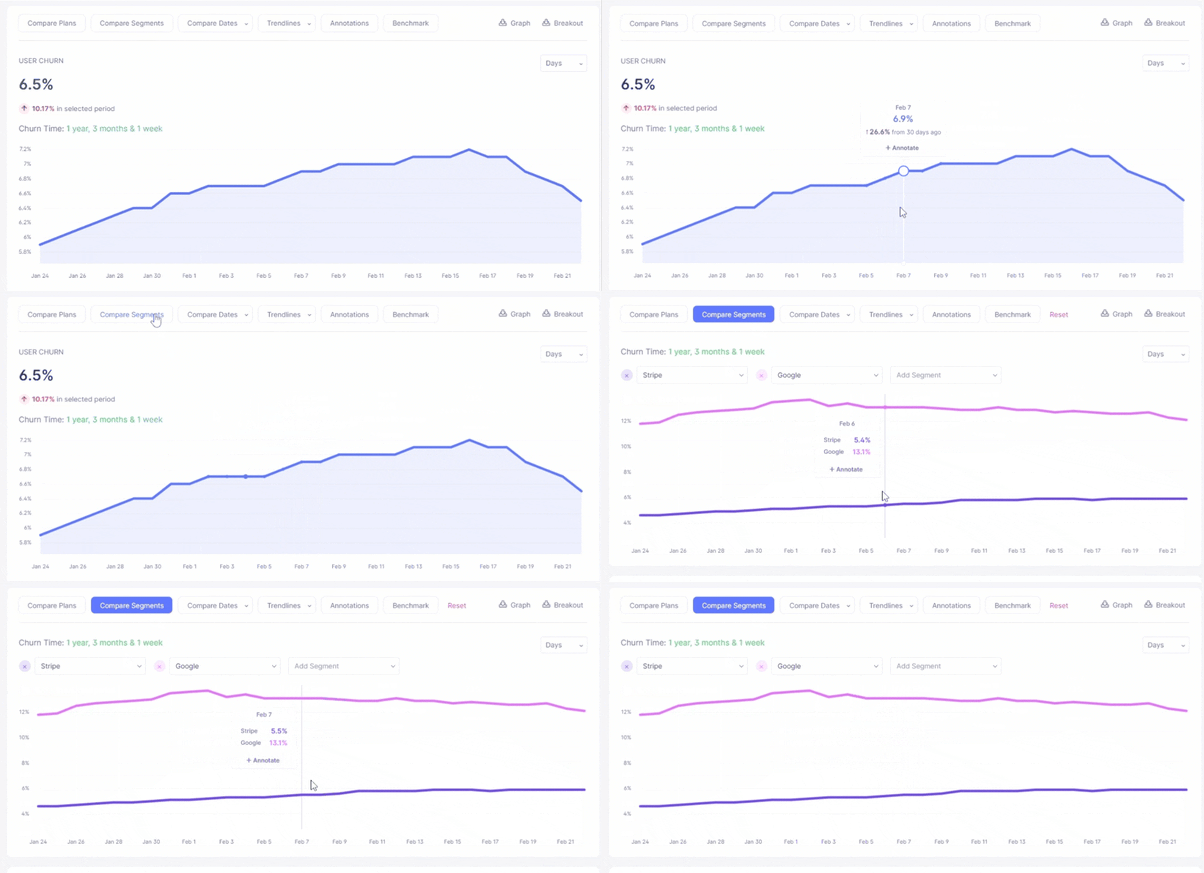
Baremetrics provides additional metrics that are critical for subscription businesses and app developers, including average revenue per user (ARPU), churn rates, and both customer and revenue retention data. And now, you can do it in a single dashboard, which brings us to our next point.
2. Review All Financial Data in One Dashboard
The all-in-one-dashboard is a major perk of integrating your subscription and app management platforms directly with Baremetrics. You don’t have to log in to Stripe and Shopify Partners to track data trends in different places; you get a single place to access all of your data— and you know it’s calculated and tracked consistently since it’s now in one platform.
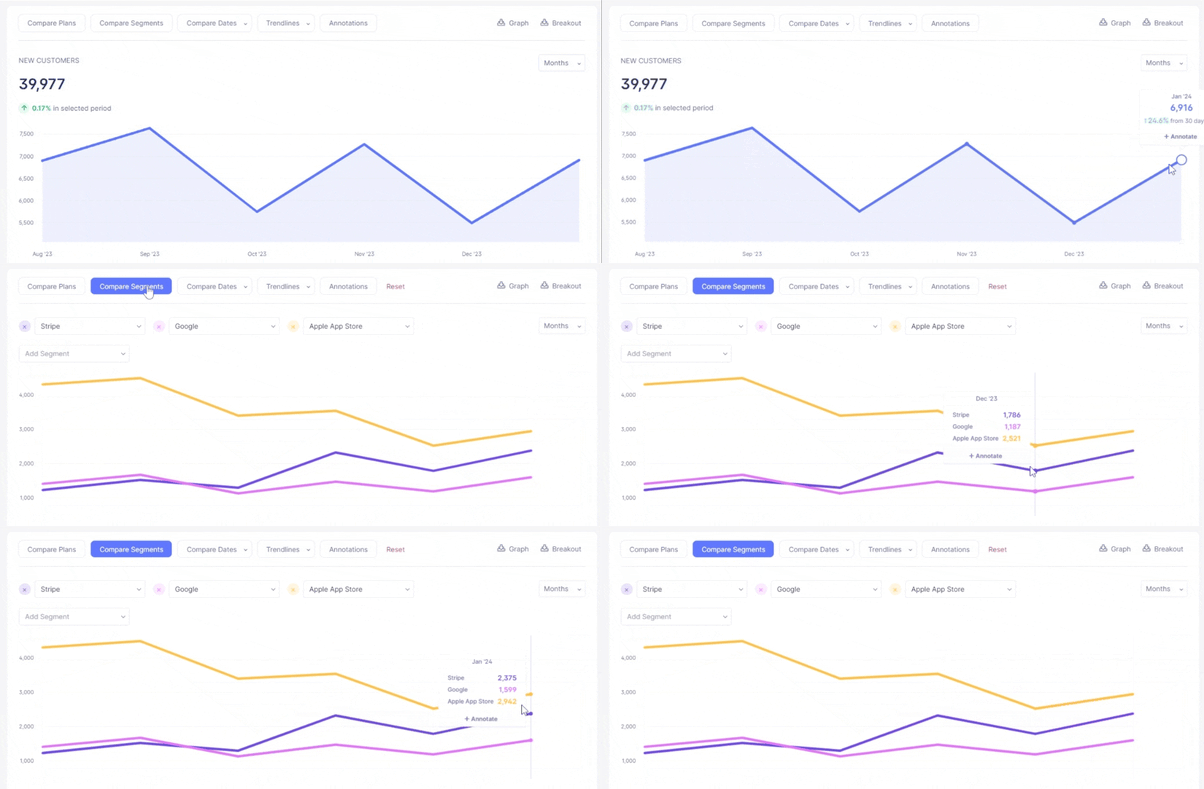
While you want to have the ability to view performance and financial data from all platforms, you also need the ability to view KPIs on a platform-by-platform basis. Baremetrics allows you to do that so you can better identify which platforms drive more customers, higher retention rates, higher churn rates, and higher ARPU.
3. Get Data You Can Trust
Unfortunately, some financial analytics tools aren’t well-suited to subscription businesses and app developers. This means they may not track revenue in a way that's ideal for subscription businesses.
It’s common, for example, for even some subscription management platforms to count all “current” and non-canceled subscriptions in the “active” category, meaning that they’re contributing to your monthly recurring revenue count. That often leads to serious reporting inaccuracy, however, as “current” subscriptions may be paused or delinquent on payment.
Baremetrics has worked hard to ensure that all of our metrics provides detailed and accurate insights into your subscription financial data— including the live status of actual subscriptions.
4. Learn More About Your Customers
Baremetrics doesn’t just provide straightforward KPI metrics; we also provide insights into your customers
Our People Insights and segmentation features can help you identify high-value audience segments in your user base. You can also learn more about who your customers are, including key demographic data.
This information can help you improve your marketing campaigns, including in-app upsells or cross-sells, to increase revenue.
5. Take Advantage of Revenue-Boosting Insights
We offer more than just People Insights, too.
Use Baremetrics to access and leverage the following insights for revenue-boosting changes:
- Revenue forecasting, to assess projected revenue growth year-over-year.
- Cancellation insights can help you determine why customers are churning and how to prevent it.
- Trial insights to discover steps you can take to improve the trial-to-customer conversion rate.
- Recover, which leverages automation to help you identify and prevent lost revenue due to missed payments.
Making Shopify and Stripe revenue comparable
Pulling both platforms into one dashboard only helps if both are counted on the same terms, and the two genuinely behave differently. Stripe tells you the moment a payment fails; Shopify doesn’t, so a merchant whose card is retrying is indistinguishable from one who left. Stripe bills on a predictable cycle; Shopify confirms money on its own payout schedule.
Baremetrics exposes those decisions as per-connection settings on your Shopify source, so you can line the two platforms up deliberately: revenue timing (count a charge when its payment settles, or on its billing date), a payment grace period of 0–60 days before silence is read as churn, churn timing (count a departing merchant through the period they paid for, or the day they leave), and whether a full refund ends the subscription or leaves the merchant a customer. Shopify usage charges are tracked as their own metric alongside plan revenue.
Set them under Settings → Connections. Choosing at connect time is free; changing one later rebuilds that connection’s history. Full detail on the Shopify connector settings.
How to Integrate Baremetrics with Stripe & Shopify Partners
Integrating Baremetrics with subscription and financial data sources (including Stripe and Shopify Partners!) just requires a few quick clicks.
When you first create your account, we’ll ask you to connect your data sources. Click on the platform you use, and you’ll be asked to connect your third-party account. Once you do, data synching begins immediately.
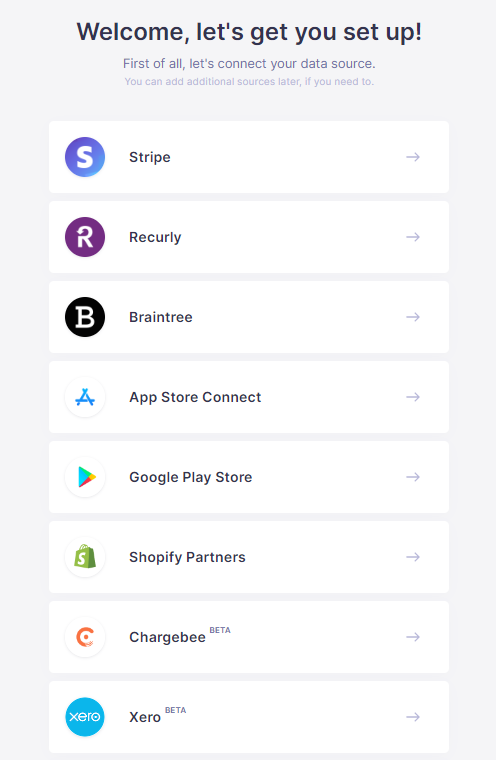
Connect with all the data sources you use, including Stripe and Shopify Partners, in this case!
Final Thoughts
Baremetrics provides detailed, accurate revenue analytics with 28 different crucial metrics for subscription businesses. We can help you track what’s happening with what you can trust when making profit-focused decisions.
Ready to get started with Baremetrics?