
Table of Contents

TL;DR
Optional product pricing works best when:
-
You have a scalable or consumable accessory ecosystem.
-
The base product attracts users and the optional items generate the real profit.
-
You can incentivize customers to upgrade or customize their experience.
Make sure to structure the strategy clearly, test add-on uptake, and continually iterate based on real user behaviour.
Optional product pricing often employs the concept of a loss leader. Loss leaders are products that are sold below market value in order to encourage consumers to buy more products in the long term.
As a classic example, gaming consoles are often sold at a loss. Over the years following the initial purchase, gamers need to buy games at a mark-up, which is where the real profit comes from.
Gaming companies and other manufacturers of physical goods are typical adopters of the loss leader strategy, but they are far from the only ones. Optional product pricing is also regularly employed by many SaaS enterprises today.
In this article, I will go over the optional product pricing strategy, illustrate its pros and cons, and provide you with some real-world examples of this strategy in use.
By the way, Baremetrics can help you measure the effect of a new pricing strategy in a few clicks. Sign up for a free trial or check out our demo to map the effects of pricing changes without disrupting your users.

What is optional product pricing?
Optional product pricing is a common pricing strategy among businesses that have one main required product, accompanied by many “optional products”. “Optional’’ is in inverted commas because, as we’ll see in some use cases below, oftentimes these aren’t exactly optional at all.
In order to maximize total revenue, some companies choose to charge separately for each product. The main product is usually priced low or even at a loss (hence the name, ‘loss leader’) to encourage buyers to purchase the main product over its competitors.
Once they’ve bought into the system, customers may soon find that they need to buy further services or accessories to get the most value out of the product. Companies can charge more for these add-ons because the user is already locked into using the core product.
This system is founded on a concept known as sunk cost. Essentially, most users choose the cheapest available option for the initial purchase, failing to take into account the long-term costs of necessary accessories.
Bundle pricing and when to use it instead
The opposite of optional product pricing is bundle pricing. In bundle pricing, individual features and accessories are sold altogether for an aggregate price.
As a company offering a service, bundle pricing is the better option when the accessories are not needed in order to get good value from the core product. Bundling add-ons into the main price allows users to trial tools they may not have used otherwise, and ensures that your development costs for additional features are covered.
Somewhat ironically, optional product pricing is best adopted when the product’s accessories are in fact not optional at all.
What are the two components of optional product pricing?
For optional product pricing to work for you, you need a minimum of two products: the primary product, and at least one complementary feature.
Furthermore, these components should possess certain traits for optional product pricing to succeed. Let’s take a look at them.
The primary product
The primary product should be the most expensive component. Its features should be the main selling point of the overall service. It should also be somewhat incomplete without the other products, without deceiving its users about its functionality.
In this instance, incomplete can mean anything from a gaming console without games, to a fully functional but limited platform that requires plugins or apps to extract the most value from its use.
While the former is overtly incomplete and unusable by itself (you need games for your Nintendo), the latter isn’t (while WordPress is perfectly usable without plugins, most users will eventually accumulate quite a few).
It’s critical that in neither case the user feels that they’ve been lied to about the need for complementary products, and the focus remains on the excellent value they’ve received for the core product.
The complementary product
The most successful cases of optional products fall under two categories:
- numerous complementary products are available for use in conjunction with the core product, instead of just one or two add-ons (e.g. you can buy many games for your PlayStation)
- the complementary good is a consumable (all those annoying ink cartridges for your printer)
With this strategy, you can sell enough optional products to compensate for the lower price of the main product.

What are some examples of optional product pricing?
Optional product pricing can be found in many industries. Here are some of the most common examples.
1. Gaming systems and games
While every new gaming console seems incredibly expensive, its price is usually much lower than the internal components are actually worth. That’s because Microsoft, Nintendo, and Sony all want you to get hooked on their gaming ecosystem, and spend more money on games or memberships over the next five years. This could be labelled the Razor and Blades business model where the razor (physical game console) is the low cost primary product that drives demand for the high cost (subscription services and downloadable content).
2. Mobile games and in-app purchases
Taking the case above to its extreme, freemium gaming has become a cash cow for many game companies. Similar to the above, the main game costs nothing, but before you know it, you’ll have spent $99.99 on crystals, energy potions, and better armor.
3. Phones and plans
Apple has broken the mould with the high price of iPhones today, but most telecom companies still offer extreme discounts on their phone hardware to get users to sign two-year contracts for their network services.
4. Plane tickets and checked bags
While plane tickets are not cheap, discount airlines have slashed their prices by making you pay extra for everything—added leg room, checked bags, use of the overhead compartment, drinks, food, priority boarding, seat choice, and whatever else they can think of.
This allows discount airlines to appear much cheaper than the main carriers while possibly charging more in the end. Southwest Airlines made headlines recently when they made the move to charge passengers for checked baggage. For over 50yrs they had allowed passengers two free bags, a significant point of difference for them in the market however a move towards standard fare structure changed this.
5. Printers and ink
Until work from home took off due to the pandemic, I thought owning a printer and buying ink cartridges every three months was finally a thing of the past. But that does not seem to be the case anymore, so let’s add that to the list.
6. SaaS platforms and apps
Slack, Shopify, WordPress, and so many other beloved SaaS platforms have opened up to third-party developers.
Offering a SaaS platform for much less than the fair market value—or even for free—has become a great way to attract a huge user base. Those same users can then be offered costly plugins to improve their experience.
In doing so, the service owner can boost revenue through complementary services. If additional plug-ins or cross-platform compatibility solutions aren’t part of the initial revenue percentage agreement between the owner and investors, these types of incidental services can actually become far more lucrative than the core product for the developer, as they might be raking in up to 100% of this part of the profits.
What are the pros and cons of optional product pricing?
All pricing strategies have strengths and weaknesses. To decide whether optional product pricing is the right strategy for your business, consider how you expect users to interact with your product and its features.
What are the advantages of optional product pricing?
If you are in a highly competitive market, you might not be able to charge enough for your software to earn profit directly.
In that case, optional product pricing can be a great way to get customers in the door. Once they are hooked on your platform, you are free to charge a bit more for all the extras that provide them with added value.
What are the disadvantages of optional product pricing?
Optional product pricing really only works when the optional products aren’t all that optional in reality. It also works best when you have a lot of optional products.
If customers decide they don’t need or want the optional products, then you might find yourself priced at a loss and burning money fast.

Summary
Many SaaS businesses find themselves choosing between bundle pricing and optional product pricing. The right choice comes down to what your customers require from your services.
Try to figure out whether your users can live without your add-ons. You can do this through user surveys, or feature experiments among new users (avoid disrupting your existing user base as much as possible!). If your users need several of the additional features you offer, consider adopting an optional product pricing model.
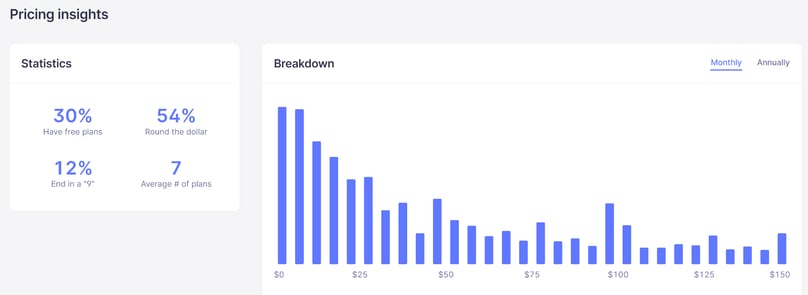
If you want to take a look at how your cohort is pricing their plans, Baremetrics offers benchmarks for many different types of metrics, including how many businesses in your field offer free plans, how their prices are presented, average subscription amounts, and much more.
Try the free trial today! You’ll get 14 days of free access to benchmarks, as well as the full range of Baremetrics’ financial tracking software.

