Table of Contents
"Churn" and "retention" get used as if they're the same number viewed from opposite ends. They aren't, and the gap between them is where most subscription businesses lose money without noticing.
Here's the version that matters: you can improve retention and watch churn stay flat. You can cut churn and see revenue keep sliding. And you can spend a quarter fixing the wrong one entirely, because the dashboard collapsed two completely different problems into a single percentage.
If you're running Chargebee, you already have strong billing infrastructure. What you likely don't have is a clean read on which kind of churn is actually hurting you — and the two kinds need different fixes.
Teams usually land here because they're tired of:
- Reporting one churn number to the board and not being able to explain what's inside it
- Not knowing whether customers are leaving on purpose or because a card failed
- Seeing revenue drop in a month when the customer count went up
- Exporting billing data to a spreadsheet every time someone outside finance needs a cohort view
- Knowing failed payments are costing them and having no figure to put on it
Running Chargebee? Baremetrics connects natively — MRR movement, cohort retention, and churn split by type, without exporting anything. See the Chargebee integration or book a call.
What is the difference between churn and retention?
Churn measures what you lost. Retention measures what you kept and what it's now worth. They are not inverses, and treating them as inverses is the single most common reporting error in subscription businesses.
![Baremetrics MRR waterfall [Screened in]](https://baremetrics.com/hs-fs/hubfs/Baremetrics%20MRR%20waterfall%20%5BScreened%20in%5D.png?width=2404&height=590&name=Baremetrics%20MRR%20waterfall%20%5BScreened%20in%5D.png)
MRR waterfall in Baremetrics showing Expansion
The reason they don't mirror each other is expansion. Churn only counts losses. Retention (at least in its net form) counts losses and the growth from customers who stayed and spent more. So a business can lose 3% of revenue to churn and still post 105% net retention, because upgrades from remaining customers more than covered the loss.
A worked example. Start the month at $100,000 MRR:
- $4,000 churned (customers left entirely)
- $1,000 contracted (customers downgraded)
- $8,000 expanded (existing customers upgraded)
Your revenue churn is 5% — the $5,000 you lost from the starting base. Your net retention is 103% — ($100,000 − $4,000 − $1,000 + $8,000) ÷ $100,000. Both are correct. Reporting only one of them tells your board a materially different story.
Edge cases that trip people up: reactivations (a returning customer isn't new revenue in every model), mid-cycle plan changes and proration, refunds, and trials converting at different points in a month. Where those get counted moves the number, which is why two tools reading the same billing data can disagree.
Customer churn vs. revenue churn
Customer churn counts logos lost. Revenue churn counts dollars lost.
To better understand the difference between the two, here are their formulas:
- Customer churn rate = customers lost in the period ÷ customers at the start of the period
- Revenue churn rate = MRR lost in the period ÷ MRR at the start of the period
They diverge whenever your customers aren't all worth the same, which is nearly always.
Lose ten customers paying $10 each and one paying $500, out of 200 customers and $50,000 MRR. Customer churn is 5.5%. Revenue churn is 1.2%. Now flip it — lose one $500 customer and no one else. Customer churn is 0.5%, revenue churn is 1%. Same month, opposite readings, completely different responses required.
If you report a single "churn rate" without saying which one, nobody in the room knows what happened.
What is gross retention vs. net retention?
Gross revenue retention (GRR) measures how much starting revenue you kept, ignoring expansion. It caps at 100%.
GRR = (starting MRR − contraction − churn) ÷ starting MRR
Net revenue retention (NRR), sometimes called net dollar retention, adds expansion back in. It can exceed 100%.
NRR = (starting MRR + expansion − contraction − churn) ÷ starting MRR
Using the earlier numbers: GRR is 95%, NRR is 103%.
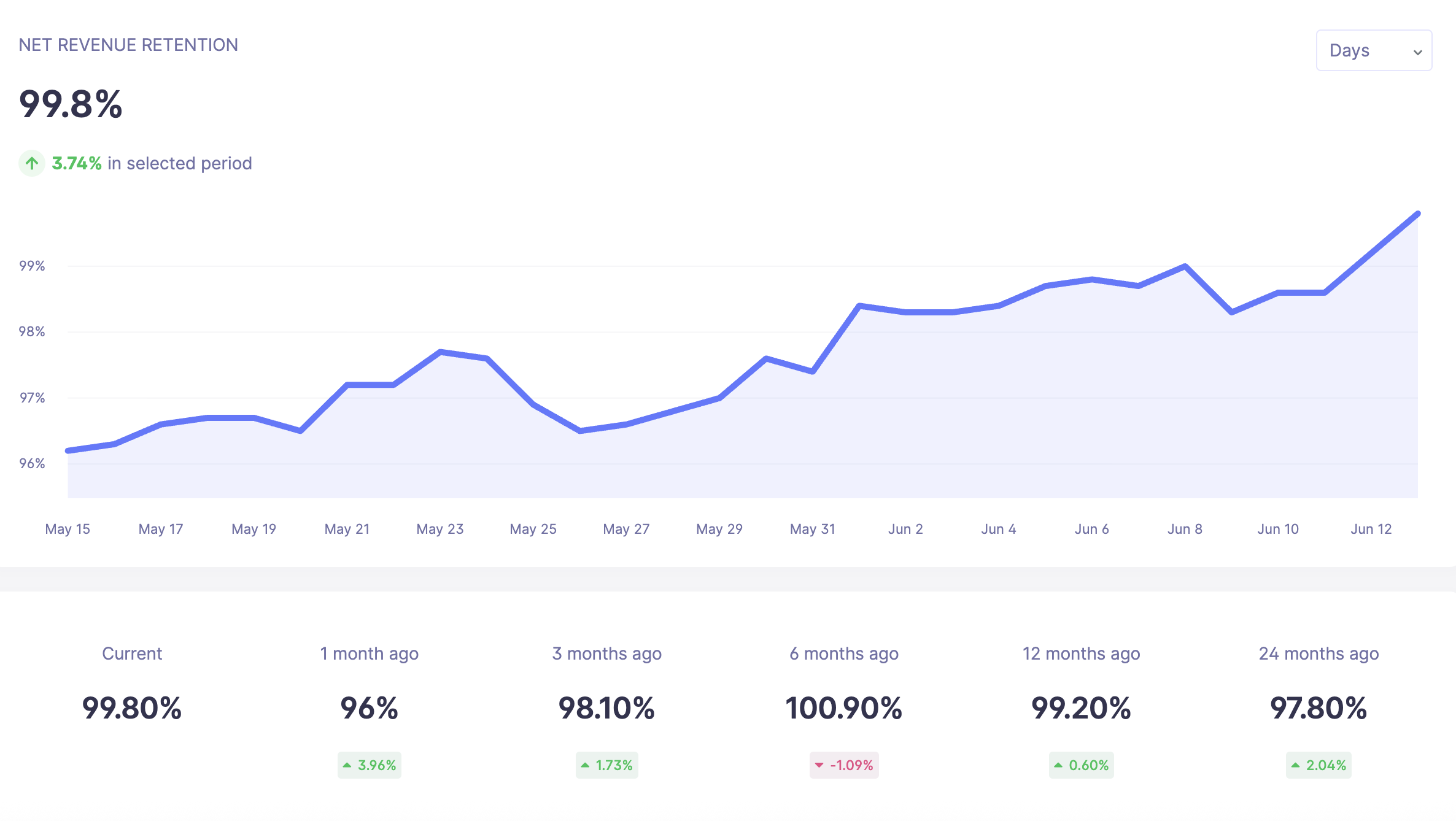
NRR in Baremetrics
Why both matter. NRR is the headline investors ask for, because above 100% means the business grows without new sales. GRR is the honesty check underneath it — it shows whether your product retains, or whether a handful of large upgrades is masking a leaky base. A company with 120% NRR and 80% GRR has a churn problem that expansion is temporarily hiding.
One edge case worth knowing: NRR calculated on a 30-day rolling basis and NRR calculated on a 12-month cohort basis will give you different numbers. Bankers and investors generally mean the 12-month cohort version. If your tool reports rolling and your investor means cohort, you'll talk past each other.
The split that actually determines your fix
Everything above is measurement. This is the part that changes what you do on Monday.
Voluntary churn — someone decided to leave. They cancelled. There was a reason, and it's knowable.
Involuntary churn — nobody decided anything. A card expired, a bank declined a charge, a payment method went stale. The customer may not even know they've been cut off.
This distinction matters more than any other on this page. The two have nothing in common as problems. Involuntary churn is a payments infrastructure problem, solved with retries, pre-emptive card warnings, and recovery messaging. Voluntary churn is a product, pricing, or expectations problem, solved by finding out why people leave and intervening at the moment they try to.
For scale: Stripe-partnered benchmark data from Churnkey puts involuntary churn at roughly 22% of total SaaS churn. Roughly a fifth of your losses may be a billing failure rather than a rejection of your product. It's also the cheaper fifth to fix.
This is also where Chargebee and Baremetrics divide cleanly.
What Chargebee handles
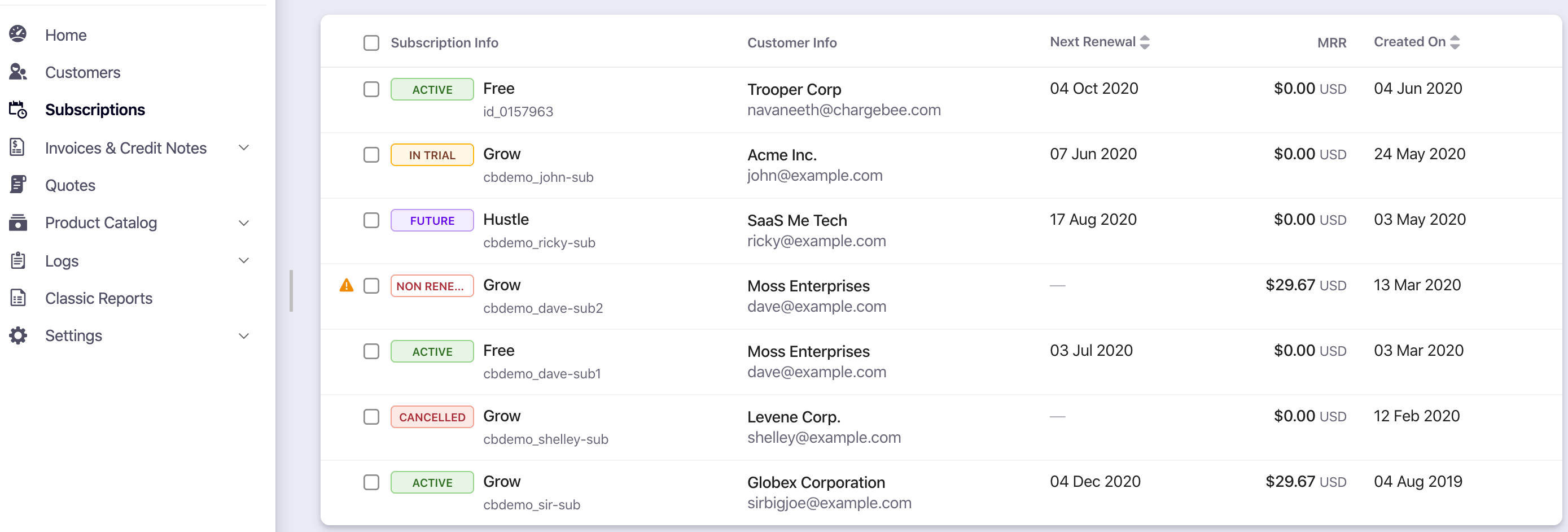
Chargebee's subscription dashboard
Chargebee is billing orchestration sitting on top of payment gateways — more than 40 of them, with per-region routing. It doesn't process payments; your gateway still does that. What it runs is the subscription layer: catalogs, proration, invoicing, tax, renewals, and dunning.
On the churn side specifically:
Smart Dunning retries failed charges on optimized timing, and it's included in Chargebee Billing alongside basic dunning for online and offline payments. This is real infrastructure. It's your first line of defence against involuntary churn.
Chargebee Growth is a separate product from Billing, and it's a full cancellation-flow builder rather than a survey widget. Its entry tier is $0 for existing Chargebee Billing customers and covers no-code cancel pages, cancellation reason capture, loss aversion cards, and pause and downgrade workflows. If you're on Chargebee Billing, you already have working cancellation instrumentation at no cost.
The product goes further than that. Cancel reasons can each carry their own offer, exit surveys capture competitor names and return likelihood alongside free-text feedback, and a locked holdout page gives you a true no-offer baseline to measure deflection against. Multiple offers per reason, entry and final offers, flow optimization, lifecycle-triggered engagement, AI churn prediction, and risk-based interventions sit on higher tiers. Chargebee publishes no figure for those, so you can't model the cost before a sales call.
Accurate billing records. Chargebee knows precisely who was invoiced, who paid, who failed, and who cancelled. That's the raw material every metric on this page depends on.
Where it stops: less than most comparison pages claim, so here's the accurate version. RevenueStory is included with Chargebee Billing and it's a serious analytics product — 150+ prebuilt reports, ten default dashboards, MRR movement broken into new, expansion, downgrades and cancellations, revenue and subscription churn as separate metrics, net dollar expansion, customer-churn cohort views, filters you can save as segments, and a report builder for custom reports.
There are three real limits. It only sees Chargebee. Consolidating multiple Chargebee sites is a premium feature you have to ask support to enable, and there's no path at all to Stripe, Braintree, an app store, or a second product on other rails. Access is role-gated to Admins, Owners, and Finance Executives, so the dashboards you build aren't visible to everyone who needs them. There's no financial layer — no P&L ingestion, no runway, no burn rate, no QuickBooks or Xero connection. Email scheduling also caps at three dashboards per site unless you're on Premium.
What Baremetrics adds on top
Baremetrics connects to Chargebee natively, with no exports or extra BI projects.
Dig into your numbers easily
MRR movement, broken out by day. New, Expansion, Reactivation, Contraction, and Churned as separate lines rather than one net figure. This is the view that makes the churn-versus-retention distinction visible instead of theoretical — you can see expansion offsetting churn in real time, which is exactly what a single percentage hides.
Every movement clicks through to the individual customer and the event that caused it.
Cohort retention tables, live. Month-by-month retention by cohort, so you can see whether you lose people in month one or month six. Month-one drop-off and month-six drop-off are different problems: onboarding versus sustained value. Aggregate churn shows you neither.
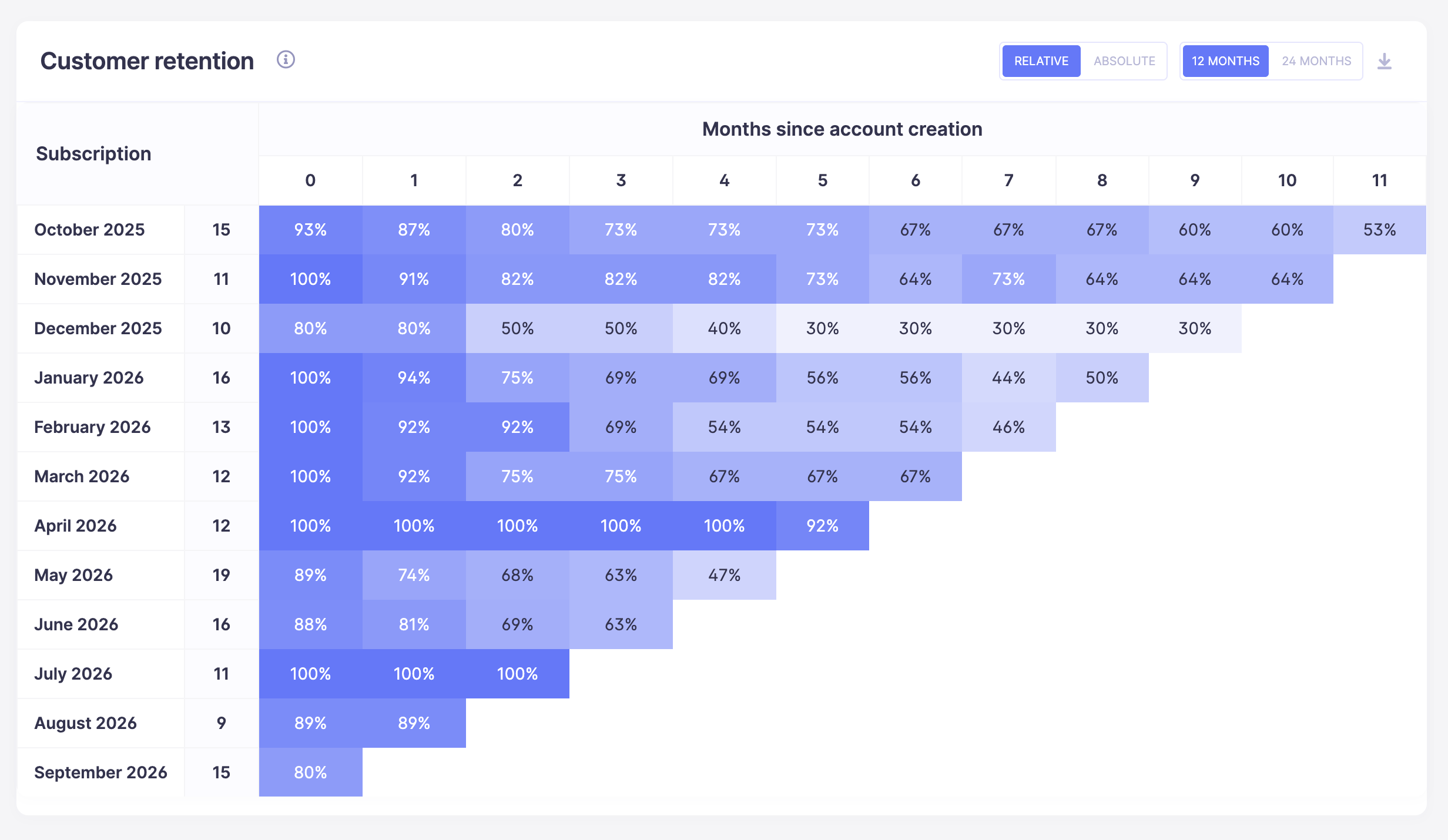
Retention tables in Baremetrics
Revenue churn and customer churn as separate metrics, plus segmentation across plan, price point, billing cadence, country, or custom attributes. Churn by plan is usually the first question that a single number can't answer.
Action your churn reduction strategy
For voluntary churn: Cancellation Insights. A widget on your cancel button captures the reason before the cancellation processes, from a list you configure. Each reason can trigger its own follow-up, and Retention Offers present reason-based save offers at the moment of intent. Setup runs about 30 minutes. The add-on is $129/month, with Retention Offers included at no extra cost. Today they're discount-only, with any discount applied automatically to the subscription; pause and trial extension are coming soon.
⚠️ Read this before you buy Cancellation Insights on top of Chargebee. If you're a Chargebee Billing customer, Growth's entry tier is free and already gives you cancellation reason capture, an offer behind each reason, loss aversion cards, and pause and downgrade workflows. It also has things we don't ship: exit surveys for competitor and return-likelihood data, and a locked holdout page so you can measure deflection against a real no-offer baseline. Cancellation Insights is a paid add-on whose retention offers are discount-only today, with pause and trial extension still to come. On a Chargebee stack, use what you already have. The gap we close for you is measurement (MRR movement, cohort tables, and the churn splits below) not cancellation instrumentation.
For involuntary churn: Recover. Up to seven fully customizable emails, card expiration warnings at 30 and 7 days, annual renewal reminders, a branded billing widget, an in-app banner that becomes a paywall, and SMS. $129/month flat and published, with no commission on recovered revenue.
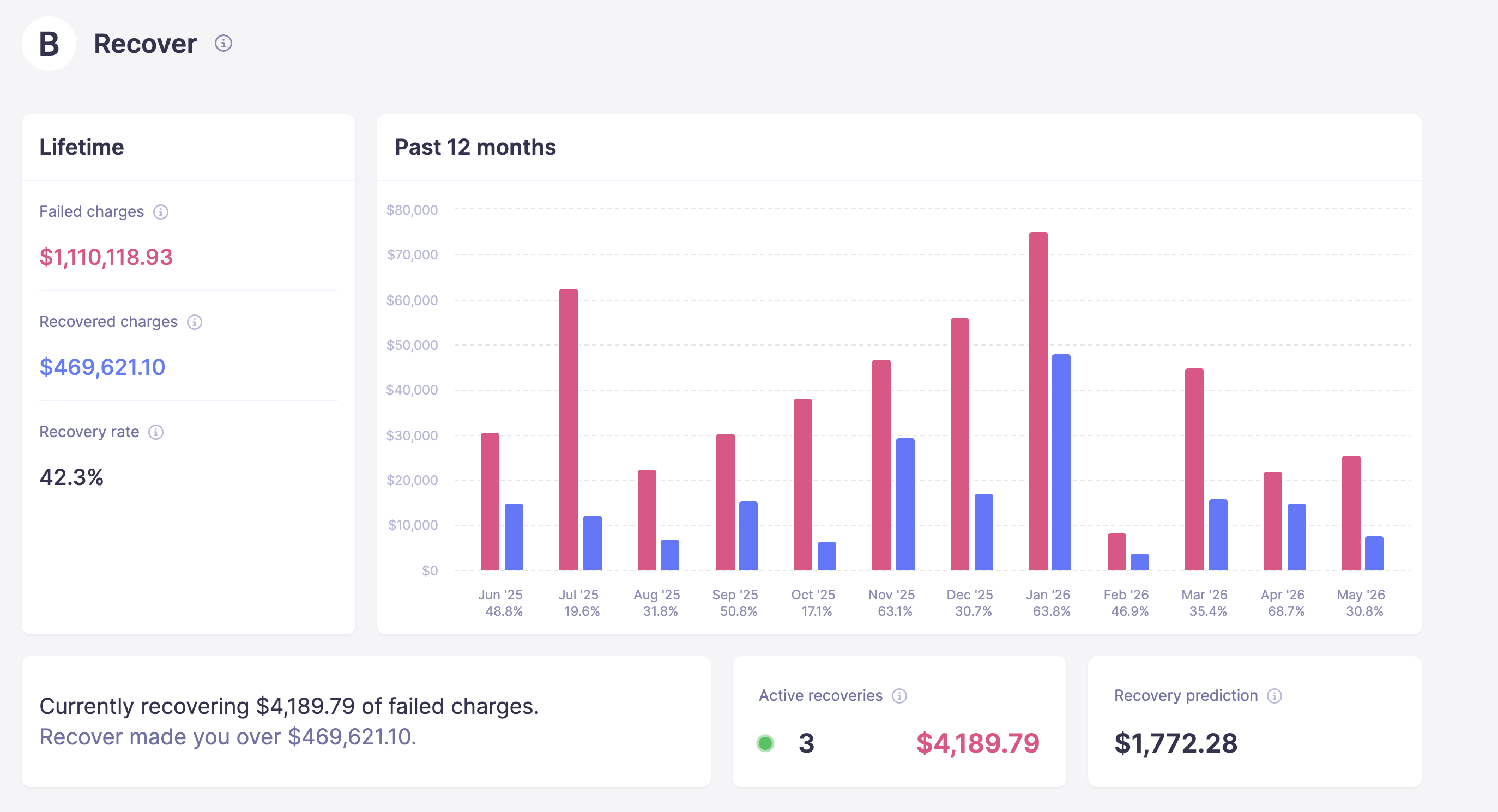
Recover dashboard in Baremetrics
Across active Recover accounts in May 2026, the internal dataset of 133 companies recorded $1,241,070 recovered, from 11,008 charges recovered across 125,150 dunning emails, at an average recovery rate of 14.9% of failed charges, with 120 of 133 accounts recovering at least some revenue that month. One month, one cohort — not a universal average, but the real figure.
⚠️ Important if you're on Chargebee: Recover works with Stripe, Braintree, and Recurly. If one of those is the gateway underneath your Chargebee layer, it applies to you. If Chargebee is routing you through Adyen, PayPal, or another gateway, Recover won't cover those subscriptions — and Chargebee Growth is the right tool for that setup. We'd rather tell you that here than after you've bought something that can't see your payments.
Forecast+, included with any paid Metrics plan, connects to QuickBooks Online or Xero and produces runway, burn rate, CAC, and budget variance alongside the retention picture.
The Chargebee + Baremetrics workflow
| Job | Chargebee | Baremetrics |
| Accurate billing records | Source of truth | Reads from Chargebee |
| Failed charge retries | Basic and Smart Dunning, both included in Billing | Not applicable — keep Chargebee's on |
| Branded, sequenced recovery emails | Dunning emails included in Billing | Recover, $129/mo flat and published — Stripe, Braintree, or Recurly rails only |
| Cancellation reason capture | Free at the entry Growth tier | Cancellation Insights, custom reason list |
| Save offers at cancellation intent | Loss aversion cards free at the entry tier; one offer per cancel reason, multiple per reason on higher tiers | Retention Offers, included with CI — discount-only today, pause and trial extension coming soon |
| Pause / downgrade workflows | Free at the entry Growth tier | Not shipped |
| Holdout page for measuring deflection | Locked control page, no-offer baseline | Not shipped |
| MRR movement breakdown | RevenueStory Monthly Watch — new, expansion, downgrades, cancellations | Pre-built and daily, every movement clickable to the customer and event |
| Cohort retention tables | Customer-churn cohort views and MRR growth cohorts in RevenueStory | Live, month-by-month by cohort |
| Revenue vs. customer churn split | Separate metrics in RevenueStory | Separate metrics |
| Churn by segment | Saved segments in RevenueStory — Chargebee data only | Unlimited segmentation across every connected source |
| GRR / NRR reporting | Net dollar expansion and net churn rate; GRR not reported as such | Both reported |
| Non-Chargebee revenue in the same view | No — site consolidation covers Chargebee sites only, and it's premium | Stripe, Braintree, Recurly, Shopify, Apple, Google Play normalized into one MRR |
| Who can see the dashboards | Admins, Owners, Finance Executives | Anyone you share them with |
| Runway, burn, CAC | No | Forecast+, included with paid plans |
How to start tackling your churn
If you're starting from one undifferentiated churn number, this is the order that works:
1. Separate revenue churn from customer churn. Report both, always, labelled. Most teams discover their two numbers tell different stories in the first month.
2. Separate voluntary from involuntary. Look at how much of your churn is failed payments rather than decisions. If it's near the ~22% benchmark, that portion is an infrastructure fix, not a product fix.
3. Fix the involuntary side first. It's cheaper, faster, and doesn't require changing the product. Make sure Chargebee's Smart Dunning is on. Then add recovery messaging — Recover if your rails are Stripe, Braintree, or Recurly; Chargebee Growth otherwise.
4. Instrument the voluntary side. You can't fix reasons you don't collect. Put a reason capture on the cancel button before you start guessing. If you're on Chargebee Billing, Growth's entry tier gives you this free — use it.
5. Then look at cohorts. Once churn is split and instrumented, cohort retention tells you when people leave, which tells you what to fix — onboarding, activation, or long-run value.
6. Report GRR alongside NRR. If NRR looks healthy and GRR doesn't, expansion is masking a retention problem. Expansion is also the first thing to go in a downturn.