
Table of Contents
If you're reading this, you probably started with ProfitWell Metrics. Most people do: it's free, it connects to Stripe in a few minutes, and for a while, it tells you what you need to know.
Then something shifts. You hire a RevOps lead who wants to segment MRR by plan. A VC asks for your 12-month cohort NRR and you can't pull it cleanly. You send a dunning email to a customer and realize the message looks like it came from Paddle, not you. Or you just hit the ceiling on what a free tool built for simplicity can actually do.
That's when founders start looking at Baremetrics.
This page is written for SaaS founders and operators who already know the category and are trying to make a real choice. We'll cover what ProfitWell does well (honestly), where Baremetrics goes deeper, and how to figure out which one fits where you are right now.
Already know you've outgrown ProfitWell? Try Baremetrics free for 14 days →
Who Each Tool Is Built For
ProfitWell Metrics is the right choice when you need a solid, zero-cost MRR dashboard connected to Stripe. It covers the basics (such as MRR, ARR, LTV, churn rate, and cohort retention) and it does them reliably enough for early-stage companies. If you're pre-$30K MRR and just need to know your numbers, ProfitWell is genuinely hard to argue against.
Baremetrics is what those same founders tend to move to once they're past that stage. The typical trigger is one of a handful of moments: a RevOps hire who needs unlimited segmentation, an investor conversation that requires clean cohort data, a realization that your dunning emails are going out with Paddle's branding instead of yours, or a desire to see your MRR in the same view as your P&L runway. Baremetrics is built for SaaS companies with $30K–$500K+ MRR that want a complete subscription management solution — metrics, subscriber churn management, revenue recovery, and financial forecasting — rather than just a dashboard.
Where Baremetrics Goes Deeper
1. Segmentation: The #1 Reason People Switch
ProfitWell Metrics offers basic segmentation: you can break your MRR down by plan, market segment, or a custom field. That's enough when you have one product, one billing source, and a small team.
It's not enough once you're asking questions like: "What's the LTV of customers who came in through our annual plan versus monthly?" or "Can I see churn rate broken out by the AE who closed the deal?" or "I need a dashboard that shows only our enterprise segment for the investor update." ProfitWell can't answer those questions cleanly.
![Segmented Breakouts [in Baremetrics]](https://baremetrics.com/hs-fs/hubfs/Segmented%20Breakouts%20%5Bin%20Baremetrics%5D.png?width=1774&height=1600&name=Segmented%20Breakouts%20%5Bin%20Baremetrics%5D.png)
Comparing Segments in Baremetrics
Baremetrics has unlimited segments with custom dashboards scoped to any segment you define. You can enrich customer attributes via the API, pull in HubSpot or Intercom data to build segments based on account properties, and give individual team members dashboards showing exactly the slice of the business they care about.
This is, according to our sales call transcripts, the single most common reason prospects make the switch. The exact phrasing that comes up over and over: "We outgrew ProfitWell and now,we're coming to you."
2. Recover vs. Retain: The Dunning Debate
Both tools include dunning management software — automated workflows that recover revenue lost to failed payments. But the experience of using them is fundamentally different, and the gap matters most at the moment your customer is deciding whether to stay.
ProfitWell Retain is a managed service. Paddle handles the recovery logic for you. That's genuinely useful if you want to set it up once and walk away. The catch: you cannot edit the recovery emails your customers receive. The message going out to your subscriber asking them to update their billing information is Paddle-branded, not yours. For a lot of founders, that's a brand problem at exactly the wrong moment. Retain's recovery emails are not customizable — Paddle controls the copy, sender, and branding, and this is a confirmed limitation of the managed service model.
Retain is also performance-based pricing — no flat rate published, scales with recovered revenue, and a custom quote. If your recovery volume is high, that model can get expensive fast with no ceiling.
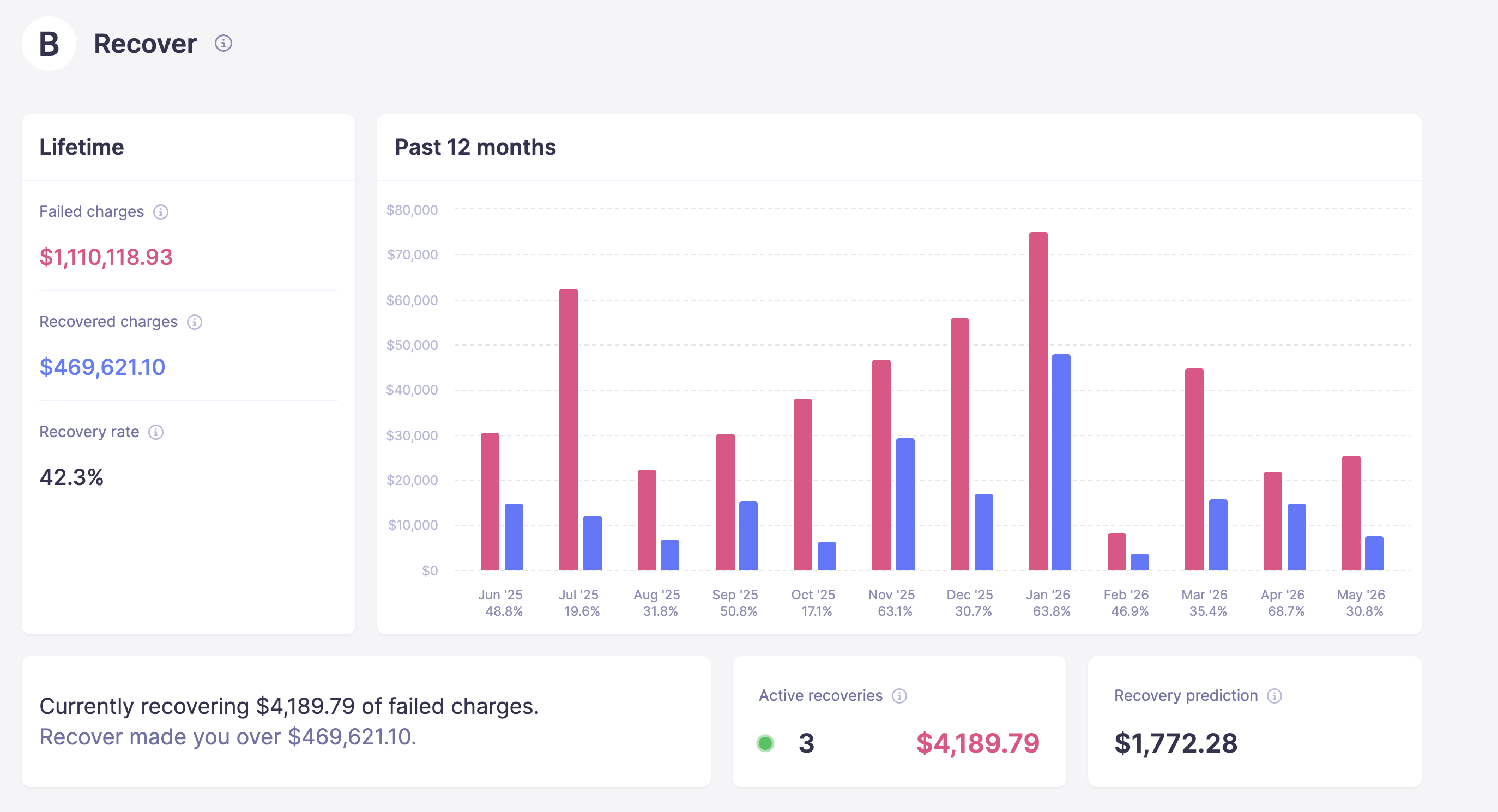
Recover Dashboard in Baremetrics
Baremetrics Recover gives you full control over every touchpoint. You write the copy. You set the sender name, subject line, and branding. Your customer sees a recovery email that looks like it came from your company. Beyond email, Recover also includes:
- In-app billing banners: when customers log into your product, they see a prompt to update their payment method
- Paywall escalation: after a configurable grace period, Recover surfaces a paywall requiring a payment update before the customer can continue
- SMS recovery: additional touchpoint not confirmed in Retain
Pricing is flat: $129/month with no commission, and Baremetrics backs it with a money-back guarantee. Setup is self-serve in about 30 minutes. Dunning best practices (such as smart retry timing, escalating touchpoints, and in-app friction before hard cancellation) are all configurable rather than managed by a third party.
The honest summary: if you want zero involvement and don't care about brand control, Retain's managed model has an appeal. If you care about how your company shows up in the moment when you're asking someone for money, Baremetrics Recover gives you that control.
3. Financial Forecasting: Forecast Plus
ProfitWell has no financial forecasting. This is a hard gap, not a nuance.
![Forecast+ Dashboard [Screened in]](https://baremetrics.com/hs-fs/hubfs/Forecast+%20Dashboard%20%5BScreened%20in%5D.png?width=2668&height=1472&name=Forecast+%20Dashboard%20%5BScreened%20in%5D.png)
Forecast+ in Baremetrics
Baremetrics Forecast Plus ingests your subscription metrics and connects to QuickBooks or Xero to build actual P&L projections — runway, burn rate, CAC, scenario planning. For a founder going into a fundraising conversation or planning a hiring sprint, this closes the loop between "what does our MRR look like" and "what can we actually afford to do."
Forecast Plus is included in your Baremetrics Metrics subscription, not a separate add-on.
4. Cancellation Insights
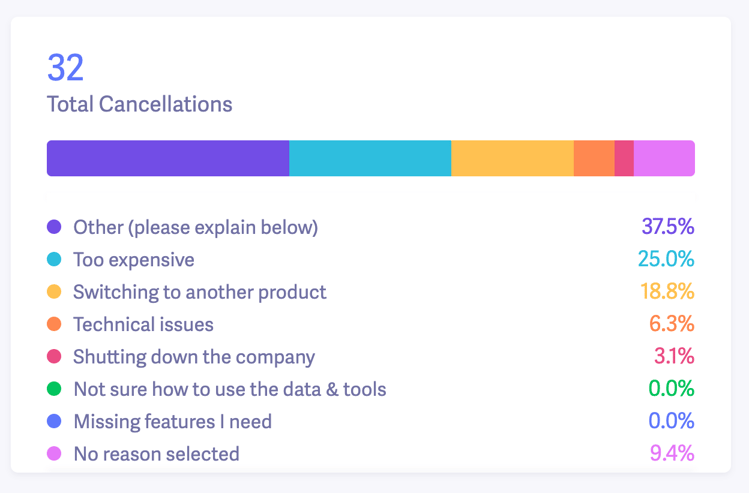
Part of the Cancellation Insights Dashboard in Baremetrics
When a customer cancels in Baremetrics, Cancellation Insights intercepts them with a customizable cancellation survey, where they select a reason and optionally leave a comment. Understanding subscription cancellation reasons at this level (by plan, cohort, or acquisition channel) is what separates reactive churn management from proactive subscriber retention. Those responses are aggregated in your dashboard, alongside your churn rate and MRR data, so you can see patterns: is a specific plan churning faster? Is "too expensive" spiking in a particular cohort? Is a competitor showing up in cancellation reasons?
ProfitWell Metrics doesn't have this. Retain includes cancellation flows as part of its managed service, but only for customers who are also using Retain for recovery — not as a standalone analytics feature.
Cancellation Insights is a separate add-on in Baremetrics at $129/month.
5. Data Accuracy
This comes up enough in sales calls to be worth naming directly. Prospects switching from ProfitWell occasionally find discrepancies between what ProfitWell reports and what's actually in Stripe. One prospect found ProfitWell showing $45K MRR against Stripe's actual $110K — a gap that typically comes down to how each tool handles coupons, trials, and subscription status.
Baremetrics pulls directly from your billing source and applies clean recognition logic. The discrepancy issue is a known pattern worth checking when you're evaluating.
Where ProfitWell Might Be A Better Fit
Here's where ProfitWell might be a better option for your specific needs:
Price. ProfitWell Metrics is free forever with no MRR cap. If you're bootstrapping and just need core metrics, that's impossible to compete with on price alone. Baremetrics starts at $49/month for the Accelerator plan (under $30K MRR). If cost is the only variable, ProfitWell wins until the segmentation ceiling matters.
Industry-specific benchmarks. ProfitWell Metrics includes industry-level benchmarking — you can see how your churn and growth rates compare to companies in your specific vertical. Baremetrics Benchmarks draws from a broader SaaS pool rather than industry-specific cohorts.
Broader native billing integrations (for specific systems). ProfitWell Metrics supports Zuora, Recharge, and Chargify natively. If you're on one of those billing systems and not on Stripe, Braintree, Chargebee, or Recurly, ProfitWell may connect more easily out of the box.
Retain's localization. Retain supports 19 languages in its recovery flows, auto-detecting customer language. Baremetrics Recover doesn't currently offer localization. If you're running a global subscription business with significant non-English-speaking customers, that's worth knowing.
Pricing: What You Actually Pay
| ProfitWell | Baremetrics | |
|---|---|---|
| Core metrics | Free forever | From $49/mo (Accelerator, <$30K MRR) |
| Dunning/Recovery | Retain — custom quote, performance-based | Recover — $129/mo flat + money-back guarantee |
| Cancellation Insights | Included in Retain (not standalone) | $129/mo add-on |
| Financial forecasting | ❌ None | Forecast Plus — included with Metrics |
The pricing picture shifts meaningfully the moment you add recovery. ProfitWell goes from free to a custom performance-based deal with no published ceiling. Baremetrics is flat and predictable. At scale, the comparison depends on your recovery volume, but for most companies in the $50K–$300K MRR range, Baremetrics ends up being comparable or cheaper in total cost.
Quick Comparison Table
| Capability | Baremetrics | ProfitWell Metrics | ProfitWell Retain |
|---|---|---|---|
| METRICS | |||
| Core SaaS metrics (MRR, ARR, LTV, ARPU, churn) | ✅ Full | ✅ Full — free forever | N/A |
| Segmentation | ✅ Unlimited + custom dashboards + API enrichment | ✅ Basic (plan, segment, custom field) | N/A |
| Annotations, trend lines, multi-account | ✅ | ❌ | N/A |
| Data sync speed | Real-time | Up to 2-hr delay (per reviews) | N/A |
| Benchmarks | ✅ General SaaS | ✅ Industry-specific | N/A |
| FORECASTING | |||
| Financial forecasting (P&L, runway, burn rate) | ✅ Forecast Plus — included | ❌ None | ❌ None |
| Scenario planning + CAC/expense tracking | ✅ | ❌ | ❌ |
| QuickBooks / Xero integration | ✅ Native | ❌ | ❌ |
| REVENUE RECOVERY | |||
| Failed payment recovery | ✅ Recover — $129/mo flat | ❌ | ✅ Managed |
| Customizable emails (copy, sender, branding) | ✅ Full control | N/A | ❌ Not editable |
| In-app banner + paywall escalation | ✅ | N/A | Automated flows only |
| SMS recovery | ✅ | N/A | Not confirmed |
| Recovery pricing | Flat $129/mo + guarantee | N/A | Performance-based, custom quote |
| Multi-language recovery | ❌ English only | N/A | ✅ 19 languages |
| CANCELLATION | |||
| Exit survey + cancellation reason dashboard | ✅ Add-on — $129/mo | ❌ | ✅ Included in Retain |
| Customizable follow-up by cancellation reason | ✅ | ❌ | ❌ |
| BILLING INTEGRATIONS | |||
| Stripe, Braintree, Chargebee, Recurly | ✅ All four | ✅ All four | ✅ All four |
| Apple App Store, Google Play, Shopify | ✅ | ❌ | ❌ |
| Zuora, Recharge, Chargify | ❌ (API only) | ✅ Native | ✅ Native |
| SUPPORT & PRICING | |||
| Support | ✅ Unlimited calls, ~2 min chat | Email/chat, slower per reviews | Managed by Paddle |
| Free tier | ❌ | ✅ Free forever, no MRR cap | N/A |
| Paid entry point | From $49/mo (Accelerator, <$30K MRR) | N/A | Custom quote, performance-based |

